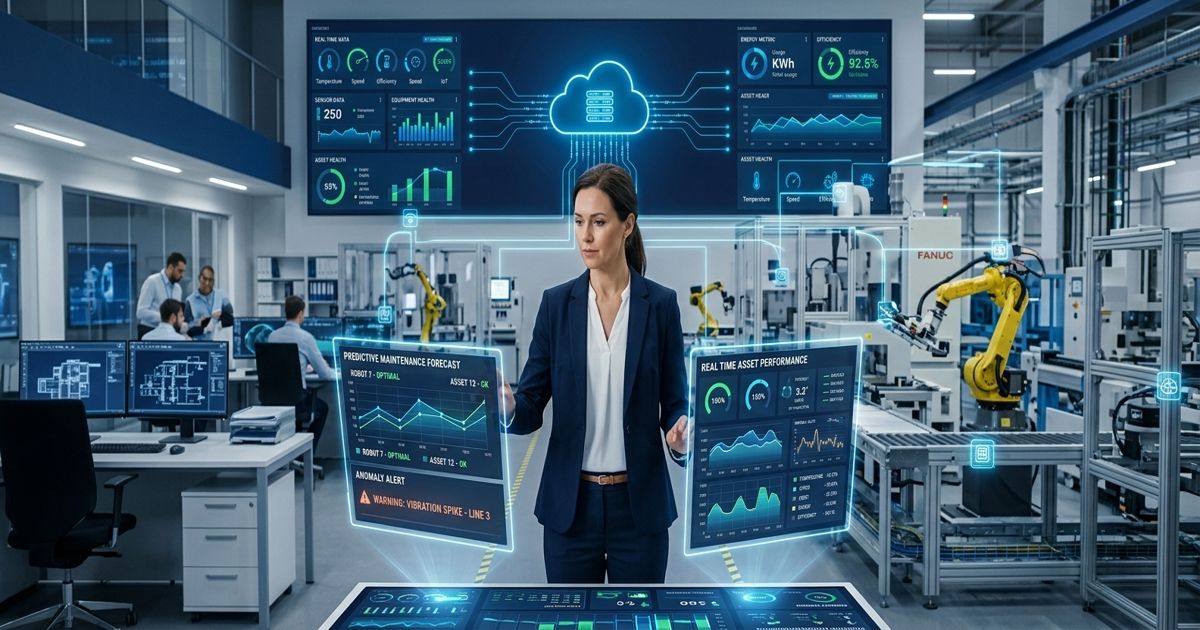
How Industrial Automation Supports Real-Time Monitoring and Data-Driven Decisions
 Author
 Date of Publication
 Category
Industrial automation is no longer just about replacing manual tasks with machines. Today, it is the backbone of intelligent, data-driven operations where every asset, process, and production line generates actionable insights in real time. As global manufacturers face growing pressure to reduce downtime, optimize energy use, and maintain quality at scale, industrial automation paired with smart factory automation and IIoT monitoring has become a critical enabler of operational resilience.
This blog explores how modern industrial automation systems support real-time monitoring, enable data-driven decision-making, and why platforms like Merjio are built to bridge the gap between operational technology and business intelligence.
Key Takeaways
- Industrial automation combined with IIoT platforms enables real-time visibility into assets, processes, and production lines, reducing unplanned downtime and maintenance costs through AI-driven anomaly detection.
- An edge-to-cloud IIoT platform like Merjio supports centralized monitoring, intelligent control, and predictive maintenance across distributed industrial environments.
- Data-driven decisions derived from automated systems improve energy efficiency, worker safety, and overall operational performance at scale.
What Real-Time Monitoring Means in Industrial Automation
Real-time monitoring in industrial automation refers to the continuous collection, transmission, and analysis of data from machines, sensors, and connected assets as operations unfold. Unlike traditional scheduled inspections or delayed reporting, real-time visibility gives plant managers and operations teams an accurate, up-to-the-second picture of what is happening on the floor.
Modern IIoT solutions achieve this through a network of sensors embedded in equipment that stream data to a centralized platform. Parameters like temperature, vibration, pressure, flow rate, and energy consumption are tracked simultaneously. When any value deviates from its normal range, the system flags it immediately. According to McKinsey Operations Insights, manufacturers that adopt real-time monitoring can reduce machine downtime by up to 50% and lower maintenance costs significantly.
The value of real-time monitoring lies in its speed. A delayed alert means a delayed response, which often translates to production loss or equipment damage. With industrial automation systems designed for live data streaming, operations teams can act before a minor issue becomes a costly failure.
How IIoT Platforms Enable Data-Driven Decisions
An IIoT platform acts as the central nervous system of an automated industrial environment. It collects data from all connected assets, processes it using AI and analytics engines, and surfaces insights that inform both tactical and strategic decisions.
Merjio, an AI-powered Industrial IoT platform developed by Lanware Solutions, exemplifies this approach. Its edge-to-cloud architecture processes data locally at the edge for immediate device inference, while also sending aggregated data to the cloud for deeper AI-driven analysis. This dual-layer processing ensures that time-sensitive decisions happen instantly at the edge, while long-term trends and patterns are analyzed in the cloud.
The platform supports data-driven decision-making through several integrated capabilities. These include real-time data analysis for proactive operational responses, AI-driven anomaly detection that distinguishes between normal variation and critical problems, integrated reporting for performance benchmarking, and centralized device management for distributed asset environments. For a deeper look at how industrial monitoring and control platforms deliver operational value, platforms like Merjio demonstrate the practical impact of these capabilities.
From Reactive to Predictive: The Role of AI in Industrial Automation
One of the most significant shifts industrial automation has enabled is the move from reactive maintenance to predictive maintenance. Traditional maintenance schedules are based on fixed intervals, which often means either servicing equipment too early or too late. Both scenarios carry costs.
AI-powered IIoT solutions change this equation entirely. By continuously analyzing equipment behavior and historical performance data, AI models can predict when a component is likely to fail before it actually does. This allows maintenance teams to schedule interventions at the right time, minimizing disruption to production. Merjio's AI-driven predictive maintenance capability is designed specifically for this purpose, moving organizations from time-based schedules to condition-based and prediction-based maintenance strategies.
The complete guide to predictive maintenance explains how these AI models are trained on asset-specific data and how they improve over time as more operational data is collected. This continuous learning loop makes the platform smarter with every production cycle.
Industrial Automation and Worker Safety Through Real-Time Alerts
Industrial automation does more than improve efficiency. It also plays a direct role in keeping workers safe. In high-risk environments like mining, manufacturing, or chemical processing, delayed awareness of a hazardous condition can have serious consequences.
Real-time alert systems within IIoT platforms notify facility managers and safety teams the moment a monitored parameter reaches a dangerous threshold. Merjio's anomaly detection engine is built to identify unusual patterns in operations automatically. The AI distinguishes between normal operational variations and conditions that require immediate human attention, then issues targeted alerts to the right personnel.
This capability aligns directly with Industry 5.0 principles, which emphasize human-machine collaboration and worker-centric automation. Rather than replacing human judgment, automated alerts give workers the information they need to make faster, more confident decisions on the floor. According to the International Labour Organization, integrating smart monitoring technologies into industrial environments is increasingly recognized as a key factor in reducing workplace incidents across heavy industries.
IIoT Solutions for Distributed and Multi-Site Industrial Environments
Many industrial organizations manage assets across multiple facilities or geographically dispersed locations. Maintaining consistent visibility and control across all these sites is a major operational challenge. Fragmented data, inconsistent reporting, and manual coordination create gaps that affect both performance and compliance.
Modern IIoT solutions address this through centralized device management platforms that aggregate data from all connected assets regardless of their physical location. Merjio is designed to scale across multiple sites and support multiple devices simultaneously, giving operations teams a single, unified view of their entire asset portfolio.
This centralized visibility transforms how decisions are made at the organizational level. Instead of relying on periodic reports from individual sites, leadership teams can access live dashboards, trend analysis, and performance benchmarks across the entire operation. For industrial organizations exploring how IIoT platforms support smart factory operations, the ability to manage distributed assets from a single interface represents one of the most practical advantages of adopting a connected industrial automation strategy.
Energy Optimization and Sustainability Through Automated Monitoring
Energy consumption is one of the largest operational costs in industrial facilities. Without real-time visibility into how and where energy is being used, organizations struggle to identify waste or optimize consumption patterns.
Industrial automation systems equipped with energy monitoring capabilities provide continuous insight into energy usage across all assets. When combined with AI-driven analysis, these systems can identify inefficiencies, model optimal operating parameters, and recommend adjustments that reduce energy waste without compromising output.
Merjio supports energy optimization as part of its Industry 5.0 alignment, recognizing that sustainability is not just a regulatory requirement but a business imperative. Real-time monitoring of energy consumption, combined with predictive analytics, enables facilities to reduce their carbon footprint while improving cost efficiency. Exploring how condition-based monitoring software contributes to energy efficiency reveals how closely operational health and sustainability goals are interconnected in modern industrial environments.
Conclusion: Building Smarter Industrial Operations with Automation and IIoT
Industrial automation has evolved far beyond mechanical efficiency. Today, it is the foundation of intelligent, connected operations where real-time data flows continuously from assets to decision-makers. By integrating an advanced IIoT platform like Merjio, industrial organizations gain the tools to monitor assets live, detect problems early, maintain equipment proactively, ensure worker safety, and make every operational decision on the basis of accurate, up-to-date information.
The combination of edge computing, AI-driven analytics, and centralized device management means that industrial automation systems can now scale with your operation, adapt to changing conditions, and deliver consistent value across every site and asset you manage. Whether you are a plant manager seeking to eliminate unplanned downtime, an operations head looking to optimize energy use, or a digital transformation leader building the case for IIoT investment, the path forward runs through connected, data-driven automation. Reach out to the Lanware Solutions team to learn how Merjio can support your operational goals.
Frequently Asked Questions
What is the role of industrial automation in real-time monitoring?
Industrial automation enables continuous data collection from sensors and connected assets, giving operations teams live visibility into equipment performance. Platforms that support smart factory automation help teams detect issues early and respond before disruptions escalate into costly failures.
How does an IIoT platform support data-driven decision-making?
An IIoT platform aggregates data from all connected devices, applies AI-driven analytics, and surfaces actionable insights in real time. This enables plant managers and operations heads to make faster, more confident decisions based on accurate live data rather than periodic reports or manual inspections.
What is the difference between predictive and preventive maintenance in industrial automation?
Preventive maintenance follows fixed time-based schedules regardless of actual equipment condition. Predictive maintenance, enabled by AI-powered IIoT solutions, analyzes real-time asset data to forecast failures before they occur, allowing maintenance teams to intervene at precisely the right time to minimize production disruption.
How does anomaly detection work in an IIoT system?
Anomaly detection uses AI models trained on historical and real-time asset data to identify patterns that deviate from normal operating behavior. The system distinguishes between harmless variations and critical conditions, then automatically alerts facility managers so they can investigate and act before the issue worsens.
Can IIoT solutions support monitoring across multiple industrial sites?
Yes. Modern IIoT solutions are designed for multi-site scalability, aggregating data from distributed assets into a single centralized platform. This gives leadership teams unified visibility and consistent reporting across all facilities, eliminating the fragmentation that comes from managing each site independently with separate tools.
What industries benefit most from industrial automation and IIoT platforms?
Manufacturing, maritime, telecommunications, and mining are among the industries with the highest adoption of industrial automation and IIoT platforms. Facilities managing large asset portfolios, distributed operations, or high-risk environments gain the most from real-time monitoring, predictive maintenance, and AI-driven anomaly detection capabilities.
How does real-time monitoring improve worker safety in industrial environments?
Real-time monitoring systems track critical parameters continuously and issue instant alerts when conditions reach unsafe thresholds. This gives safety teams the information they need to act quickly. Platforms built on asset reliability principles also reduce the likelihood of equipment failures that put workers at risk.
What is edge-to-cloud architecture and why does it matter for IIoT?
Edge-to-cloud architecture processes data locally at the device level for immediate inference, while also sending aggregated data to the cloud for deeper AI analysis. This dual-layer approach ensures that time-critical decisions happen instantly at the edge, while long-term trends and strategic insights are derived from centralized cloud processing.
How does an IIoT platform contribute to energy efficiency in manufacturing?
By continuously monitoring energy consumption across all connected assets, an IIoT platform identifies waste patterns and inefficiencies that would otherwise go unnoticed. AI-driven analysis then recommends optimal operating parameters, helping facilities reduce energy costs and lower their carbon footprint without sacrificing production output or quality.
What should industrial organizations look for when evaluating an IIoT platform?
Key criteria include real-time monitoring capability, AI-driven predictive maintenance, anomaly detection, centralized device management, and scalability across sites. Organizations planning a connected industrial future with IIoT solutions should also evaluate the platform's edge-to-cloud architecture and its alignment with Industry 5.0 goals.
Related product
Merjio IIoT Platform by Lanware
Any sensor. Any industry. One unified data layer — explore SKID solutions, AI-driven analytics, and live monitoring on the Merjio platform.
Explore merjio.com