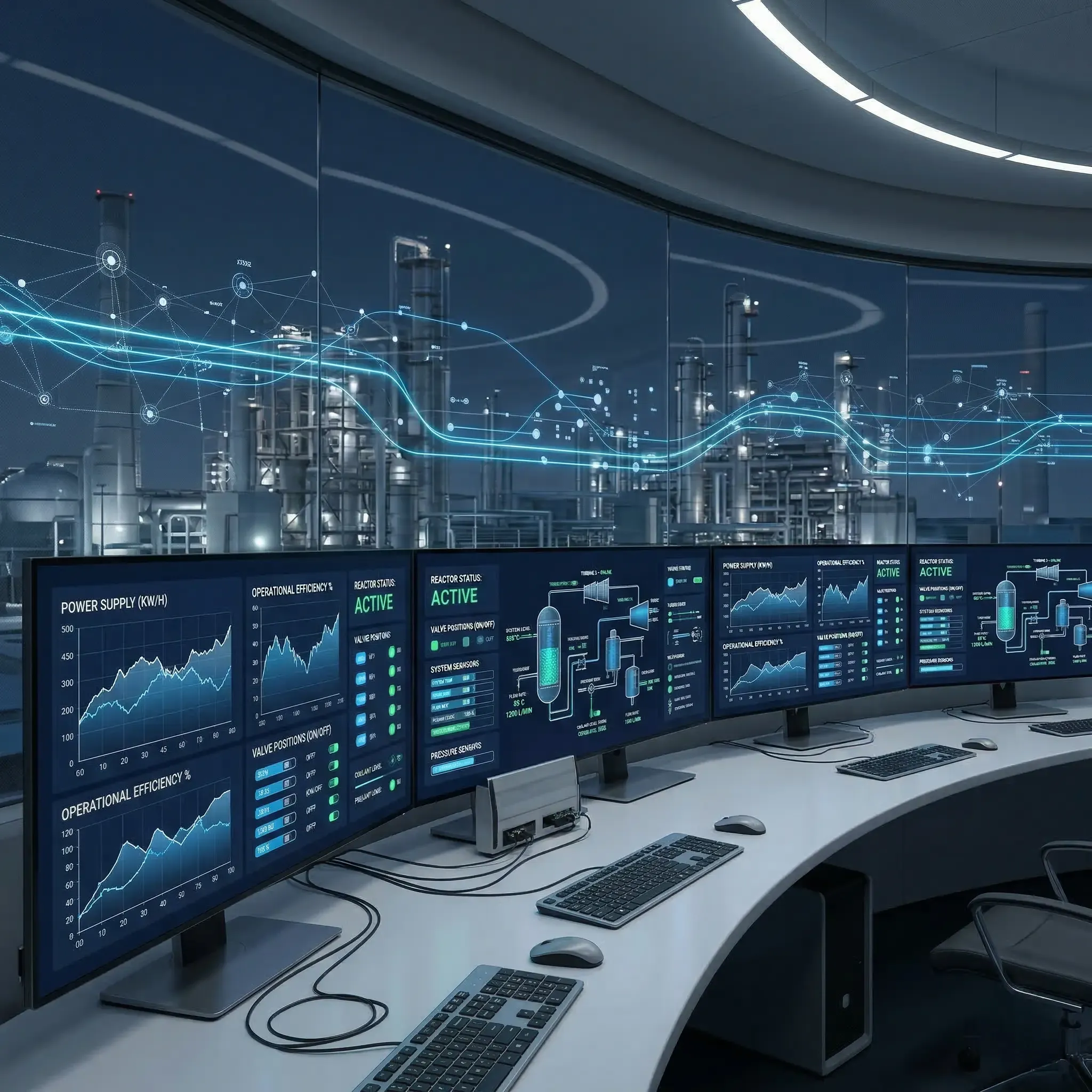
Key Benefits of an Industrial Monitoring & Control Platform
 Author
 Date of Publication
 Category
Introduction
Industrial plants face relentless pressure to cut costs, reduce downtime, and keep assets running safely. An Industrial Monitoring & Control Platform addresses all of these challenges in a single, connected solution. It brings together real-time asset data, AI-driven analytics, and remote control capabilities into one centralized system. Merjio, developed by Lanware Solutions, is built as a full-scale monitoring and control platform that combines edge computing with cloud-based intelligence, giving operations teams both the visibility to detect issues and the control to act on them instantly. This blog explores the key benefits these platforms deliver and why industrial organizations are adopting them at an accelerating pace.
Key Takeaways
- An Industrial Monitoring & Control Platform provides real-time visibility, AI-powered predictive maintenance, and automated anomaly detection across all connected plant assets.
- Industrial IoT solutions built on edge-to-cloud architecture are scalable, secure, and well-suited for both single-site plants and distributed multi-location operations.
- Adopting an Industrial IoT platform like Merjio enables organizations to move from reactive, scheduled maintenance to proactive, data-driven operations, reducing costs and improving uptime.
Real-Time Visibility Across Every Industrial Asset
Real-time monitoring eliminates blind spots in plant operations, giving managers a live view of every connected asset and enabling faster, better-informed decisions.
Without continuous data, plant managers rely on manual inspections and periodic reports to understand the state of their equipment. This approach creates significant gaps in awareness, and by the time a problem is identified, it has often already caused disruption. An Industrial Monitoring & Control Platform solves this by aggregating live sensor data from every connected asset into a single, centralized dashboard. Whether it is a pump on a water treatment skid, a blower in a wastewater facility, or a motor driving a slurry pump in a mining application, every asset reports its status in real time. Managers can track performance trends, spot deviations early, and respond before small irregularities develop into costly failures. This shift from periodic spot-checks to always-on visibility is one of the most immediate and measurable benefits of modern Industrial IoT solutions.
In a water and wastewater environment, for example, real-time visibility into pump flow rates, chemical dosing levels, and membrane pressures allows operators to maintain treatment quality consistently, even as inlet conditions change throughout the day.
AI-Driven Predictive Maintenance That Prevents Unplanned Downtime
Predictive maintenance powered by AI allows industrial teams to address equipment issues before they cause production stoppages, safety incidents, or costly emergency repairs.
Traditional scheduled maintenance operates on fixed intervals, replacing components according to a calendar rather than actual asset condition. This creates two problems. Teams either replace parts that still have significant useful life remaining, wasting materials and labor, or they miss developing failures that occur between scheduled service windows. An Industrial Monitoring & Control Platform changes this dynamic fundamentally. By continuously analyzing equipment behavior, the AI engine identifies patterns that indicate a component is trending toward failure. Maintenance teams receive early warnings and can schedule targeted repairs during planned downtime windows instead of scrambling to respond after an unexpected breakdown. According to the International Energy Agency, predictive maintenance strategies supported by digital monitoring can reduce unplanned downtime significantly across industrial sectors. For industries like mining and metals, where equipment failures in remote locations carry enormous logistical costs, this capability represents a substantial operational and financial advantage. Merjio is purpose-built as a monitoring and control platform, enabling teams not only to detect early failure signals but also to trigger control responses that protect assets before damage occurs.
Intelligent Anomaly Detection for Safer Plant Operations
Anomaly detection identifies irregular operational patterns in real time and alerts facility managers before those patterns escalate into critical failures or safety risks.
Not every equipment problem announces itself with an obvious alarm. Subtle shifts in vibration frequency, temperature readings, or discharge pressure can signal a developing fault long before a conventional threshold-based alarm would trigger. An Industrial Monitoring & Control Platform uses AI to distinguish between normal operational variation and patterns that represent genuine operational or safety risk. When the system detects an anomaly, it automatically notifies the responsible team with enough lead time to investigate and take corrective action. This capability is especially critical in water and wastewater treatment, where an undetected failure in a chemical dosing pump or membrane filtration unit can lead to non-compliance with environmental discharge standards. The combination of continuous data collection and intelligent alerting transforms how facilities manage both operational continuity and worker safety.
What sets Merjio apart as a monitoring and control platform is that its AI does not simply flag problems and wait. It is designed to combine anomaly detection with control-layer responses, so the system reduces alert fatigue for engineers while enabling timely, targeted action on deviations that genuinely matter.
Centralized Control for Distributed Industrial Sites
Centralized device management through an Industrial IoT platform allows organizations to monitor and control multiple sites from a single interface, eliminating data silos and reducing staffing overhead.
Many industrial operations span multiple facilities or remote deployment sites. Mining dewatering skids, mobile water treatment units, and chemical reagent dosing systems are frequently deployed far from central control rooms. Managing these assets through isolated local systems creates data silos, increases the number of staff needed on site, and slows down response times when something goes wrong. An Industrial Monitoring & Control Platform consolidates all of these distributed assets into one management layer accessible from any location and any device. Operators can issue commands, review performance reports, and respond to alerts remotely without dispatching a technician to site for every issue. This centralized approach delivers significant cost and efficiency advantages for manufacturing companies and industrial service providers that manage assets across multiple client locations simultaneously.
Merjio is architected as a true monitoring and control platform on an edge-to-cloud model. Processing happens at the edge device level for low-latency control and immediate responses, while aggregated data flows to the cloud for broader analytics, reporting, and long-term trend analysis, giving operators full command regardless of where their assets are deployed.
Data Analytics That Turn Operational Data Into Competitive Advantage
Integrated data analytics capabilities transform raw sensor readings into actionable operational insights, helping plant managers optimize processes, reduce energy consumption, and lower operating costs.
Collecting data from industrial assets delivers value only when that data is processed and presented in ways that drive better decisions. An Industrial Monitoring & Control Platform with built-in data analytics capabilities enables operations teams to identify patterns that would be impossible to detect manually. Over time, the analytics layer can surface which operating conditions deliver the highest energy efficiency for a given output, which maintenance intervals produce the longest equipment lifespan, and which process parameters consistently lead to the best product quality. These insights translate directly into reduced energy bills, lower maintenance costs, and improved production reliability. For leadership teams evaluating the business case for investment in an Industrial IoT platform, this kind of data-backed operational improvement provides a clear and measurable return on that investment.
According to Deloitte research on smart manufacturing, organizations that adopt data-driven operations through connected platforms report measurable improvements in productivity and cost efficiency compared to those relying on manual or paper-based monitoring systems.
Conclusion
An Industrial Monitoring & Control Platform delivers value at every level of plant operations. Real-time visibility eliminates the blind spots that lead to reactive decision-making. AI-driven predictive maintenance reduces unplanned stoppages before they happen. Intelligent anomaly detection keeps operations and workers safe. Centralized control simplifies the management of distributed assets, and integrated analytics turn raw operational data into a genuine competitive advantage. Merjio is designed from the ground up as an industrial monitoring and control platform, built to scale with your business from a single treatment plant to a network of remote industrial sites. If your organization is ready to move beyond manual monitoring and scheduled maintenance cycles, contact the Merjio team to explore how this platform can be configured for your specific industry and operational requirements.
FAQ
What is an Industrial Monitoring & Control Platform?
An Industrial Monitoring & Control Platform is a connected system that collects real-time data from industrial assets, analyzes it using AI, and enables remote monitoring and control. It helps plant managers improve uptime, safety, and operational efficiency across all connected equipment and sites.
How does an Industrial IoT platform reduce downtime?
An Industrial IoT platform uses AI-driven predictive maintenance to identify equipment issues before they cause failures. By analyzing continuous sensor data, the system detects early warning signs and alerts maintenance teams, allowing them to schedule repairs proactively and avoid costly unplanned stoppages.
What industries benefit most from Industrial IoT solutions?
Industries with high asset density, distributed operations, or harsh environments benefit most. Water and wastewater treatment, mining, manufacturing, and maritime sectors are strong use cases. These industries have pumps, motors, and blowers that require continuous monitoring to maintain uptime and regulatory compliance.
What is anomaly detection in industrial monitoring?
Anomaly detection is an AI capability that identifies unusual patterns in equipment behavior in real time. Unlike simple threshold alarms, it distinguishes between normal variation and genuine risk. Facility managers receive targeted alerts, enabling them to investigate and respond before minor irregularities become critical failures.
Can an Industrial IoT platform manage assets across multiple sites?
Yes. Modern Industrial IoT platforms use centralized device management to consolidate assets from multiple sites into one interface. Operators can monitor performance, issue control commands, and receive alerts remotely, eliminating the need for dedicated on-site staff at every location.
What is the difference between predictive and preventive maintenance?
Preventive maintenance follows a fixed schedule regardless of actual equipment condition. Predictive maintenance uses real-time sensor data and AI analysis to schedule repairs based on actual asset health. This approach reduces unnecessary servicing, extends equipment lifespan, and prevents failures that occur between scheduled service windows.
How does edge-to-cloud architecture benefit industrial monitoring?
Edge-to-cloud architecture processes data at the device level for immediate, low-latency control, while sending aggregated data to the cloud for broader analytics and reporting. Secure cloud infrastructure enables centralized visibility and long-term trend analysis across all connected assets, even during local network interruptions.
Is Merjio suitable for water and wastewater treatment plants?
Yes. Merjio is well-suited for water and wastewater environments where STP, ETP, MBR, and RO skids require continuous monitoring and control. Its real-time alerting, anomaly detection, and centralized control capabilities help operators maintain treatment quality and equipment reliability across decentralized or modular plant configurations.
What are the key features of an Industrial Monitoring & Control Platform?
Key features include real-time asset monitoring, AI-driven predictive maintenance, anomaly detection, centralized device management, remote control, integrated data analytics, and cloud-based reporting. Platforms like Merjio also support edge computing for fast local processing and scalability across multiple sites and asset types.
How does an Industrial IoT platform support Industry 5.0 goals?
An Industrial IoT platform supports Industry 5.0 by improving worker safety through early warnings, optimizing energy use through data analytics, and enabling human-machine collaboration where AI provides guidance rather than replacing human judgment. These outcomes align with sustainability, resilience, and people-centered operational goals.
Related product
Merjio IIoT Platform by Lanware
Any sensor. Any industry. One unified data layer — explore SKID solutions, AI-driven analytics, and live monitoring on the Merjio platform.
Explore merjio.com