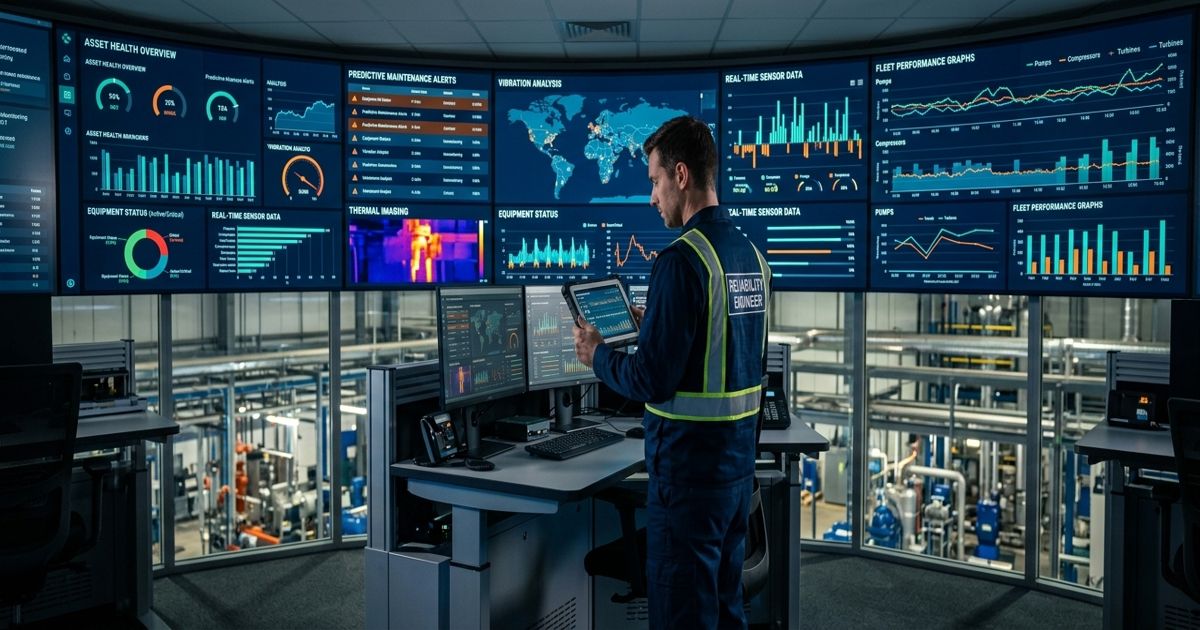
Asset Reliability Solutions: A Complete Guide for Industry
 Author
 Date of Publication
 Category
Asset Reliability Solutions: A Complete Guide for Industry
Asset reliability solutions are no longer optional for industrial operations. Unplanned equipment failures cost manufacturers billions every year in lost productivity, emergency repairs, and safety risks. If your facility still relies on scheduled maintenance cycles and manual inspections, you are leaving efficiency and profitability on the table. This guide explains what asset reliability solutions are, why they matter, and how modern reliability maintenance software and AI-powered platforms like Merjio are helping industrial teams move from reactive to predictive operations.
Key Takeaways
- Asset reliability solutions use real-time data and AI to predict failures before they occur, reducing unplanned downtime and maintenance costs while extending asset lifespan.
- Reliability maintenance software replaces time-based schedules with condition-based strategies, improving operational efficiency and delivering centralized visibility across distributed industrial assets.
- Platforms like Merjio combine predictive maintenance, anomaly detection, and intelligent control within an edge-to-cloud architecture that aligns with Industry 5.0 goals including worker safety and sustainability.
What Are Asset Reliability Solutions?
Asset reliability solutions refer to a combination of technologies, processes, and software systems designed to keep industrial equipment running at peak performance. They cover everything from condition monitoring and fault detection to predictive analytics and maintenance planning. The core goal is to maximize asset uptime while minimizing unplanned failures and maintenance costs.
Traditionally, industrial maintenance followed one of two models. Either equipment was repaired after it broke down (reactive maintenance) or it was serviced on a fixed schedule regardless of actual condition (preventive maintenance). Both approaches have significant limitations. Reactive maintenance leads to costly downtime. Preventive maintenance leads to unnecessary servicing of equipment that may still be in good working order.
Modern asset reliability solutions introduce a third and far more intelligent model: predictive maintenance. By using sensors, real-time monitoring, and AI-driven analytics, these solutions identify early warning signs of equipment degradation before failure occurs. This allows maintenance teams to act at precisely the right time, not too early and not too late.
According to research published by the U.S. Department of Energy, predictive maintenance programs can reduce maintenance costs by 25 to 30 percent, cut unplanned downtime by 35 to 45 percent, and extend equipment life significantly when implemented effectively.
Why Industrial Teams Need Reliability Maintenance Software
The shift toward reliability maintenance software is being driven by the growing complexity of industrial environments. Modern plants operate hundreds of interconnected assets across large facilities and sometimes across multiple geographic locations. Managing all of this with spreadsheets and manual logs is neither scalable nor safe.
Reliability maintenance software centralizes asset data, automates condition monitoring, and connects maintenance workflows in one platform. Instead of waiting for a sensor to trigger an alarm after failure, the software continuously analyzes equipment behavior and flags anomalies before they become critical problems.
For example, a manufacturing plant running conveyor systems, compressors, and motors across multiple production lines can use reliability maintenance software to monitor vibration, temperature, pressure, and load data in real time. When the software detects that a motor is drawing more current than normal, it alerts the maintenance team before the motor burns out entirely. That single early intervention can prevent hours of production downtime and thousands in emergency repair costs.
Merjio, the AI-powered Industrial IoT platform developed by Lanware Solutions, exemplifies this approach. Its anomaly detection engine distinguishes between normal operational variations and genuine warning signals, automatically alerting facility managers to potential issues in real time. Learn more about smart factory automation solutions and IIoT monitoring benefits to understand how this works in practice.
Core Features of Effective Asset Reliability Software
Not all platforms are created equal. When evaluating asset reliability software, industrial teams should look for a defined set of capabilities that directly impact operational outcomes. Below are the most important features to consider.
Real-Time Monitoring and Anomaly Detection
Real-time monitoring is the foundation of any asset reliability solution. The platform must collect sensor data continuously and present it in a way that operations teams can act on immediately. Anomaly detection goes one step further by using AI to identify unusual patterns in equipment behavior that human operators might miss.
Merjio's anomaly detection system uses AI to distinguish between normal process variation and conditions that require intervention. This precision is critical because not every deviation from baseline is a problem. False alarms fatigue maintenance teams and reduce trust in the system. A well-designed asset reliability software platform minimizes false positives while catching genuine early-stage failures.
AI-Driven Predictive Maintenance
Predictive maintenance is the most valuable capability within modern asset reliability solutions. Instead of relying on fixed schedules, the system uses historical data, sensor readings, and AI models to forecast when a specific component is likely to fail. Maintenance is then scheduled proactively at the optimal time.
This approach eliminates both over-maintenance (servicing equipment that does not need it) and under-maintenance (missing deterioration until failure occurs). Merjio enables industrial organizations to make this shift from scheduled preventive maintenance to AI-driven predictive maintenance, which is one of the most impactful upgrades any industrial facility can make. Explore how key benefits of industrial monitoring and control platforms extend beyond maintenance into broader operational intelligence.
Centralized Device and Asset Management
For organizations managing assets across multiple sites or production lines, centralized management is essential. Asset reliability software must aggregate data from all connected devices into a single platform, giving operations leaders a unified view of performance, health, and maintenance status.
Merjio's centralized device management capability supports enhanced control and scalability of IoT devices across complex industrial environments. Whether you are managing a single plant or a distributed fleet of assets, the platform provides the same consistent visibility and control. This also supports compliance and reporting requirements, since all asset data is captured and stored securely in the cloud.
Edge-to-Cloud Architecture for Industrial Environments
Industrial environments present unique connectivity challenges. Network latency, bandwidth constraints, and the need for real-time decision-making mean that cloud-only architectures are often insufficient for true asset reliability solutions. Edge computing addresses this by processing data at the device level before sending aggregated insights to the cloud.
Merjio uses an edge-to-cloud architecture that enables real-time inference at the edge combined with deep analytics and storage in the cloud. This ensures that time-critical alerts and control commands are never delayed by network issues. It also reduces the volume of data transmitted to the cloud, lowering bandwidth costs and improving system responsiveness. For a deeper look at how edge AI is reshaping industrial operations, read about Merjio edge AI built for water treatment and mining sites.
Asset Reliability Solutions Across Key Industries
The need for asset reliability solutions spans virtually every sector that depends on physical equipment and continuous operations. Here is how different industries are applying these capabilities.
- Manufacturing: Predictive maintenance of motors, conveyors, compressors, and CNC machines reduces production stoppages and improves output quality.
- Water Treatment: Continuous monitoring of pumps, filtration systems, and chemical dosing equipment ensures regulatory compliance and prevents supply disruptions.
- Mining: Remote asset monitoring in geographically isolated locations reduces the need for on-site inspections and improves worker safety.
- Maritime: Engine health monitoring and component tracking prevent costly breakdowns at sea and support fleet maintenance planning.
- Telecommunications: Infrastructure monitoring ensures network uptime and early detection of equipment failures that could affect service delivery.
Each of these industries shares a common challenge: the cost of unplanned downtime far exceeds the cost of proactive maintenance. Asset reliability solutions directly address this equation. You can explore more about how Merjio serves specific sectors through the Lanware Solutions industries page.
How Merjio Supports Industry 5.0 Asset Reliability Goals
Industry 5.0 builds on the automation and connectivity of Industry 4.0 by placing greater emphasis on human-machine collaboration, sustainability, and resilience. Asset reliability solutions play a central role in this evolution.
Merjio is designed to support Industry 5.0 outcomes across several dimensions. Worker safety is enhanced through real-time alerts that prevent operators from working with degraded or dangerous equipment. Energy optimization is enabled by monitoring consumption patterns and identifying inefficiencies. Human-machine collaboration is supported by AI-driven insights that guide maintenance decisions rather than replacing human judgment entirely.
The platform also supports traceability and compliance, which are increasingly important in regulated industries. Every sensor reading, alert, and maintenance action is logged and accessible through integrated reporting. This creates a defensible audit trail that supports both internal quality programs and external regulatory requirements.
According to the European Commission's Industry 5.0 framework, resilience and sustainability are now core industrial imperatives alongside productivity. Merjio's approach to asset reliability solutions aligns with this broader vision by helping organizations build operations that are both efficient and durable over the long term.
Choosing the Right Asset Reliability Software for Your Operation
Selecting the right asset reliability software is a strategic decision that requires careful evaluation of your operational environment, technical infrastructure, and business goals. Here are the key questions to ask before committing to a platform.
- Does the platform support real-time monitoring and AI-driven anomaly detection, or does it rely on manual threshold alerts?
- Can it scale from a single facility to multiple sites without requiring significant rearchitecting?
- Does it use an edge-to-cloud architecture suitable for environments with connectivity constraints?
- How does the platform handle data security, especially for cloud-stored operational data?
- What reporting and integration capabilities does it offer for maintenance planning and compliance purposes?
- Is the platform designed around simplicity of deployment and operation, or does it require extensive specialist configuration?
Merjio is built around three core principles: Simplicity, Scalability, and Security. These principles directly address the most common barriers to IIoT adoption in industrial settings. The platform is designed for practical deployment across complex environments without requiring industrial teams to become data scientists or software engineers.
Conclusion
Asset reliability solutions represent one of the most impactful investments an industrial organization can make. By moving from reactive and time-based maintenance to AI-driven predictive strategies, facilities reduce unplanned downtime, lower maintenance costs, improve worker safety, and build more resilient operations. The right reliability maintenance software provides real-time visibility, intelligent alerts, and actionable analytics across every asset in your operation. Merjio, developed by Lanware Solutions, brings together edge-to-cloud architecture, AI-powered anomaly detection, predictive maintenance, and centralized control in one platform designed for industrial scale. To see how Merjio can transform your approach to asset reliability solutions, explore the smart plant monitoring and automation complete guide or contact the Lanware team to discuss your specific operational needs.
FAQ
Q1: What are asset reliability solutions and why do they matter?
Answer: Asset reliability solutions are technology systems that monitor, analyze, and maintain industrial equipment to prevent failures. They matter because unplanned downtime costs industries billions annually. Proactive maintenance enabled by these solutions directly reduces repair costs, improves safety, and extends equipment lifespan across industrial operations.
Q2: How does reliability maintenance software differ from traditional maintenance management?
Answer: Traditional maintenance uses fixed schedules regardless of equipment condition. Reliability maintenance software uses real-time sensor data and AI to determine the optimal maintenance window. This condition-based approach eliminates unnecessary servicing and catches genuine deterioration early, reducing both costs and unplanned stoppages significantly.
Q3: What industries benefit most from asset reliability software?
Answer: Manufacturing, water treatment, mining, maritime, and telecommunications sectors benefit most from asset reliability software. Any industry relying on continuous equipment operation gains value from real-time monitoring, predictive maintenance, and centralized asset visibility that these platforms provide across single or multi-site environments.
Q4: How does predictive maintenance work within an asset reliability platform?
Answer: Predictive maintenance collects continuous sensor data including vibration, temperature, pressure, and current. AI models analyze this data to forecast when a specific component is likely to fail. Maintenance is then scheduled before failure occurs, preventing costly unplanned downtime and extending the operational life of critical equipment.
Q5: What is edge-to-cloud architecture and why is it important for asset reliability?
Answer: Edge-to-cloud architecture processes data at the device level for real-time decisions before sending insights to the cloud for deeper analysis. This is critical for asset reliability solutions in environments with connectivity constraints, ensuring time-sensitive alerts and control commands are never delayed by network latency or bandwidth limitations.
Q6: Can asset reliability solutions help with worker safety in industrial environments?
Answer: Yes. Real-time anomaly detection alerts operators before degraded or dangerous equipment causes accidents. Platforms like Merjio support edge AI applications that improve worker safety by identifying hazardous conditions instantly and enabling maintenance teams to respond before situations escalate into serious incidents.
Q7: How does anomaly detection improve the accuracy of asset reliability monitoring?
Answer: Anomaly detection uses AI to distinguish between normal operational variation and genuine warning signals. This precision reduces false alarms that fatigue maintenance teams, improving trust in the system. Only conditions that truly require intervention trigger alerts, allowing teams to focus their attention where it matters most.
Q8: What should I look for when evaluating asset reliability software for my facility?
Answer: Look for real-time monitoring, AI-driven anomaly detection, scalable architecture, edge computing support, cloud data security, and integrated reporting. Ease of deployment is equally important, as platforms designed around embedded hardware development driving IoT innovation tend to integrate more smoothly into existing industrial infrastructure without extensive reconfiguration.
Q9: How does asset reliability software support regulatory compliance and reporting?
Answer: Modern asset reliability software logs every sensor reading, alert, and maintenance action in a centralized, cloud-accessible system. This creates a complete audit trail for internal quality programs and external regulatory requirements. Integrated reporting tools convert raw operational data into structured compliance documentation, reducing administrative burden for maintenance teams significantly.
Q10: What is the difference between preventive and predictive maintenance in reliability solutions?
Answer: Preventive maintenance services equipment on fixed schedules regardless of actual condition, often leading to unnecessary work or missed deterioration. Predictive maintenance within asset reliability solutions uses real-time data and AI to service equipment only when needed, optimizing resource use and preventing failures before they impact production operations.
Related product
Merjio IIoT Platform by Lanware
Any sensor. Any industry. One unified data layer — explore SKID solutions, AI-driven analytics, and live monitoring on the Merjio platform.
Explore merjio.com