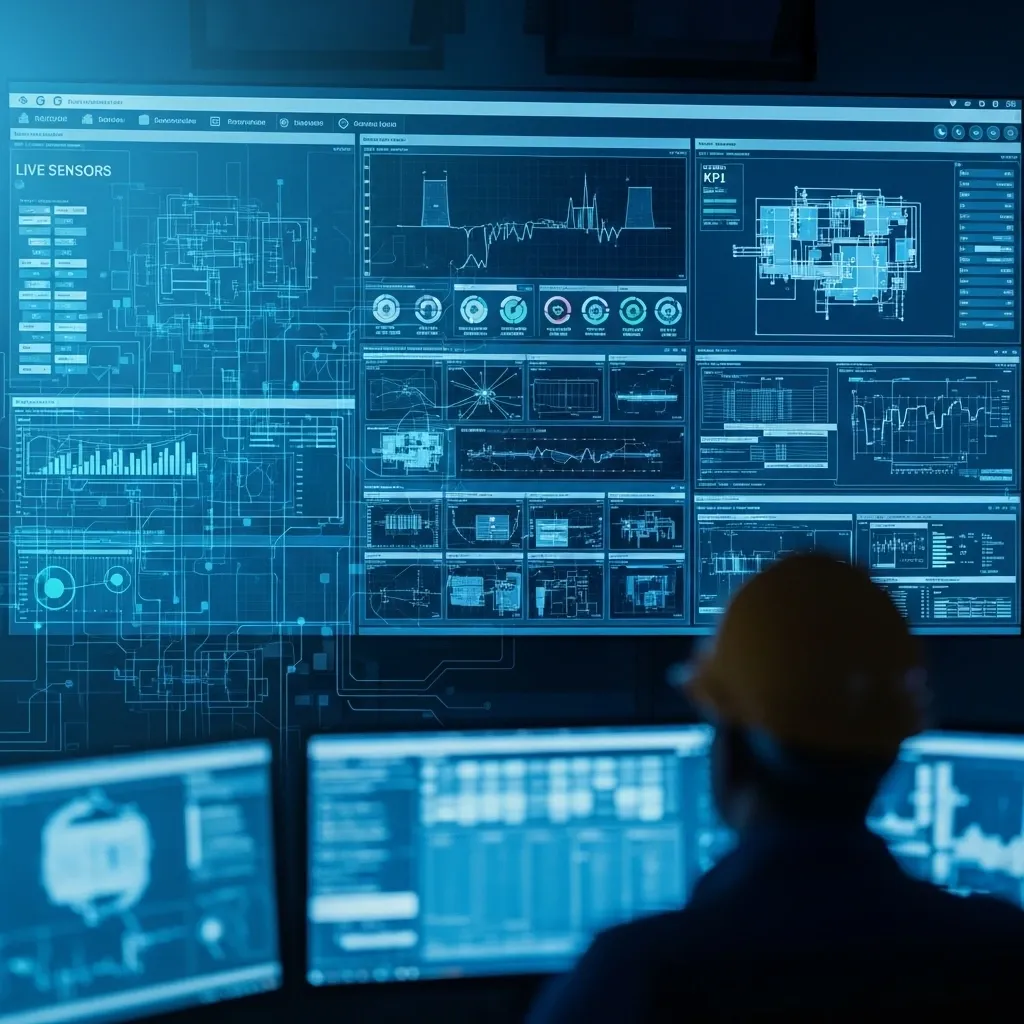
Smart Plant Monitoring and Automation: The Complete Guide
 Author
 Date of Publication
 Category
Introduction
Industrial plants face growing pressure to maintain uptime, reduce costs, and meet compliance standards all at once. A Smart Plant Monitoring and Automation System addresses these challenges by giving operations teams real-time visibility into every asset, process, and data point across the facility. From water treatment plants managing RO skids to mining operations running pump skids in remote locations, the demand for intelligent, connected platforms is rising fast. This guide covers how an Industrial Monitoring and Control Platform works, what capabilities to look for, and how platforms like Merjio are helping industrial operators stay ahead of failures and inefficiencies.
Key Takeaways
- A Smart Plant Monitoring and Automation System connects all plant assets to a centralized platform, enabling real-time monitoring and automated control from a single interface.
- Industrial IoT solutions with built-in data anomaly detection capabilities support predictive maintenance strategies and measurably reduce unplanned downtime.
- Industries like water treatment and mining benefit most from connected asset monitoring, given their distributed equipment, harsh environments, and high cost of operational failure.
What Is a Smart Plant Monitoring and Automation System?
A Smart Plant Monitoring and Automation System centralizes asset data, process visibility, and automated controls into a single connected platform that gives operators full situational awareness.
A modern industrial plant runs on a complex network of motors, pumps, blowers, sensors, compressors, and process skids. Managing these assets manually creates visibility gaps, increases the risk of missed faults, and places a heavy burden on maintenance teams. A Smart Plant Monitoring and Automation System closes these gaps by connecting every asset to a digital platform that collects data continuously, analyzes performance trends, and sends alerts or triggers automated actions when conditions change.
These systems typically operate across two layers: edge computing, where local gateways process sensor data in real time close to the equipment, and cloud infrastructure, where historical data is stored and analyzed for deeper insights. This edge-to-cloud architecture is especially valuable for remote or decentralized plants where connectivity can be limited and on-site staffing is minimal.
Platforms like Merjio, Lanware's AI-powered Industrial IoT platform, are designed specifically around this architecture. Merjio connects industrial assets across water treatment plants, mining sites, and process facilities, giving operators a live view of plant health and the tools to act on what they see. When every asset feeds into one system, plant teams can move from reactive firefighting to structured, data-driven operations management that improves both efficiency and safety.
The Case for an Industrial Monitoring and Control Platform
An Industrial Monitoring and Control Platform consolidates data from disparate assets and delivers the real-time intelligence operators need to make faster, more accurate decisions.
Plants that rely on manual inspections or disconnected monitoring tools are always working with incomplete information. An Industrial Monitoring and Control Platform addresses this by pulling data from sensors, PLCs, flow meters, and control systems into a unified dashboard. Operators can monitor live process parameters, review historical trends, receive automated alerts, and issue remote commands from a single interface accessible from any location.
This centralization matters because downtime in industrial environments is costly. A single pump failure at a water treatment facility, or a blocked filtration stage in a mining operation, can halt production, trigger regulatory issues, or create safety risks for personnel. Real-time monitoring allows teams to identify warning signs well before an asset reaches failure, enabling intervention at a point where the cost and disruption are far lower.
The Industrial IoT capabilities built into platforms like Merjio give plant teams this level of visibility at scale. Whether an operation monitors ten assets or several hundred, the platform scales without requiring extensive on-site infrastructure investment. This makes connected monitoring practical for both mid-sized plants and large enterprise operations across a wide range of industries and geographies.
Pump Skid and RO Skid Monitoring: Keeping Critical Assets Online
Dedicated monitoring for pump skids and RO skids provides early warning of performance degradation, enabling teams to act before failures disrupt operations.
Pump skids and RO skids are among the most critical and maintenance-intensive assets in water treatment, wastewater management, and process industries. A Pump Skid Monitoring Platform continuously tracks key parameters including flow rate, discharge pressure, motor current draw, vibration levels, and bearing temperature. When any of these metrics moves outside the acceptable operational range, the system triggers an alert for the maintenance team or initiates an automated protective response to safeguard the equipment.
For facilities running reverse osmosis systems, an RO Skid Monitoring System adds a further layer of oversight. It tracks membrane performance indicators, feed water pressure, permeate flow, and salt rejection rates. Consistent monitoring of these parameters ensures that product water quality stays within specification and helps maintenance teams detect membrane fouling or scaling before it significantly degrades performance or causes system failure.
Combining Pump Skid and RO Skid monitoring within a single Industrial IoT platform provides a unified view of all critical assets on one screen. This is where data analytics becomes essential, transforming raw sensor readings into trend analyses, performance benchmarks, and maintenance recommendations that drive measurable improvements across the plant floor.
How Data Anomaly Detection Powers Predictive Maintenance
Data anomaly detection identifies deviations in equipment behavior at an early stage, enabling teams to schedule maintenance before failures cause costly unplanned shutdowns.
Traditional time-based maintenance schedules service or replace equipment on fixed intervals regardless of its actual condition. This approach wastes resources when equipment is healthy and creates risk when hidden faults develop between service windows. Data anomaly detection offers a far more effective alternative by continuously comparing real-time sensor data against established performance baselines.
Using AI and machine learning models trained on historical sensor data, an Industrial Monitoring and Control Platform establishes a normal operating profile for each asset. When real-time readings deviate from that profile, for example unusual vibration in a pump motor, an unexpected pressure drop across an RO membrane, or elevated bearing temperatures in a blower, the system flags the anomaly immediately.
Maintenance teams can then investigate and resolve the issue during a planned downtime window, avoiding the considerably greater cost of an emergency repair or an unscheduled production halt. According to published industry research, predictive maintenance programs can reduce equipment breakdown frequency by up to 70 percent compared to reactive approaches. In the manufacturing sector and in industries like mining and water treatment, this shift from reactive to predictive operations significantly reduces both costs and safety risks while extending the working life of critical assets.
Industrial Water Treatment Monitoring: Compliance and Efficiency Together
Industrial Water Treatment Monitoring ensures that every stage of the treatment process meets quality and compliance standards while supporting reliable, cost-efficient plant operations.
Water and wastewater treatment facilities operate under strict regulatory requirements for effluent quality, chemical dosing accuracy, and process performance. Any monitoring gap can lead to non-compliance, operational disruptions, or significant remediation costs. Industrial Water Treatment Monitoring platforms provide continuous oversight across the full treatment chain, from screening and biological processing through membrane filtration and disinfection.
For plants using membrane bioreactor (MBR), moving bed biofilm reactor (MBBR), or RO systems, monitoring individual process stages is especially critical. Changes in feed water quality, membrane fouling, or dosing imbalances can affect final water quality rapidly. A connected Industrial IoT platform surfaces this data in real time, allowing operators to respond before compliance thresholds are breached.
Merjio supports Industrial Water Treatment Monitoring by integrating sensor inputs from across the full plant and presenting them in a clear operational dashboard. Automated alerts notify teams the moment a parameter moves outside acceptable limits, ensuring that compliance and quality are maintained around the clock. According to the U.S. Environmental Protection Agency, continuous monitoring and early detection are among the most effective practices for maintaining effluent quality in treatment operations. This level of oversight is particularly valuable for decentralized and modular treatment plants, where assets are distributed across multiple locations and centralized operational control is essential for consistent performance.
Conclusion
A Smart Plant Monitoring and Automation System is no longer an optional upgrade for forward-thinking facilities. It is a practical operational necessity for industrial plants that want to stay competitive, compliant, and efficient. From real-time asset visibility to AI-powered data anomaly detection, an Industrial Monitoring and Control Platform puts operations teams in full control of their plant's performance and reliability. Whether you manage a water treatment facility, a mining operation, or a process plant, Industrial IoT solutions give you the visibility and intelligence needed to reduce downtime and extend asset life. Explore how Merjio can transform your plant operations, and contact Lanware Solutions today to discuss how connected monitoring can work for your facility.
FAQ
What is a Smart Plant Monitoring and Automation System?
A Smart Plant Monitoring and Automation System is an Industrial IoT platform that connects plant assets to a centralized digital interface, enabling real-time data collection, automated alerts, and remote control of equipment such as pumps, motors, and process skids across industrial facilities.
How does an Industrial Monitoring and Control Platform improve plant uptime?
An Industrial Monitoring and Control Platform continuously tracks asset performance, detects early warning signs of equipment degradation, and triggers alerts before failures occur. This proactive approach helps maintenance teams schedule repairs during planned windows, reducing unplanned shutdowns and their associated production losses.
What is an RO Skid Monitoring System and why does it matter?
An RO Skid Monitoring System tracks key reverse osmosis performance parameters, including membrane pressure, permeate flow, and salt rejection rates. Continuous oversight ensures consistent product water quality, helps detect membrane fouling early, and prevents compliance breaches in water treatment and industrial process applications.
How does data anomaly detection support predictive maintenance?
Data anomaly detection uses AI models to compare real-time sensor readings against established equipment baselines. When unusual patterns appear, such as pressure drops or vibration spikes, the system alerts maintenance teams immediately, enabling them to address issues before they escalate into costly equipment failures or unplanned downtime.
What industries benefit most from Industrial IoT solutions?
Industries with distributed equipment, remote operations, and high downtime costs benefit most, including water and wastewater treatment, mining, oil and gas, and manufacturing. Industrial IoT solutions deliver real-time visibility and control for assets operating across multiple locations or in harsh environments.
What is a Pump Skid Monitoring Platform?
A Pump Skid Monitoring Platform continuously measures parameters like flow rate, discharge pressure, motor current, and bearing temperature across pump skid assemblies. It alerts operators to deviations from normal operating ranges, enabling prompt intervention and helping extend the service life of critical pumping equipment.
How does Industrial Water Treatment Monitoring ensure regulatory compliance?
Industrial Water Treatment Monitoring provides continuous oversight of treatment stages, chemical dosing, and effluent quality parameters. Automated alerts notify operators the moment readings exceed compliance thresholds, ensuring facilities meet regulatory standards consistently while reducing the risk of costly non-compliance incidents or remediation requirements.
Can an Industrial IoT platform scale across multiple plant sites?
Yes. A modern Industrial IoT platform uses edge-to-cloud architecture that scales across multiple facilities without requiring significant on-site infrastructure investment. Operators can monitor and control assets across all locations from a single dashboard, making it practical for both mid-sized operations and large enterprise deployments.
What should businesses look for when choosing an Industrial Monitoring and Control Platform?
Key factors include real-time monitoring capabilities, AI-driven anomaly detection, edge-to-cloud connectivity, scalability, and industry-specific configurability. Businesses should also evaluate integration support for existing equipment and sensors. Consulting services can help identify the right platform fit for specific operational requirements.
How does Merjio function as a Smart Plant Monitoring and Automation System?
Merjio is an AI-powered Industrial IoT platform that delivers real-time asset monitoring, remote intelligent control, and predictive maintenance for industrial plants. It supports water treatment, mining, and process industries with edge-to-cloud connectivity, data anomaly detection, and a unified operational dashboard for complete plant visibility.
Related product
Merjio IIoT Platform by Lanware
Any sensor. Any industry. One unified data layer — explore SKID solutions, AI-driven analytics, and live monitoring on the Merjio platform.
Explore merjio.com