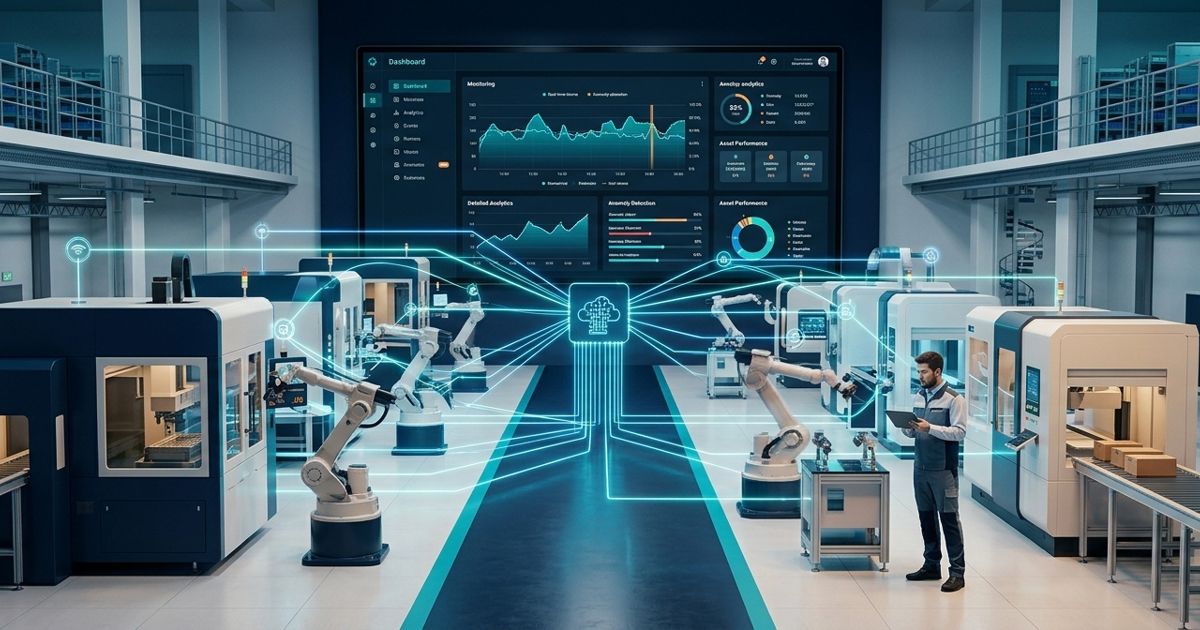
Smart Factory Automation Solutions: Benefits of IoT Monitoring
 Author
 Date of Publication
 Category
Smart factory automation solutions are reshaping how industrial operations are managed, monitored, and optimized. As manufacturers and plant operators face growing pressure to reduce downtime, cut costs, and improve safety, the need for intelligent, real-time visibility across assets has never been more urgent. This blog explores how Industrial IoT platforms like Merjio deliver measurable operational benefits and why now is the right time to invest in connected industrial monitoring and control.
Key Takeaways
- Smart factory automation solutions powered by Industrial IoT platforms enable real-time asset monitoring, remote control, and AI-driven decision-making at scale.
- Platforms like Merjio combine edge computing and generative AI to deliver predictive maintenance and anomaly detection that prevent costly unplanned downtime.
- Adopting an Industrial IoT platform helps industrial organizations move from reactive operations to proactive, data-driven plant management aligned with Industry 5.0 goals.
- Centralized device management through a unified IoT dashboard eliminates siloed data, reduces reporting overhead, and accelerates data-driven decision-making across multiple sites.
- The ROI of smart factory automation is measurable and well-documented, spanning reduced maintenance costs, improved energy efficiency, and enhanced worker safety outcomes.
What Makes Smart Factory Automation Solutions Different Today
Traditional factory monitoring relied on periodic inspections and scheduled maintenance. This approach left operations exposed to sudden failures and unpredictable costs. Smart factory automation solutions change this by embedding continuous intelligence into every layer of the operation.
Modern platforms connect sensors, machines, and control systems across the plant floor and aggregate that data in real time. Instead of reacting to failures after they occur, operations teams can now identify patterns, receive early warnings, and take corrective action before a problem becomes a crisis. This shift from reactive to proactive management is one of the most significant operational transformations in industrial history.
According to McKinsey and Company, manufacturers that adopt advanced IoT-driven monitoring can reduce machine downtime by up to 50% and extend equipment life significantly. These are not marginal gains. They represent real competitive advantages for industrial businesses operating in cost-sensitive environments.
What differentiates today's platforms from earlier machine monitoring tools is the integration of AI, edge computing, and cloud analytics into a single cohesive system. Earlier tools captured data but required human analysts to interpret it. Modern smart factory automation solutions interpret data autonomously, surface actionable insights, and deliver them directly to the people who need to act. This democratization of operational intelligence is what makes current-generation platforms so transformative for industrial businesses of all sizes.
How Merjio Delivers Industrial IoT Platform Capabilities
Merjio is an AI-powered Industrial IoT platform developed by Lanware Solutions. It is purpose-built for real-time monitoring, intelligent control, and predictive maintenance of industrial assets. The platform follows a clear design philosophy built on simplicity, scalability, and security.
At its core, Merjio uses an edge-to-cloud architecture. This means data is processed at the edge of the network, close to the physical asset, before being sent to the cloud for deeper AI analysis. This reduces latency, supports real-time decision-making, and ensures that critical alerts reach operators without delay.
The platform is not just a monitoring tool. Merjio is a full monitoring and control platform that allows facility managers to remotely manage connected assets, adjust operational parameters, and respond to alerts from a centralized dashboard. This level of control makes it a practical solution for organizations managing distributed assets across multiple sites.
You can explore a detailed real-world application in the blog on how Merjio transforms industrial asset monitoring and control, which covers specific use cases and outcomes in depth.
Real-Time Anomaly Detection: Catching Problems Before They Escalate
One of the most operationally valuable features of a smart factory automation platform is its anomaly detection system. In a busy industrial environment, distinguishing between normal operational variation and a genuine early-warning signal is not simple. Human operators cannot process the volume of sensor data generated by a modern plant in real time.
Merjio's AI-driven anomaly detection addresses this challenge directly. The platform continuously analyzes operational data and uses AI to differentiate between expected fluctuations and patterns that indicate potential equipment failure, process deviation, or safety risk. When an anomaly is identified, facility managers receive automated alerts, giving them time to investigate and intervene before the situation escalates.
This capability is particularly valuable in industries like manufacturing and maritime, where equipment failures can result in costly shutdowns or safety incidents. Rather than waiting for a machine to fail, the system creates a window for proactive intervention. The result is fewer unplanned stoppages, better asset utilization, and a safer working environment for plant personnel.
The broader value of this approach is explored in depth in the blog on smart plant monitoring and automation, which explains how connected monitoring transforms plant visibility across industries.
It is also worth noting that anomaly detection systems grow more accurate over time. As the AI model accumulates more operational data specific to an asset or environment, its ability to distinguish real warning signals from benign variation improves continuously. This means the platform becomes more valuable the longer it is deployed, making early adoption a strategic advantage for industrial operators who want to build a mature, intelligent monitoring capability.
Predictive Maintenance vs. Scheduled Maintenance: A Critical Shift
For decades, industrial maintenance followed a fixed schedule. Machines were serviced at regular intervals regardless of their actual condition. This approach led to two common inefficiencies. First, maintenance was sometimes performed unnecessarily on equipment that was functioning perfectly. Second, equipment sometimes failed between scheduled service intervals, causing unplanned downtime.
Smart factory automation solutions enable a fundamentally better approach. By continuously collecting and analyzing data from connected assets, an Industrial IoT platform can predict when a component is likely to fail based on real usage patterns, not arbitrary time intervals.
Merjio enables this shift from scheduled preventive maintenance to AI-driven predictive maintenance. The platform monitors asset performance indicators in real time and uses AI to identify degradation patterns before they result in failure. Maintenance teams receive targeted, timely alerts that direct them to the specific asset and issue requiring attention.
This approach reduces the total cost of maintenance, extends the operational life of equipment, and minimizes disruption to production schedules. For industrial businesses where downtime translates directly into lost revenue, predictive maintenance is one of the highest-return applications of an Industrial IoT platform.
The financial impact is significant. Studies across manufacturing sectors consistently show that predictive maintenance can reduce overall maintenance costs by 20 to 30 percent compared to purely scheduled approaches, while simultaneously reducing unplanned downtime by up to 45 percent. When those figures are applied to large industrial facilities with hundreds of connected assets, the cumulative savings over a multi-year horizon become a compelling investment case in their own right.
Centralized Device Management and Operational Visibility
Managing a large fleet of industrial assets across multiple locations creates significant operational complexity. Without a centralized platform, operations teams often rely on siloed data sources, manual reporting, and disconnected systems that make it difficult to get a clear picture of plant performance.
Merjio addresses this through centralized device management, giving operations teams a single, unified interface for monitoring and controlling all connected assets. Whether a facility has ten machines or ten thousand across multiple sites, the platform provides consistent visibility and control without adding operational burden.
This centralized approach also supports better decision-making. Real-time data analysis within the platform enables operations managers and plant heads to identify performance trends, compare asset utilization across sites, and make data-driven decisions that improve efficiency and reduce waste. The platform's integrated reporting capabilities make it straightforward to generate operational performance insights for internal stakeholders and compliance purposes.
Centralized visibility also plays an important role in workforce productivity. When maintenance engineers and plant operators have access to a single source of truth, they spend less time gathering and reconciling data from disparate systems and more time acting on the insights that platform delivers. This improvement in operational flow has a compounding effect on plant performance over time. Teams become faster at identifying and resolving issues, communication between shifts improves, and the organization as a whole develops a stronger culture of data-driven operations.
For organizations looking to understand how asset management systems streamline operations and optimize efficiency, connected IoT monitoring platforms represent the most scalable path forward.
ROI Justification: Measuring the Business Case for Smart Factory Automation
For industrial decision-makers evaluating smart factory automation solutions, the question of return on investment is central to any procurement decision. The good news is that the ROI of an Industrial IoT platform is both measurable and well-documented across multiple dimensions of operational performance.
The first and most direct ROI driver is the reduction in unplanned downtime. For facilities where a single hour of unexpected production stoppage costs tens of thousands of dollars, even a modest improvement in uptime reliability translates into substantial financial recovery. Platforms like Merjio, by enabling predictive maintenance and early anomaly detection, directly address this cost center.
The second ROI driver is maintenance cost reduction. By transitioning from scheduled to condition-based maintenance, organizations eliminate unnecessary service interventions and extend the useful life of components. Spare parts inventory can be managed more efficiently because maintenance teams know in advance what parts will be needed and when, rather than stocking broad contingency inventories for unexpected failures.
Energy efficiency represents a third significant ROI dimension. Industrial facilities are among the largest consumers of energy in any economy. An Industrial IoT platform with real-time energy monitoring capabilities helps operations teams identify equipment running inefficiently, processes consuming more power than necessary, and patterns of energy waste that were previously invisible. Even a 5 to 10 percent reduction in energy consumption across a large facility produces meaningful cost savings annually.
Worker safety improvements also carry financial value, both through avoided incident costs and through reduced insurance and compliance exposure. Platforms that deliver real-time safety alerts and prevent personnel from operating faulty equipment reduce the probability of workplace injuries and the associated financial and reputational consequences. Taken together, these ROI dimensions build a business case that spans finance, operations, and risk management, making it relevant to multiple stakeholders across the industrial organization.
Industry 5.0 Alignment: Safety, Sustainability, and Human-Machine Collaboration
The next evolution of industrial operations is not just about automation. Industry 5.0 places equal emphasis on worker safety, energy sustainability, and meaningful human-machine collaboration. Smart factory automation solutions that align with these goals provide a broader business case beyond operational efficiency.
Merjio is designed with Industry 5.0 outcomes in mind. The platform supports worker safety by delivering real-time alerts that prevent personnel from operating faulty or unsafe equipment. It enables energy optimization by giving operations teams the visibility to identify and eliminate inefficient energy consumption patterns across the plant.
Importantly, Merjio is built around human-machine collaboration rather than pure automation. The AI provides guidance, early warnings, and data-driven recommendations. Human operators and plant managers retain control and make the final decisions. This approach creates a more resilient, adaptable operation that can respond to unexpected conditions without over-relying on automated responses that may not account for context.
According to the European Parliament, Industry 5.0 frameworks are increasingly influencing industrial policy and investment priorities globally. Organizations that adopt platforms aligned with these principles will be better positioned for regulatory and market requirements in the years ahead.
IoT Monitoring Across Industries: Where Merjio Delivers Value
The applications of an AI-powered Industrial IoT platform extend across a wide range of industries. Merjio has demonstrated relevance across manufacturing, maritime, telecommunications, and distributed asset management use cases such as vending and cloud kitchen fleet monitoring.
In manufacturing, the platform supports continuous monitoring of production equipment, real-time quality and process control, and energy management across the plant floor. In maritime operations, remote asset monitoring and predictive maintenance capabilities help manage equipment in environments where on-site intervention is costly and logistically complex.
For telecommunications infrastructure operators, centralized device monitoring and anomaly detection reduce the risk of service disruptions and support proactive network asset management. In distributed operations like vending machine fleets, the platform enables centralized visibility over large numbers of remote assets without the need for constant manual inspection.
You can explore Merjio's application in water treatment operations in the detailed case study on IoT monitoring and control for water treatment skids, which illustrates how connected monitoring works in practice for process-driven industrial environments.
Why Now Is the Right Time to Invest in Smart Factory Automation
The convergence of affordable IoT hardware, cloud infrastructure, and mature AI capabilities means that smart factory automation solutions are no longer reserved for large enterprises with deep technology budgets. Platforms like Merjio are designed to scale from small facilities to enterprise-wide deployments, making the investment accessible for a wider range of industrial operators.
The cost of inaction is also rising. Competitive pressure, tightening margins, and increasing regulatory scrutiny around safety and sustainability are pushing industrial businesses to modernize their operations. Organizations that delay the adoption of connected monitoring and control platforms risk falling behind peers who are already capturing the efficiency and safety benefits of real-time industrial intelligence.
The operational ROI of an Industrial IoT platform is well-documented. Reduced unplanned downtime, lower maintenance costs, better energy efficiency, and improved worker safety each contribute to a measurable return. When combined, they build a compelling case for investment that industrial decision-makers can present with confidence to finance and executive leadership.
Furthermore, the pace of IoT technology development means that organizations that invest early benefit from a longer period of operational learning. AI models improve with more data. Maintenance teams become more skilled at interpreting platform insights. And the organization accumulates institutional knowledge about its assets that becomes a lasting competitive advantage. Waiting to invest is not a neutral decision. It is a decision to fall further behind the operational maturity curve as the industrial landscape continues to evolve rapidly.
Conclusion
Smart factory automation solutions represent one of the most impactful investments an industrial business can make in the current environment. Platforms like Merjio deliver the real-time visibility, AI-driven predictive maintenance, and intelligent anomaly detection capabilities that modern operations demand. From centralized device management to Industry 5.0 alignment, the benefits extend across every layer of industrial performance. The ROI case is measurable, the technology is mature, and the competitive stakes of inaction are real. If your organization is ready to move from reactive operations to proactive, data-driven plant management, explore what Merjio can do for your assets and operations by visiting the Merjio product page or connecting with the Lanware Solutions team through consulting services to discuss your specific requirements.
FAQ
What is a smart factory automation solution and how does it work?
A smart factory automation solution connects industrial assets through IoT sensors and uses AI to monitor performance, detect anomalies, and trigger automated or human-assisted responses in real time, enabling proactive plant management instead of reactive maintenance cycles.
How does an Industrial IoT platform reduce unplanned downtime?
An Industrial IoT platform continuously analyzes asset data to identify early warning signs of equipment degradation. By alerting maintenance teams before a failure occurs, platforms like Merjio help operations managers schedule targeted interventions rather than dealing with costly unplanned production stoppages.
What makes Merjio different from standard monitoring tools?
Merjio is not just a monitoring tool. It is a full monitoring and control platform that combines edge computing, generative AI, and centralized device management. It enables remote control of connected assets, AI-driven predictive maintenance, and real-time anomaly detection from a single unified interface.
What industries benefit most from IoT monitoring systems like Merjio?
Merjio delivers value across manufacturing, maritime, telecommunications, and distributed asset operations such as vending fleets. Any industry managing multiple connected assets across sites can benefit from centralized visibility, real-time control, and AI-driven predictive maintenance capabilities the platform provides.
How does anomaly detection work in an Industrial IoT platform?
The anomaly detection system uses AI to analyze continuous sensor data streams and distinguish normal operational variation from patterns that indicate a real problem. When an anomaly is detected, facility managers receive automated alerts so they can investigate and act before the issue escalates into a failure.
What is the difference between predictive and preventive maintenance?
Preventive maintenance follows a fixed schedule regardless of equipment condition, which can lead to unnecessary servicing or failures between intervals. Predictive maintenance, enabled by platforms like Merjio, uses real-time data and AI to predict when a component will fail, allowing targeted intervention based on actual asset condition.
Can small and mid-sized manufacturers use smart factory automation solutions?
Yes. Modern smart factory automation solutions are designed to scale. Merjio is built around simplicity, scalability, and security, making it accessible for facilities of varying sizes. Organizations exploring how Merjio revolutionizes industrial asset management can find relevant starting points for mid-scale deployments.
How does edge computing improve IoT monitoring performance?
Edge computing processes sensor data at the asset level before sending it to the cloud. This reduces latency, supports real-time alerts, and ensures that critical operational signals are acted upon immediately. Merjio's edge-to-cloud architecture combines the speed of local processing with the analytical power of cloud-based AI.
What are the Industry 5.0 benefits of using an IoT monitoring platform?
Industry 5.0 focuses on human-machine collaboration, sustainability, and worker safety alongside efficiency. Merjio supports these goals by providing real-time safety alerts, energy optimization insights, and AI guidance that empowers human operators rather than replacing them, making industrial operations more resilient and sustainable.
How do I get started with implementing an Industrial IoT platform for my facility?
The best starting point is assessing your current asset monitoring gaps and operational pain points. From there, working with experienced technology partners helps scope the right solution. Businesses in telecommunications or distributed infrastructure can explore industry-specific IoT applications for telecommunications to understand relevant deployment approaches.
Related product
Merjio IIoT Platform by Lanware
Any sensor. Any industry. One unified data layer — explore SKID solutions, AI-driven analytics, and live monitoring on the Merjio platform.
Explore merjio.com