What Is Predictive Maintenance: A Complete Guide
 Author
 Date of Publication
 Category
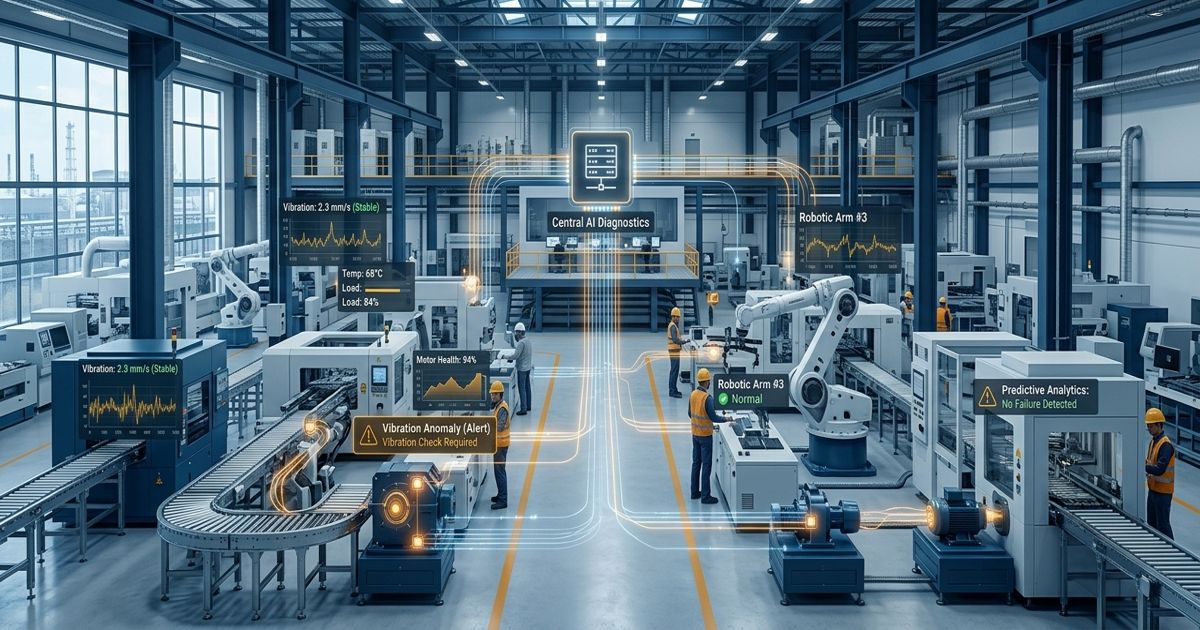
What is predictive maintenance? It is a data-driven strategy that uses real-time sensor data, AI analytics, and an anomaly detection system to identify equipment problems before they escalate into costly failures. Instead of waiting for a machine to break down or following a fixed service schedule, this approach monitors actual asset condition continuously. In this guide, you will learn how the process works, why it outperforms traditional approaches, and how modern IIoT platforms like Merjio are making proactive asset management accessible for industrial operations of all sizes.
Key Takeaways
- AI-driven condition monitoring uses real-time sensor data to identify equipment issues before failures occur, reducing unplanned downtime significantly.
- An anomaly detection system is a critical component that distinguishes between normal operational variations and faults requiring immediate action.
- Moving from scheduled preventive maintenance to AI-driven strategies helps organizations cut costs, improve worker safety, and extend asset life.
Understanding Condition-Based Asset Management
This maintenance strategy replaces two older approaches: reactive maintenance, which responds after a failure, and preventive maintenance, which follows a fixed time-based schedule regardless of actual equipment condition.
According to research published by McKinsey, this approach can reduce machine downtime by 30 to 50 percent and extend equipment life by 20 to 40 percent. These numbers reflect a straightforward insight: if you know a bearing is degrading before it fails, you can schedule a repair at the right time rather than shutting down an entire production line unexpectedly.
The strategy relies on continuous data collection from sensors attached to motors, pumps, compressors, and other critical assets. That data is then analyzed by AI models trained to detect early warning signals. The result is a maintenance schedule driven by actual asset condition, not guesswork or arbitrary intervals.
How the Process Works: Four Core Stages
Understanding the mechanics of AI-driven maintenance helps operations teams evaluate whether a platform fits their environment. The process typically follows four stages.
Stage 1: Continuous Sensor Data Collection
Industrial sensors capture temperature, vibration, pressure, flow rates, and electrical consumption across connected assets. This data is collected continuously, often at millisecond intervals, to build a detailed operational picture of each machine. The volume and frequency of this data make manual analysis impossible, which is why AI processing is essential.
Stage 2: Anomaly Detection and Pattern Recognition
This is where an anomaly detection system plays a central role. AI models analyze incoming sensor data and compare it against established baselines of normal operation. When readings deviate from those baselines in ways that suggest a developing fault, the system flags the anomaly. Importantly, a well-designed anomaly detection system distinguishes between harmless operational variations and genuine warning signals. Merjio's AI layer is specifically built to make this distinction, reducing false alarms while ensuring critical issues are surfaced promptly to facility managers.
Platforms like Merjio deploy this intelligence at the edge, meaning the analysis happens close to the machine rather than relying entirely on a remote cloud server. This edge-to-cloud architecture ensures low-latency alerts even in environments with limited connectivity. You can learn more about this approach in the overview of Merjio Edge AI built for water treatment and mining sites.
Stage 3: Alert Generation and Maintenance Scheduling
Once an anomaly is confirmed as a potential fault, the platform automatically generates an alert for the relevant facility manager or maintenance team. The alert includes context about which asset is affected, what the detected pattern suggests, and how urgent the situation appears to be. This enables maintenance teams to schedule interventions at the optimal time, before a breakdown occurs but without performing unnecessary maintenance on healthy equipment.
Stage 4: Continuous Learning and Refinement
AI models used in condition-based monitoring improve over time. As more operational data accumulates and more fault events are logged, the model becomes better at identifying early warning patterns specific to your equipment and environment. This self-improving loop is one of the key advantages that separates AI-driven monitoring from static rule-based systems.
Predictive vs. Preventive Maintenance: Key Differences
Many organizations still rely on preventive maintenance, scheduling service interventions based on calendar dates or usage hours. While this is an improvement over pure reactive maintenance, it has a fundamental limitation: equipment condition is not uniform. A machine running in a harsh environment will degrade faster than one in ideal conditions, even if both follow the same maintenance calendar.
Condition-based strategies solve this by tying interventions to actual equipment data. The comparison below summarizes the key differences between each approach.
- Reactive maintenance: Respond after failure. High downtime and repair costs. No data required.
- Preventive maintenance: Service on a fixed schedule. Reduces some failures but wastes resources on healthy equipment.
- Condition-based maintenance: Service based on real-time condition data. Minimizes downtime, optimizes resource use, and extends asset life.
The shift from preventive to condition-driven approaches is one of the defining moves of Industry 4.0 and now Industry 5.0, where human-machine collaboration and sustainability are central goals. Merjio is designed to support this transition, enabling organizations to move away from schedule-driven maintenance toward AI-driven prediction without requiring a complete overhaul of existing infrastructure.
The Role of IIoT and Edge Computing
Industrial IoT platforms are the infrastructure that makes proactive asset management practical at scale. Sensors generate data, but that data needs to be collected, transmitted, processed, and acted upon reliably. IIoT platforms handle this end-to-end pipeline, connecting physical assets to digital intelligence.
Edge computing adds a critical layer. By processing data locally at the machine or site level before sending it to the cloud, edge computing reduces latency, bandwidth consumption, and dependency on continuous internet connectivity. For industrial environments where milliseconds matter and connectivity can be intermittent, this architecture is not optional. It is essential.
Merjio's edge-to-cloud architecture combines real-time device inference at the edge with cloud-based AI for deeper analytics and centralized reporting. This design supports condition-based monitoring across multiple sites and asset types without sacrificing speed or reliability. For a broader look at how this monitoring infrastructure supports industrial operations, the key benefits of an industrial monitoring and control platform provides useful context.
The Anomaly Detection System: Core Intelligence in Action
An anomaly detection system is not just a feature. It is the analytical engine that transforms raw sensor data into actionable maintenance intelligence. Without it, operators would be forced to manually review enormous data streams looking for irregularities, a task that is both impractical and error-prone at industrial scale.
A well-built anomaly detection system uses machine learning models trained on historical operational data to establish what 'normal' looks like for each asset. As new data arrives, the model calculates how far current readings deviate from that normal baseline. Deviations beyond a defined threshold trigger an alert. The sophistication lies in calibrating the threshold correctly: too sensitive and you flood teams with false alarms; not sensitive enough and real faults go undetected.
Merjio's AI distinguishes between normal variations and critical problems, automatically alerting facility managers to potential issues in real time. This capability is particularly valuable in complex environments like water treatment plants and manufacturing facilities, where dozens of variables interact simultaneously. For a detailed example of this in action, see how Merjio IoT monitoring supports water treatment operations.
Business Benefits for Industrial Operations
The operational and financial case for AI-driven asset monitoring is well established. Here are the most significant benefits organizations experience after implementing a condition-based approach.
- Reduced unplanned downtime: Faults are caught before they cause failures, keeping production lines running.
- Lower maintenance costs: Resources are spent only when and where they are needed, not on arbitrary schedules.
- Extended asset lifespan: Early intervention prevents minor issues from escalating into major damage.
- Improved worker safety: Equipment failures in industrial environments can be dangerous. Early warnings reduce the risk of accidents caused by mechanical failure.
- Energy optimization: Degraded equipment often consumes more energy than healthy equipment. Keeping assets running efficiently supports sustainability goals.
- Better compliance and traceability: Maintenance records tied to real condition data provide stronger audit trails than schedule-based logs.
These benefits align directly with Industry 5.0 goals, where operational resilience, sustainability, and human-centric outcomes are central priorities. Platforms like Merjio are designed with these goals in mind, offering integrated reporting for operational performance and centralized device management across assets and sites.
For organizations exploring how smart factory tools connect to these outcomes, the overview of smart factory automation solutions and IoT monitoring benefits is a valuable read.
Conclusion
AI-driven condition monitoring represents a fundamental shift in how industrial organizations approach equipment care. By combining real-time sensor data, machine learning analytics, and a reliable anomaly detection system, facilities can move from reactive and schedule-based approaches to a proactive, condition-driven model. The result is less downtime, lower costs, safer workplaces, and longer-lived assets. Merjio, developed by Lanware Solutions, delivers this capability through an edge-to-cloud architecture designed for simplicity, scalability, and security. These core principles form the right foundation for any organization evaluating IIoT platforms and looking to understand how proactive asset strategies can transform their operations. Explore how Merjio revolutionizes industrial asset management to see these capabilities in practice.
FAQ
What is predictive maintenance in simple terms?
It is a strategy that uses real-time sensor data and AI analytics to detect equipment problems before they cause failures. Instead of waiting for a breakdown or following a fixed service schedule, teams act on actual condition data, reducing downtime and repair costs significantly.
How does an anomaly detection system work in industrial settings?
An anomaly detection system analyzes incoming sensor data against a baseline of normal operation. When readings deviate beyond acceptable thresholds, the system flags the anomaly and alerts the maintenance team. It is designed to distinguish harmless variations from genuine faults requiring immediate attention.
What is the difference between predictive and preventive maintenance?
Preventive maintenance follows a fixed time-based schedule regardless of equipment condition. Condition-based approaches are driven by real-time data, so interventions happen only when needed. This reduces unnecessary maintenance, lowers costs, and prevents failures that schedule-based approaches would miss entirely.
What sensors are commonly used in condition-based asset monitoring?
Common sensors include vibration sensors, temperature probes, pressure transducers, flow meters, and current monitors. These devices continuously measure key operating parameters. The data they generate feeds AI models that identify patterns associated with developing faults before those faults cause equipment failure.
How does edge computing support real-time fault detection?
Edge computing processes sensor data locally at the machine or site level before sending it to the cloud. This reduces latency, lowers bandwidth consumption, and ensures alerts are generated in real time even when connectivity is limited, which is critical for time-sensitive industrial monitoring applications like RO skid control in water treatment.
What industries benefit most from AI-driven maintenance strategies?
Manufacturing, water treatment, maritime, telecommunications, and energy sectors benefit most. Any industry that relies on continuous equipment operation and faces high costs from unplanned downtime can gain value from AI-driven IIoT solutions for smart factory and manufacturing environments where asset reliability is critical.
Can condition-based monitoring improve worker safety?
Yes. Equipment failures in industrial environments can cause serious safety incidents. By detecting developing faults early, this approach reduces the risk of sudden mechanical failures. Real-time alerts give maintenance teams time to intervene before a fault escalates into a hazardous situation on the plant floor.
What role does AI play in IIoT maintenance platforms?
AI models analyze historical and real-time sensor data to learn what normal equipment operation looks like. They detect deviations that indicate developing faults, prioritize alerts by severity, and continuously improve as more data accumulates, making it possible to monitor hundreds of assets simultaneously without manual review.
How long does it take to implement an IIoT monitoring system?
Implementation timelines vary depending on the number of assets, existing sensor infrastructure, and integration complexity. Starting with high-priority assets and scaling gradually is a practical approach. Organizations can explore enterprise cloud solutions for unification of controls to understand how cloud integration accelerates deployment across multiple sites.
What data is needed to build an effective AI fault detection model?
You need historical sensor readings covering both normal operation and known fault events. The more data available across different operating conditions, the more accurate the AI model becomes. Data quality, labeling of past maintenance events, and consistent sensor calibration are all important factors for model performance.
Related product
Merjio IIoT Platform by Lanware
Any sensor. Any industry. One unified data layer — explore SKID solutions, AI-driven analytics, and live monitoring on the Merjio platform.
Explore merjio.com