How Merjio Powers RO Skid Monitoring and Control in Water Treatment
 Author
 Category
Introduction
Water treatment plants depend on complex RO skid systems to deliver clean, processed water for industrial and municipal use. When these systems fail without warning, the operational and financial consequences are significant. Merjio, the AI-powered Industrial IoT platform developed by Lanware Solutions, gives plant operators continuous real-time visibility and intelligent control over every connected asset on their skid. From membrane pressure to pump operations, Merjio brings integrated industrial water treatment monitoring and control to facilities that can no longer afford reactive approaches. This blog explains how Merjio transforms the way water and wastewater operations manage and control their most critical infrastructure.
Key Takeaways
- Merjio delivers real-time RO skid monitoring and control capabilities, including anomaly detection, instant asset-level alerts, and intelligent automated responses.
- The platform uses AI-driven predictive maintenance to reduce unplanned downtime across water and wastewater treatment plants.
- Merjio's edge-to-cloud architecture supports remote, distributed, and modular water treatment deployments at scale.
Why RO Skid Monitoring and Control Is Critical in Water Treatment
RO skids handle some of the most demanding and continuous processes in industrial water treatment. They regulate pressure, flow, conductivity, and membrane integrity across multiple treatment stages, often in harsh or remote environments. Monitoring these assets manually and responding to faults without an intelligent control layer is slow, infrequent, and increasingly inadequate for modern water treatment standards.
Reverse osmosis skids sit at the core of water purification and effluent treatment workflows. In a single skid, you may have high-pressure pumps, pre-filtration stages, chemical dosing systems, and multiple membrane modules all operating in sequence. Each of these components carries its own failure profile. A pump running hot, a dosing valve losing calibration, or a membrane showing early signs of fouling can each lead to substandard output or a full production halt. Without an integrated monitoring and control platform, operators are forced to respond to failures manually, often after significant damage has already occurred. For facilities running decentralized or modular setups such as STP and ETP skids deployed across large industrial sites, the challenge is even greater. Merjio addresses this gap by providing a connected, intelligent monitoring and control layer across the entire skid.
How Merjio Delivers Real-Time RO Skid Monitoring and Control
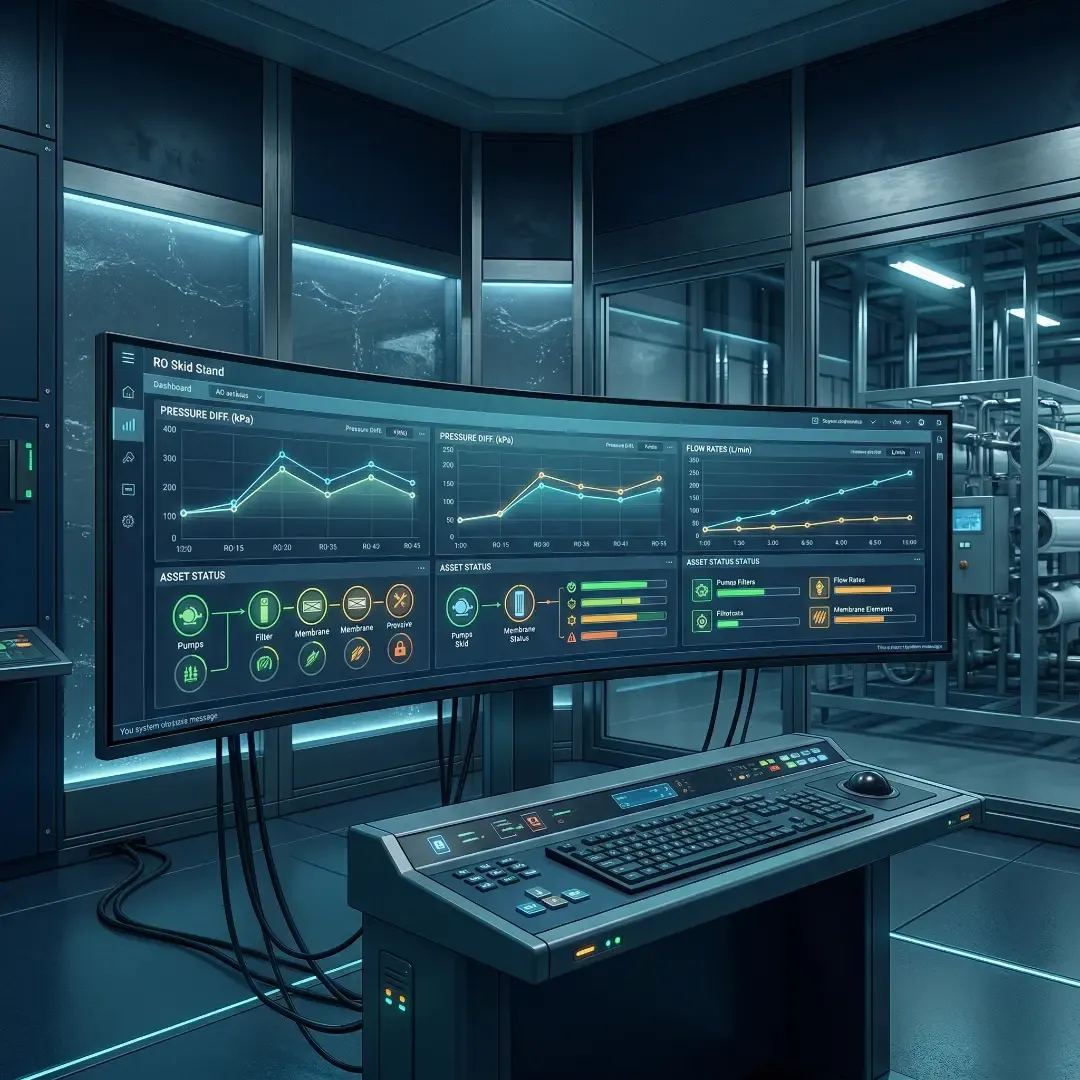
Merjio connects to sensors and controllers embedded in RO skid infrastructure and delivers live operational data, intelligent alerts, and direct control actions through a single centralized dashboard. This gives plant teams not just the visibility but also the operational authority to manage skid performance proactively, from adjusting membrane pressure setpoints to controlling chemical dosing pump output remotely.
Merjio integrates with the sensors and programmable controllers already embedded in most industrial RO skid systems. It captures real-time data on key performance parameters including pressure differentials across membrane stages, flow rates at each treatment zone, pump motor current draw and temperature, and chemical dosing output. All of this flows into a centralized dashboard where plant engineers and facility managers can monitor live conditions, review historical trends, and execute control commands directly. When a reading crosses a safe operating boundary, Merjio's RO skid monitoring system triggers an immediate alert and, where configured, initiates automated control responses to prevent fault escalation. This combination of real-time visibility and responsive control significantly reduces both the detection window and the reaction time for operational faults. Lanware's IoT solutions provide the underlying device connectivity that makes this integrated monitoring and control pipeline possible.
AI-Driven Predictive Maintenance and Intelligent Control
Merjio moves water treatment operations beyond reactive and scheduled maintenance by using AI to learn normal operating patterns, flag deviations that signal impending failure, and support intelligent control decisions that protect high-value skid components. This approach improves output reliability and reduces the cost of unplanned shutdowns across industrial water treatment facilities.
Traditional maintenance schedules are built around time intervals rather than actual asset condition. In water treatment, this often means servicing components that are functioning well while missing others that are quietly degrading. Merjio addresses this with AI-driven predictive maintenance that continuously analyzes operational data from every connected asset. The system builds a behavioral baseline for each component including pump vibration patterns, flow consistency, and sensor response curves. When the AI detects a deviation, it distinguishes between routine operational variation and a pattern that signals a genuine fault. Facility managers receive targeted alerts with context, and the platform can trigger pre-configured control responses such as adjusting flow rates or initiating safe-mode protocols to protect equipment while a maintenance response is being organized. This moves the operation from passive monitoring to active, AI-guided control. The data analytics layer within Merjio powers this intelligence across all connected assets.
Edge-to-Cloud Architecture for Distributed Water Treatment Sites
Merjio's edge-to-cloud design ensures that industrial water treatment monitoring and control remains fast, reliable, and actionable even for remote or multi-site facilities. By processing critical data and executing control logic at the device level, Merjio eliminates the latency limitations that prevent cloud-only solutions from delivering effective real-time control in field environments.
Water and wastewater treatment often takes place at distributed locations, from municipal treatment sites at the edges of populated areas to industrial campuses with multiple ETP or ZLD skid installations. Sending all sensor data to a central cloud before executing control actions introduces latency that can be unacceptable when a high-pressure pump or membrane module is approaching a fault threshold. Merjio solves this through edge computing, where real-time inference and control execution runs locally on the device or gateway, enabling immediate automated responses without waiting for round-trip cloud communication. Aggregated data is then stored and analyzed in a secure cloud environment, giving management teams access to site-wide reporting, cross-asset comparisons, and long-term performance trends. Lanware's cloud technology infrastructure ensures this deployment model remains secure, scalable, and available to control operators across multiple sites.
Key Benefits of Merjio for Water and Wastewater Plant Operations
Merjio delivers measurable operational improvements for water treatment facilities by combining real-time monitoring, intelligent control, AI-driven intelligence, and scalable connected infrastructure. From anomaly detection to centralized asset command, the platform supports every aspect of industrial water treatment monitoring and control.
Deploying Merjio across a water or wastewater treatment facility provides the following operational advantages:
- Real-time monitoring and control of all RO skid components including pumps, membranes, valves, and chemical dosing systems.
- Anomaly detection that distinguishes minor sensor fluctuations from genuine fault conditions, reducing false alarms and alert fatigue.
- Predictive maintenance that extends asset service life and reduces emergency repair costs.
- Remote monitoring and control for multi-site or geographically dispersed treatment plants.
- Automated control responses that protect equipment by triggering safe-mode actions when fault conditions are detected.
- Scalable edge-to-cloud deployment that accommodates modular plant expansions without significant infrastructure changes.
These capabilities directly address the challenges faced by operators running STP, ETP, RO, and ZLD skids across industrial settings. Water treatment is a central operational function in sectors including the manufacturing industry, where effluent treatment, water reuse, and regulatory compliance requirements continue to grow.
Conclusion
Industrial water treatment monitoring and control has moved well beyond the era of manual rounds and periodic checks. As RO skids and treatment systems become more complex and more distributed, the ability to monitor, respond, and actively control operations in real time is a genuine competitive advantage. Merjio provides water and wastewater facilities with AI-driven intelligence, predictive maintenance capability, remote visibility, and direct control authority they need to protect asset health and maintain output quality. If your facility manages RO skid infrastructure or industrial water treatment assets, explore the full capabilities of Merjio and see how integrated monitoring and control intelligence can transform your plant operations.
FAQ
What is an RO skid monitoring and control system?
An RO skid monitoring and control system tracks real-time performance of reverse osmosis skid components and enables direct operational control. Using connected sensors and controllers, it provides continuous data on pressure, flow, and asset health, and allows operators to adjust parameters or trigger automated responses remotely.
How does Merjio support industrial water treatment monitoring and control?
Merjio connects to sensors and controllers within water treatment skids, delivers real-time data to a centralized dashboard, and enables direct control of connected assets. Its AI layer detects anomalies, triggers alerts, and initiates intelligent control responses, giving plant operators proactive command over their industrial water treatment operations.
Why is real-time monitoring and control important for RO skid systems?
RO skid components such as high-pressure pumps and membrane modules can degrade quickly when operating outside normal parameters. Real-time monitoring ensures deviations are caught within minutes, while integrated control allows operators to respond immediately, reducing the risk of treatment failures, quality breaches, and costly unplanned downtime.
Can Merjio monitor and control multiple water treatment sites remotely?
Yes. Merjio's edge-to-cloud architecture is designed for distributed deployments. Operators managing STP, ETP, or RO skids across multiple sites can view all asset data in a unified dashboard, receive site-specific alerts, and execute control commands remotely without being physically present at each location.
What is predictive maintenance in water treatment plants?
Predictive maintenance uses AI and real-time sensor data to identify early signs of component failure before a breakdown occurs. In water treatment, this means monitoring pump performance, membrane condition, and dosing accuracy continuously. This is made possible through embedded and firmware systems that enable deep sensor-level connectivity and control integration across skid components.
How does Merjio's anomaly detection work for RO skids?
Merjio's AI builds a behavioral baseline for each connected asset. When a sensor reading or operational pattern deviates from this baseline, the system determines whether it reflects a normal fluctuation or a genuine fault condition. Plant teams receive targeted alerts, and the platform can initiate automated control actions to protect equipment before the fault escalates.
Is Merjio suitable for decentralized water treatment plants?
Merjio is specifically designed for environments with distributed or modular infrastructure. Its edge computing capability allows real-time monitoring and control processing at the field level, making it well-suited for decentralized STP and ETP skid deployments where connectivity to a central cloud may be intermittent or limited.
What types of water treatment skids can Merjio monitor and control?
Merjio can monitor and control a wide range of water treatment skids including RO and UF skids, MBBR and MBR process skids, chemical dosing skids, sludge dewatering skids, and ZLD systems. Any skid with connected sensors or controllers can be integrated into the Merjio monitoring and control network.
How does edge computing improve water treatment monitoring and control?
Edge computing processes sensor data and executes control logic locally at the device or gateway level, enabling immediate responses without depending on cloud round-trip times. For water treatment, this means faster anomaly responses and automated control actions, even in remote locations with limited or unstable internet connectivity.
Which industries benefit most from Merjio's water treatment monitoring and control capabilities?
Water and wastewater treatment, mining and minerals processing, and industrial manufacturing are among the strongest use cases for Merjio. These industries rely on skid-based treatment infrastructure in demanding environments where uptime, real-time control, compliance, and remote visibility are critical operational priorities.
Related product
Merjio IIoT Platform by Lanware
Any sensor. Any industry. One unified data layer — explore SKID solutions, AI-driven analytics, and live monitoring on the Merjio platform.
Explore merjio.com