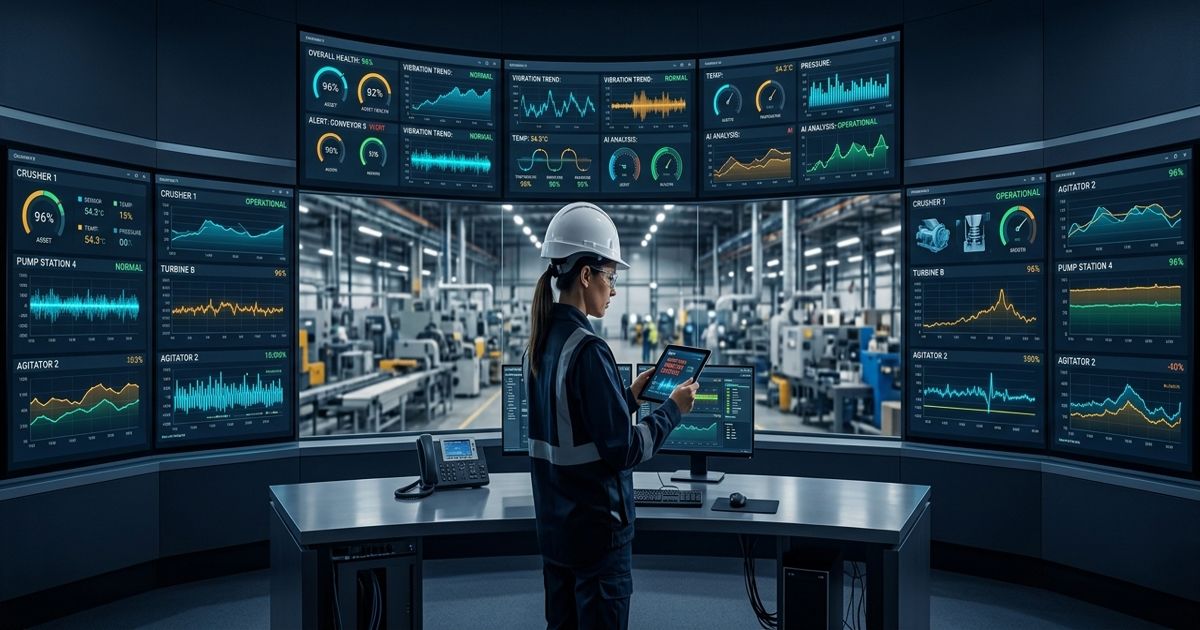
Condition Based Maintenance: A Complete Software Guide
 Author
 Date of Publication
 Category
Condition based maintenance is transforming the way industrial facilities manage their assets. Instead of waiting for equipment to fail or following rigid scheduled maintenance intervals, operations teams can now act on real data. This blog explores how condition-based monitoring software works, why it matters for modern industrial operations, and how platforms like Merjio are making this approach accessible, scalable, and actionable across manufacturing, maritime, and other asset-heavy industries.
Key Takeaways
- Condition based maintenance uses real-time sensor data to trigger maintenance only when equipment shows signs of degradation, reducing unnecessary downtime and costs.
- Condition based monitoring software collects, analyzes, and visualizes asset health data, giving operations teams the intelligence they need to act before failures occur.
- AI-powered platforms like Merjio combine edge computing and cloud analytics to deliver predictive insights, anomaly detection, and centralized asset management at scale.
What Is Condition Based Maintenance?
Condition based maintenance (CBM) is a maintenance strategy that triggers service actions based on the actual condition of an asset rather than a fixed schedule. Sensors continuously monitor parameters like temperature, vibration, pressure, and energy consumption. When readings deviate from normal ranges, the system flags the issue for investigation or intervention.
This approach stands in contrast to traditional scheduled maintenance, where components are replaced at set intervals regardless of their actual wear state. CBM eliminates unnecessary replacements, reduces labor costs, and extends the useful life of industrial assets. It is a core pillar of modern industrial reliability programs and a natural fit for IIoT-enabled facilities.
According to the U.S. Department of Energy, predictive and condition-based maintenance strategies can reduce maintenance costs by 25 to 30 percent compared to reactive approaches, while cutting unplanned downtime significantly.
How Condition Based Monitoring Software Works
At its core, condition based monitoring software connects to sensors and data acquisition devices installed on industrial equipment. It collects continuous streams of operational data and applies analytical models to detect patterns that indicate potential failure or performance degradation.
The key functional layers of a modern CBM platform include the following:
- Data ingestion: Real-time collection from sensors tracking vibration, temperature, pressure, flow rate, and electrical parameters.
- Edge processing: Local computation at the device level to filter noise, reduce latency, and enable real-time inference without relying solely on cloud connectivity.
- Anomaly detection: AI algorithms that distinguish between normal operational variation and signals that indicate a developing fault.
- Alerting and notifications: Automated alerts sent to maintenance teams when thresholds are breached or anomalies are detected.
- Reporting and dashboards: Visual interfaces that give facility managers a clear view of asset health across their entire operation.
Platforms built on an edge-to-cloud architecture are particularly well suited for industrial environments where connectivity may be intermittent and real-time response is critical. The edge layer processes data locally for immediate action, while the cloud layer aggregates data for long-term trend analysis and AI model training.
Condition Based Maintenance vs. Preventive and Reactive Maintenance
Understanding the differences between maintenance strategies helps operations leaders make the right investment decisions. Here is a comparison of the three main approaches:
- Reactive maintenance: Fix it when it breaks. Low upfront cost but high risk of unplanned downtime, collateral damage, and safety incidents.
- Preventive maintenance: Service assets on a fixed schedule. Reduces unexpected failures but often leads to over-maintenance and unnecessary part replacements.
- Condition based maintenance: Service assets based on actual condition data. Optimizes maintenance timing, extends asset life, and reduces both over-maintenance and unplanned failures.
The shift from preventive to condition based maintenance is a central goal for industrial digital transformation programs. Organizations that have adopted IIoT monitoring report measurable improvements in equipment availability, maintenance labor efficiency, and overall production throughput. Explore how smart plant monitoring and automation enables this transition in real-world industrial settings.
Key Features to Look for in Condition Based Monitoring Software
Not all condition based monitoring software platforms are created equal. When evaluating solutions, operations managers and engineering teams should prioritize the following capabilities:
Real-Time Asset Health Monitoring
The platform should provide live visibility into equipment status across all monitored assets. This includes dashboards that update continuously and support drill-down views for individual machines or process lines. Real-time monitoring enables teams to respond to developing issues before they escalate into failures.
AI-Driven Anomaly Detection for Condition Based Maintenance
Advanced platforms use machine learning models to establish baselines for normal equipment behavior and automatically flag deviations. The AI layer should be capable of distinguishing between benign operational variations and genuine fault signatures. This reduces false alarms and ensures maintenance teams focus their attention where it is actually needed. Merjio's anomaly detection engine, for example, continuously analyzes sensor data and alerts facility managers to potential issues in real time, with the AI specifically trained to separate normal variation from critical problems.
Predictive Maintenance Intelligence
Beyond detecting current anomalies, a strong condition based monitoring software platform should provide forward-looking predictions. By analyzing historical data and trend trajectories, the system can estimate remaining useful life (RUL) for critical components and recommend proactive interventions. This moves maintenance from a reactive or scheduled posture to a truly predictive one. Learn how industrial manufacturing monitoring delivers measurable value through predictive insights.
Centralized Device and Asset Management
For organizations managing assets across multiple sites or facilities, centralized management is essential. The software should support a unified view of all connected devices, with the ability to configure monitoring parameters, update firmware, and manage alarms from a single interface. This reduces the operational overhead of managing distributed IoT deployments and improves consistency of monitoring coverage.
Condition Based Monitoring Integrated Reporting and Compliance
Maintenance records, alert histories, and performance trends should be automatically captured and made available for reporting. This supports both internal performance reviews and external compliance requirements. Configurable reports that align with operational KPIs give managers the data they need to justify maintenance investments and demonstrate continuous improvement.
Merjio: An AI-Powered Platform for Condition Based Maintenance
Merjio is an AI-powered Industrial IoT platform developed by Lanware Solutions for real-time monitoring, intelligent control, and predictive maintenance of industrial assets. It is built around three core principles: Simplicity, Scalability, and Security.
The platform uses an edge-to-cloud architecture that enables real-time device inference at the edge while leveraging cloud AI for deeper analytics and trend modeling. This design is well suited for industrial environments where low latency and continuous uptime are non-negotiable requirements.
Merjio supports condition based maintenance through several integrated capabilities. Its anomaly detection layer monitors assets continuously and alerts facility managers to potential issues before they result in failures. Its AI-driven predictive maintenance engine helps organizations move away from scheduled service intervals toward data-driven maintenance decisions. Centralized device management gives operations teams full visibility and control across all connected assets.
The platform also aligns with Industry 5.0 goals, including worker safety improvement, energy optimization, and human-machine collaboration. This makes it relevant not just as a maintenance tool but as a broader operational intelligence platform. See how Merjio has been applied to centralized data aggregation in manufacturing IoT environments to understand its practical impact.
Industry Applications of Condition Based Monitoring Software
Condition based monitoring software is applicable across a wide range of industrial sectors. Here are some of the most common use cases:
- Manufacturing: Monitoring CNC machines, conveyors, compressors, and motors for vibration, temperature, and electrical anomalies to prevent unplanned production stoppages.
- Maritime: Tracking engine performance, pump conditions, and hull sensor data on vessels to support predictive servicing and reduce port downtime.
- Water treatment: Monitoring pumps, filtration systems, and chemical dosing equipment to ensure process integrity and regulatory compliance. Explore how IoT monitoring for water treatment skids addresses these challenges in practice.
- Telecommunications: Tracking power systems, cooling units, and network hardware at remote sites to prevent service disruptions.
- Vending and distributed assets: Centralized monitoring of vending machines or cloud kitchen equipment across hundreds of locations for proactive servicing.
How to Implement Condition Based Maintenance in Your Facility
Implementing a successful condition based maintenance program requires more than just installing sensors. Here is a practical framework for getting started:
- Identify critical assets: Prioritize equipment where failure would have the greatest impact on production, safety, or cost.
- Define monitoring parameters: Select the sensor types and data points that are most predictive of failure for each asset class.
- Choose a scalable software platform: Select a condition based monitoring software solution that supports your current asset count and can scale as your program grows.
- Establish baselines and thresholds: Work with engineers to define normal operating ranges and set alert thresholds that balance sensitivity with false alarm rates.
- Integrate with maintenance workflows: Ensure that alerts and work orders flow into your maintenance management processes so that detected issues are acted upon promptly.
- Review and iterate: Use reporting data to refine thresholds, improve models, and expand monitoring coverage over time.
According to McKinsey and Company, industrial companies that adopt data-driven maintenance strategies can reduce equipment failures by up to 70 percent and lower maintenance costs by 10 to 25 percent. The key is starting with a clear scope and a platform that makes data actionable from day one.
Conclusion
Condition based maintenance is no longer an advanced concept reserved for large enterprises with deep engineering resources. With modern condition based monitoring software, organizations of all sizes can deploy sensor-driven monitoring, AI-powered anomaly detection, and predictive maintenance intelligence at scale. Platforms like Merjio bring together edge computing, cloud analytics, and centralized asset management into a single, accessible solution. If your facility is ready to move from scheduled or reactive maintenance toward a smarter, data-driven approach, exploring an AI-powered IIoT platform is the right next step. Visit the Merjio product page to learn how the platform supports condition based maintenance across industrial environments.
FAQ
Q1: What is condition based maintenance and how does it differ from preventive maintenance?
Answer: Condition based maintenance triggers service actions based on real-time asset health data, while preventive maintenance follows fixed schedules. CBM reduces unnecessary servicing and helps teams intervene only when sensor data indicates actual degradation, making it more cost-effective and operationally efficient for industrial facilities.
Q2: What types of sensors are used in condition based monitoring software?
Answer: Common sensors include vibration accelerometers, temperature probes, pressure transducers, flow meters, and current transformers. These devices collect continuous operational data that condition based monitoring software analyzes to detect deviations from normal performance baselines and trigger alerts for maintenance teams.
Q3: How does AI improve condition based maintenance outcomes?
Answer: AI models analyze historical and real-time sensor data to identify patterns associated with developing faults. This enables platforms to distinguish normal operational variation from genuine fault signatures, reduce false alarms, estimate remaining useful life of components, and recommend proactive interventions before failures occur.
Q4: Can condition based monitoring software be used across multiple industrial sites?
Answer: Yes. Modern platforms support centralized management of assets distributed across multiple facilities. A unified dashboard provides visibility into all connected equipment, and alerts can be configured site-specifically. This is especially valuable for organizations managing large distributed asset portfolios such as manufacturing plants or remote telecom infrastructure.
Q5: What industries benefit most from condition based monitoring software?
Answer: Manufacturing, maritime, water treatment, telecommunications, and distributed asset operations like vending machine fleets all benefit significantly. Any industry where unplanned equipment failure carries high costs or safety risks is a strong candidate for adopting condition based maintenance as a core reliability strategy. Learn how smart factory automation and IoT monitoring delivers these benefits in manufacturing.
Q6: What is edge-to-cloud architecture in the context of condition based monitoring?
Answer: Edge-to-cloud architecture processes sensor data locally at the device level for low-latency real-time response, while sending aggregated data to the cloud for deeper AI analysis and long-term trend modeling. This dual-layer approach ensures continuous monitoring even in environments with intermittent connectivity.
Q7: How long does it take to implement a condition based maintenance program?
Answer: Implementation timelines vary by asset complexity and scope. A focused pilot covering critical equipment can be operational within a few weeks. Full deployment across a large facility typically takes several months and involves sensor installation, baseline establishment, alert configuration, and integration with existing maintenance workflows.
Q8: What is anomaly detection and why is it important for condition based maintenance?
Answer: Anomaly detection uses AI to identify sensor readings that deviate from established normal operating patterns. It is critical because it enables early warning of developing faults, reduces reliance on manual inspection, and allows maintenance teams to prioritize interventions based on actual risk rather than scheduled intervals or visual inspections.
Q9: How does condition based monitoring software support worker safety?
Answer: By detecting equipment faults before they escalate into failures, condition based monitoring software reduces the risk of sudden breakdowns that can injure nearby workers. Real-time alerts also allow safety teams to respond quickly to dangerous operating conditions. Explore how IoT solutions are reshaping industrial safety and operations across sectors.
Q10: What should organizations look for when selecting condition based monitoring software?
Answer: Key criteria include real-time monitoring capabilities, AI-powered anomaly detection, edge-to-cloud architecture, centralized asset management, scalability across sites, integrated reporting, and ease of integration with existing maintenance workflows. Security, vendor support, and the ability to customize alert thresholds are also important evaluation factors for industrial deployments.
Related product
Merjio IIoT Platform by Lanware
Any sensor. Any industry. One unified data layer — explore SKID solutions, AI-driven analytics, and live monitoring on the Merjio platform.
Explore merjio.com