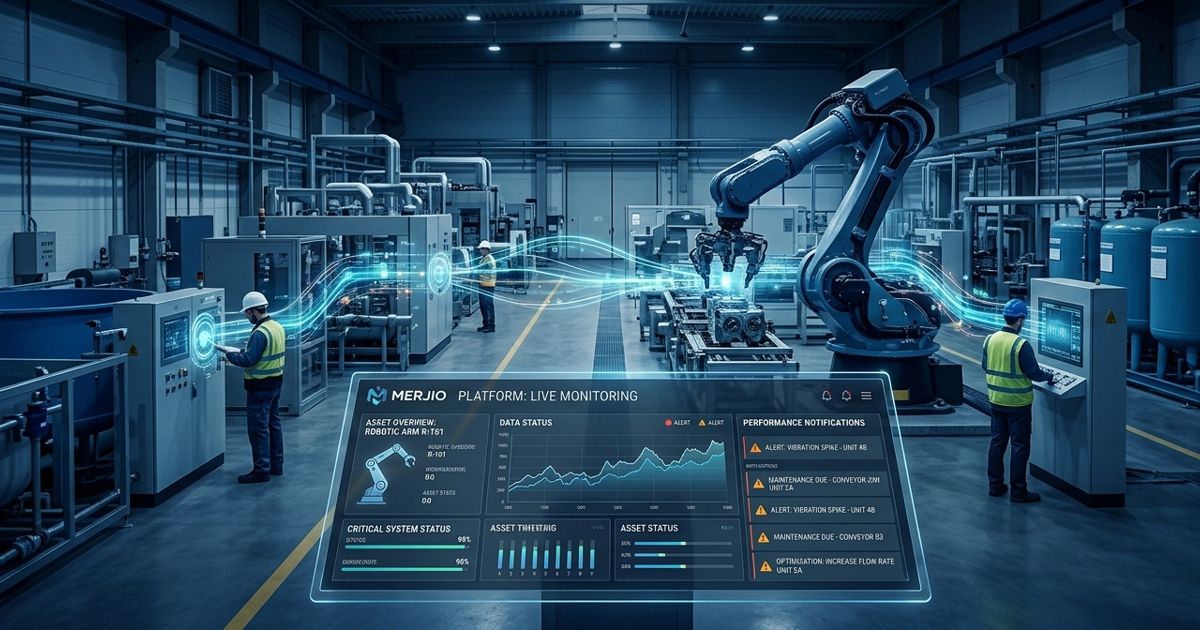
Merjio: The Industrial IoT Platform for Smart Factories
 Author
 Date of Publication
 Category
Merjio: The Industrial IoT Platform Redefining Smart Factory Automation
Industrial operations are under more pressure than ever. Plant managers, operations heads, and engineering teams are expected to reduce downtime, cut costs, and maintain safety standards across complex, distributed assets. The Merjio Industrial IoT platform was built to address exactly these challenges. Developed by Lanware Solutions, Merjio is an AI-powered platform that delivers real-time monitoring, intelligent control, and predictive maintenance for industrial assets. This blog walks through how Merjio works, who it serves, where it delivers the greatest ROI, and why it is one of the most practical smart factory automation solutions available today.
Key Takeaways
- Merjio is an AI-powered Industrial IoT platform that combines edge computing with cloud intelligence to deliver real-time operational visibility and control.
- The platform supports smart factory automation solutions including predictive maintenance, anomaly detection, and centralized device management across multiple sites.
- Merjio's RO Skid Monitoring System capabilities demonstrate its ability to handle complex industrial process monitoring at the edge.
- Built on principles of Simplicity, Scalability, and Security, Merjio is designed to serve manufacturers, maritime operators, and other industrial organizations globally.
- Organizations deploying Merjio gain measurable ROI through reduced downtime, lower maintenance costs, and improved operational throughput.
What Is Merjio and How Does It Work?
Merjio is positioned as a Connected Asset Monitoring and Control Platform with an edge-to-cloud architecture. This means the platform processes real-time data directly at the device level using edge computing, while simultaneously aggregating and analyzing that data in the cloud using AWS and Azure infrastructure.
The edge layer handles fast, localized decisions. The cloud layer handles deep analytics, AI-driven predictions, and centralized reporting. Together, they give industrial teams a complete picture of what is happening across every connected asset at any given moment.
This architecture is especially valuable in environments where network latency could delay critical decisions. For example, in a water treatment facility monitoring an RO Skid Monitoring System, milliseconds matter. Merjio's edge processing ensures that alerts and control actions happen immediately, without waiting for cloud round-trips. You can explore how this works in practice in the blog on IoT monitoring and control for water treatment skids.
The platform supports multiple devices and multiple customer environments simultaneously. Its centralized device management layer gives operations teams enhanced visibility and control over their entire asset portfolio from a single interface. This means a regional operations director can oversee assets across five plants in three countries from the same dashboard, without switching systems or consolidating manual reports.
Core Capabilities That Drive Smart Factory Automation
Merjio is more than a monitoring tool. It is a full operational intelligence platform. The following capabilities make it one of the most complete smart factory automation solutions on the market today.
Real-Time Monitoring and Intelligent Control
Real-time visibility into industrial operations is the foundation of effective plant management. Merjio provides live monitoring of every connected asset, giving operations teams instant access to performance data, sensor readings, and process status. But Merjio goes beyond passive monitoring. It enables intelligent control, allowing remote commands and automated responses to be triggered based on real-time conditions.
This moves plant management from reactive troubleshooting to proactive operational governance. For industrial manufacturers running continuous processes, this level of control directly reduces unplanned downtime and improves throughput. Consider a scenario where a conveyor motor begins drawing abnormal current levels at 2 AM. A traditional system logs the data. Merjio detects the deviation, assesses severity, and triggers an alert before the motor fails and halts an entire production line. That single intervention can save tens of thousands of dollars in lost production and emergency repairs.
AI-Driven Predictive Maintenance
One of the most impactful capabilities Merjio offers is AI-driven predictive maintenance. Traditional maintenance models rely on fixed schedules or reactive repairs, both of which are inefficient. Merjio's AI analyzes operational data continuously to identify patterns that signal potential equipment failures before they occur.
This allows maintenance teams to act at the right time, rather than too early or too late. The result is fewer emergency shutdowns, lower maintenance costs, and longer asset lifespans. According to McKinsey and Company, predictive maintenance can reduce machine downtime by up to 50% and extend equipment life by years. Merjio brings this capability to industrial operations of all sizes.
What makes this particularly compelling is that the AI models continue improving as more operational data is ingested. A facility that deploys Merjio today will have more accurate maintenance predictions in six months than on day one. This compounding accuracy makes the long-term ROI case for Merjio especially strong compared to static threshold-based systems.
Anomaly Detection with AI Intelligence
Industrial environments generate enormous volumes of operational data. Not every deviation from normal is a problem, but every real problem starts as a deviation. Merjio's anomaly detection engine uses AI to distinguish between normal variation and patterns that require urgent attention.
When a genuine anomaly is detected, the platform automatically alerts facility managers in real time. This removes the cognitive burden of manually monitoring sensor feeds and ensures that critical issues are never missed. The AI is trained to avoid false positives, meaning operations teams receive actionable alerts rather than noise. This is a significant advantage over threshold-based alerting systems that either miss issues or overwhelm teams with irrelevant warnings.
In high-throughput environments such as food processing or pharmaceutical manufacturing, this distinction is critical. A false alarm that triggers an unnecessary shutdown can cost more than the failure it was meant to prevent. Merjio's AI-driven approach ensures that alerts carry genuine signal value, enabling teams to act with confidence rather than second-guessing every notification.
RO Skid Monitoring and Industrial Process Control
The RO Skid Monitoring System is one of the clearest examples of Merjio's ability to handle complex, safety-critical industrial processes. Reverse osmosis systems used in water treatment require continuous monitoring of pressure, flow rate, conductivity, and temperature. Any deviation can indicate membrane fouling, pump failure, or chemical imbalance.
Merjio's edge-to-cloud architecture enables real-time data acquisition from RO skid sensors, with AI-powered analysis running at the edge to detect issues instantly. Control commands can be sent remotely, and historical performance data feeds into predictive models that anticipate maintenance needs. This same architecture applies across other industrial process equipment, making Merjio a versatile solution for process-heavy industries. To see how this translates into mining and other demanding environments, read more about Merjio as the industrial IoT backbone built for mining.
Industry 5.0 Alignment: Beyond Automation to Human-Centric Operations
Merjio is designed with Industry 5.0 principles at its core. While Industry 4.0 focused on automation and connectivity, Industry 5.0 adds a human-centric dimension. It prioritizes worker safety, sustainability, resilience, and collaboration between humans and AI systems. Merjio supports each of these outcomes directly.
- Worker safety: Real-time alerts and remote monitoring reduce the need for personnel to be physically present in hazardous environments.
- Energy optimization: AI-driven analytics identify energy waste and enable more efficient operations, supporting sustainability goals.
- Human-machine collaboration: Merjio provides AI guidance and recommendations rather than simply replacing human judgment.
- Traceability and compliance: Centralized data aggregation ensures that every asset action is logged and auditable.
- Resilience: Early warning systems and predictive models allow industrial operations to absorb disruptions without catastrophic failures.
This alignment with Industry 5.0 makes Merjio particularly relevant for organizations that are not just seeking efficiency gains but are also building more responsible, sustainable industrial operations. For a broader perspective on how IoT technologies are reshaping industrial sectors, the blog on the limitless horizons of IoT solutions in the era of digital disruption provides valuable context.
Merjio vs. Legacy Monitoring Approaches: Why the Difference Matters
Many industrial facilities still rely on legacy monitoring systems built around SCADA platforms, manual inspection cycles, and fixed threshold alarms. These approaches were effective for their era, but they are increasingly inadequate for modern operational demands. Understanding the gap between legacy approaches and what Merjio offers is important for any organization evaluating an upgrade.
Legacy SCADA systems typically operate in isolation, gathering data from specific equipment without integrating that data into a broader operational picture. They require on-site access for updates, lack machine learning capabilities, and generate static reports that reflect what happened rather than what is about to happen. When something goes wrong, maintenance teams must investigate manually, often discovering the problem only after it has already caused disruption.
Merjio operates on a fundamentally different model. Its edge-to-cloud architecture means data is collected, processed, and acted upon continuously and automatically. AI models run against live data streams, identifying degradation patterns that no human operator could consistently spot across hundreds of simultaneous sensor feeds. Control actions can be triggered remotely, reducing the need for on-site personnel to respond to every alert.
The practical outcome of this difference is measurable. Organizations transitioning from legacy monitoring to Merjio typically report faster mean time to detect (MTTD) and mean time to respond (MTTR), fewer emergency maintenance events, better energy efficiency, and improved compliance documentation. For operations leaders evaluating where to invest their digital transformation budget, this contrast makes the ROI case for Merjio straightforward.
The Business Case and ROI for Deploying Merjio
The business case for an Industrial IoT platform like Merjio is strongest when measured across three dimensions: downtime reduction, maintenance cost savings, and operational efficiency gains.
Unplanned downtime is one of the most expensive challenges in industrial operations. Industry estimates suggest that unplanned downtime costs manufacturers an average of several hundred thousand dollars per hour in heavy industries. Even in smaller operations, a single unexpected equipment failure that halts production for several hours can eliminate weeks of margin. Merjio's predictive maintenance and real-time anomaly detection directly address this cost by catching failures before they cause shutdowns.
Maintenance cost savings come from two sources: avoiding emergency repairs and optimizing scheduled maintenance. Emergency repairs are expensive not just because of parts and labor, but because of the disruption they cause to production schedules. Optimized maintenance, driven by Merjio's AI predictions, means maintenance teams work on assets when they genuinely need attention rather than on arbitrary calendar intervals. This extends equipment lifespans and reduces total maintenance spend.
Operational efficiency gains compound over time. As Merjio's AI models become more accurate with accumulated data, the quality of operational insights improves. Energy consumption data enables cost reduction initiatives. Production throughput data informs capacity planning. Asset utilization data supports capital expenditure decisions. These insights transform Merjio from a monitoring tool into a strategic asset for operations leadership.
Lanware Solutions also offers complementary consulting services to help organizations build a clear ROI model for their IIoT investment and ensure that Merjio is deployed in a way that maximizes business impact from day one.
Who Should Consider Merjio?
Merjio is built for organizations that manage complex, distributed industrial assets and need more than basic monitoring. The platform is particularly well suited for the following profiles.
Manufacturing Operations Teams
Plant managers and production heads in manufacturing face constant pressure to maximize uptime while controlling costs. Merjio provides the real-time visibility and intelligent control they need to achieve both goals. The platform's centralized device management layer is especially valuable for manufacturers with multiple production lines or facilities. Whether the operation runs discrete manufacturing or continuous process production, Merjio adapts to the operational model.
OEMs with IoT-Enabled Machines
Original Equipment Manufacturers who embed sensors in their products can use Merjio to offer remote monitoring and predictive maintenance as a value-added service. This transforms a traditional product sale into an ongoing service relationship, improving customer retention and creating new recurring revenue streams. OEMs in sectors such as industrial HVAC, pumping systems, and automated machinery are particularly well positioned to leverage this capability.
Facilities with Safety-Critical Processes
Water treatment plants, chemical processing facilities, and other operations where process integrity is non-negotiable benefit greatly from Merjio's real-time monitoring, anomaly detection, and remote control capabilities. The platform ensures that deviations from safe operating parameters are caught and addressed immediately. The cost of a safety incident in these environments far exceeds any investment in preventive monitoring technology.
Organizations Pursuing Digital Transformation
For COOs, CTOs, and digital transformation leaders who are evaluating how to modernize their industrial operations, Merjio offers a clear path from legacy manual processes to AI-driven, connected operations. The platform is designed to integrate into existing environments without requiring wholesale infrastructure replacement. This makes it accessible to organizations at different stages of their digital maturity.
Step-by-Step Deployment: What to Expect When Implementing Merjio
For operations leaders considering Merjio, understanding the deployment journey is important for planning and setting internal expectations. The process follows a structured, phased approach that prioritizes speed to value without sacrificing implementation quality.
The first phase is asset discovery and connectivity. Lanware's team works with the organization to map existing industrial assets, identify sensor types and communication protocols, and define the data points that matter most for the operation. This phase establishes the technical foundation for the deployment and typically takes between two and four weeks depending on asset complexity.
The second phase is edge infrastructure setup. Edge devices are configured and installed at the facility level, connecting to existing sensors and control systems. Merjio's edge layer is designed to work with a wide range of industrial protocols, minimizing the need for equipment replacement. The edge devices begin collecting and processing data locally from day one.
The third phase is cloud integration and dashboard configuration. Operational data flows from the edge layer into the Merjio cloud environment, where it is aggregated, stored, and made available through the platform's reporting and visualization layer. Dashboards are configured to reflect the specific KPIs and alert thresholds relevant to the organization's operations.
The fourth phase is AI model training and calibration. Merjio's anomaly detection and predictive maintenance models are calibrated against the organization's historical operational data. Initial models are deployed and refined during a monitored period where the AI learning is validated against known operational patterns.
The fifth phase is team enablement and go-live. Operations teams receive training on the Merjio interface, alert management, and reporting tools. The platform goes live, with Lanware providing ongoing support during the initial operational period to ensure a smooth transition.
Organizations that have explored Merjio's edge AI capabilities in water treatment and mining contexts have reported faster anomaly response times and improved maintenance planning after following this structured deployment approach. For a detailed look at real-world outcomes, review the blog on Merjio Edge AI built for water treatment and mining sites.
The Technology Stack Behind Merjio
Merjio is built on a modern, enterprise-grade technology stack that supports scalability and reliability. The platform uses Flutter for cross-platform interfaces, AWS and Azure for cloud infrastructure, Spring Boot and Java for backend services, React and ASP.NET for frontend development, Snowflake for data warehousing, and Python for AI and machine learning workloads.
This breadth of technology ensures that Merjio can scale from a single facility to a global multi-site deployment without architectural constraints. MySQL provides reliable relational data management, while Jenkins supports continuous integration and deployment pipelines. The result is a platform that is both technically robust and operationally agile. Lanware Solutions' broader expertise in enterprise application development underpins the engineering quality of the Merjio platform, ensuring that the codebase evolves with the latest enterprise standards and security requirements.
Conclusion: A Platform Built for the Industrial Operations of Tomorrow
The demands placed on industrial operations are only going to increase. Asset complexity is growing, safety standards are tightening, and the cost of unplanned downtime is rising. The Industrial IoT platform that can address these pressures simultaneously while remaining practical to deploy and operate will define the next era of industrial productivity.
Merjio is that platform. With its AI-powered predictive maintenance, real-time anomaly detection, intelligent control, and edge-to-cloud architecture, Merjio gives industrial teams the tools they need to operate with confidence. Whether you are managing a water treatment facility, a manufacturing plant, or a distributed fleet of industrial assets, Merjio is designed to help you run smarter, safer, and more efficiently.
The combination of measurable ROI, rapid deployment, and continuous AI improvement makes Merjio one of the most compelling IIoT investments available to industrial operations leaders today. Organizations that act now gain not just a monitoring platform but a compounding operational advantage that deepens with every day of deployment. To learn more about what Merjio can do for your operations, visit the Merjio product page and take the first step toward connected industrial operations.
FAQ
Q1: What is Merjio and what does it do?
Answer: Merjio is an AI-powered Industrial IoT platform developed by Lanware Solutions. It provides real-time monitoring, intelligent control, and AI-driven predictive maintenance for industrial assets using an edge-to-cloud architecture that supports multi-site deployments.
Q2: How does Merjio support smart factory automation?
Answer: Merjio supports smart factory automation by enabling real-time asset monitoring, remote control, anomaly detection, and AI-driven predictive maintenance. These capabilities help manufacturing teams reduce downtime, optimize energy use, and improve overall production efficiency across complex industrial environments.
Q3: What industries can use the Merjio platform?
Answer: Merjio is designed for manufacturing, maritime, telecommunications, water treatment, and vending operations. Its flexible edge-to-cloud architecture makes it suitable for any industry managing distributed industrial assets that require continuous monitoring, intelligent control, and AI-powered operational insights.
Q4: What is an RO Skid Monitoring System and how does Merjio support it?
Answer: An RO Skid Monitoring System tracks pressure, flow, and water quality in reverse osmosis processes. Merjio's edge AI processes sensor data in real time, detecting anomalies instantly and enabling remote control to maintain safe and efficient water treatment operations without requiring on-site personnel.
Q5: How does Merjio's predictive maintenance differ from traditional maintenance?
Answer: Traditional maintenance follows fixed schedules or reactive repairs. Merjio's AI analyzes continuous operational data to predict failures before they happen, allowing teams to act at the right time. This reduces unnecessary maintenance costs, extends equipment life, and significantly lowers unplanned downtime across industrial facilities.
Q6: What is edge-to-cloud architecture and why does it matter for IIoT?
Answer: Edge-to-cloud architecture processes data locally at the device level for immediate decisions, while the cloud handles deep analytics. This approach is explained well in the context of why edge AI is the future of industrial operations, reducing latency and improving real-time responsiveness.
Q7: Can Merjio manage multiple industrial sites from one platform?
Answer: Yes. Merjio includes centralized device management that supports multiple assets and multiple customer environments simultaneously. Operations teams can monitor and control equipment across different sites from a single unified interface, improving coordination and reducing the need for on-site personnel at each location.
Q8: How does Merjio's anomaly detection system work?
Answer: Merjio's AI continuously analyzes operational data to identify patterns that deviate from normal behavior. It distinguishes between routine variation and genuine problems, then automatically alerts facility managers. This reduces false positives and ensures critical issues are addressed before they escalate into costly equipment failures or production shutdowns.
Q9: Is Merjio aligned with Industry 5.0 principles?
Answer: Yes. Merjio supports Industry 5.0 outcomes including worker safety, energy optimization, human-machine collaboration, and operational resilience. Businesses exploring how asset management systems streamline industrial operations will find Merjio directly aligned with sustainable and human-centric industrial goals.
Q10: What technology stack powers the Merjio platform?
Answer: Merjio is built on Flutter, AWS, Azure, Spring Boot, Java, React, Python, Snowflake, and MySQL. This enterprise-grade stack ensures the platform is scalable, reliable, and capable of supporting complex industrial deployments from a single facility to large global multi-site operations.
Related product
Merjio IIoT Platform by Lanware
Any sensor. Any industry. One unified data layer — explore SKID solutions, AI-driven analytics, and live monitoring on the Merjio platform.
Explore merjio.com