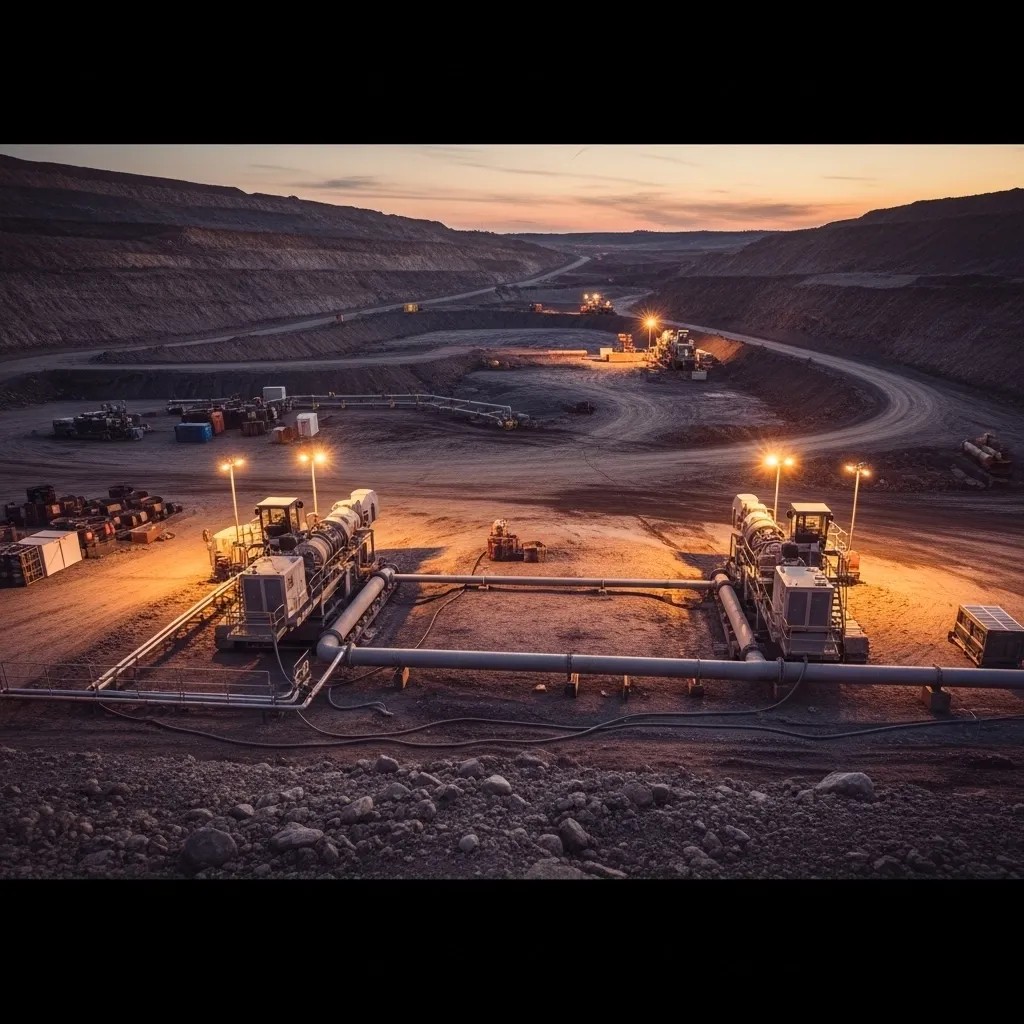
Merjio: The Industrial IoT Backbone Built for Mining
 Author
 Date of Publication
 Category
Introduction
A pump failure on a remote mining site doesn't just stop one machine. It can halt an entire production line for hours or days. Yet most operations still rely on scheduled maintenance schedules or manual walkthroughs that miss early warning signs entirely. Merjio, Lanware Solutions' Asset monitoring,control platform and Industrial Operational Intelligence Platform,is built to close that gap. By combining edge computing with generative AI, Merjio delivers continuous, real-time data anomaly detection across distributed industrial assets —so mining and water treatment teams can act before a deviation becomes a disaster.
Key Takeaways
- Merjio is not a monitoring dashboard. It is a universal industrial IoT backbone that combines device lifecycle management, remote asset control and orchestration, and a multi-layer AI stack purpose-built for harsh, distributed industrial environments like mining and water treatment.
- The core operating model is detect → decide → act. Merjio doesn't stop at flagging a data anomaly. It enables automated escalation workflows, device-level commands, remote configuration updates, OTA firmware pushes, remote scheduling, and fleet-wide rule configuration all without requiring a technician on-site.
- The AI stack behind Merjio goes well beyond anomaly detection — covering predictive maintenance, Remaining Useful Life (RUL) estimation, failure forecasting, efficiency optimization, and AI-based recommendations, with edge inference and agentic AI capabilities on the roadmap.
Why Mining Operations Need More Than Basic Anomaly Monitoring
Mining environments push equipment past its limits around the clock and the consequences of failure are never limited to a single asset.
Slurry pumping skids, dewatering systems, reagent dosing units, and flotation thickeners operate under extreme mechanical stress in remote locations, often with no full-time technician available. Vibration patterns shift. Pressure readings drift. Motor temperatures creep upward. Under a traditional inspection model, none of these changes surface until something breaks. Even basic anomaly alerting which flags a deviation but triggers no follow-on action still leaves the resolution gap wide open.
This is where the depth of Merjio's AI stack becomes the differentiator. Rather than running a single detection model, Merjio applies a layered intelligence framework across every connected asset. According to a McKinsey analysis on industrial digitization, AI-driven predictive maintenance can reduce machine downtime by up to 50% and extend asset lifespan by 20 to 40%. For mining companies managing dozens of skids across multiple sites, that depth of intelligence is what creates measurable operational gains.
Merjio's AI stack applied across mining and water treatment assets:
- Anomaly detection — real-time deviation flagging across temperature, vibration, pressure, and flow
- Predictive maintenance — failure risk scoring based on live and historical sensor data
- Remaining Useful Life (RUL) estimation — calculates how long a component can operate before service is required
- Failure forecasting — projects the probability and timeline of specific failure modes
- Efficiency optimization — identifies operating conditions that reduce energy use or extend component life
- AI-based recommendations — surfaces prioritized, actionable maintenance guidance for operators
- Agentic AI (roadmap) — autonomous decision-making and task execution without human trigger
- Edge inference potential — runs AI models locally on the device, independent of cloud connectivity
Merjio: IoT Backbone, Device Lifecycle, and Remote Orchestration
Merjio is not a sensor dashboard or a standalone alert engine. It is the industrial IoT backbone that connects, manages, and controls every asset across a distributed operation from the moment a device is provisioned to the end of its operational life.
Merjio's Industrial IoT platform uses edge computing to process sensor data close to the source, minimizing latency and ensuring decisions happen fast even when connectivity is limited. But what separates Merjio from a conventional monitoring platform is the control layer on top of data collection. Operators can push remote configuration updates, issue device-level commands, manage OTA firmware updates, and apply fleet-wide rule changes all without dispatching a technician to a remote mining site. The platform also integrates with enterprise systems, allowing anomaly events and maintenance workflows to flow directly into existing operational infrastructure.
Core platform capabilities:
- 360-degree asset visibility across all connected skid equipment and distributed sites
- Device lifecycle management from provisioning through decommissioning
- Remote configuration updates and fleet-wide rule deployment
- Device-level command execution without on-site intervention
- OTA firmware and software updates pushed across connected assets
- Automated escalation workflows triggered by anomaly or threshold events
- Enterprise system integration connecting Merjio events to existing operational platforms
- Remote scheduling of maintenance tasks and operational adjustments
Beyond Detection: From Insight to Automated Action
Detecting an anomaly is only the first step. What happens in the minutes after detection determines whether a deviation becomes a recorded event or an unplanned shutdown.
Most monitoring platforms stop at the alert. Merjio closes the loop. When a data anomaly is detected on a dewatering skid at a remote mining site, the platform doesn't wait for a human to read a notification and manually decide what to do. It can automatically trigger an escalation workflow, route the alert to the right team or system, and execute a device-level command to adjust operating parameters while a technician is dispatched. For fleet-wide issues, rules can be updated simultaneously across all connected assets from a single central interface.
Consider a reagent dosing skid where flow rate drops below its established threshold. Merjio's anomaly detection identifies the deviation. Its failure forecasting model estimates the probability of a full pump failure within the next 48 hours. An AI-based recommendation surfaces the most likely root cause and the suggested corrective action. An escalation workflow routes the case to a maintenance supervisor. A remote scheduling entry is created for the next available service window. All of this happens within the platform without a single manual step between detection and resolution. With the support of data analytics and Industrial IoT infrastructure, the detect → decide → act cycle completes in minutes, not days.
Merjio for Water and Wastewater Treatment Operations
Beyond mining, Merjio's anomaly detection capabilities bring the same operational advantage to water and wastewater treatment plants, where skid-based equipment faces near-identical reliability demands.
Water treatment facilities rely on STP and ETP skids, MBBR and MBR process skids, sludge dewatering systems, RO and ZLD skids, and chemical dosing units. These assets operate under continuous load in decentralized plants with limited on-site staffing. A malfunction in a chemical dosing skid can compromise treatment output across a full facility. An anomaly in a sludge dewatering system can back up an entire processing chain.
Merjio's data analytics layer processes sensor streams from all of these asset types and applies the same anomaly detection logic that protects mining equipment. Operators gain a unified, real-time view of all skid equipment, whether it runs across one plant or multiple decentralized facilities. This is exactly the kind of continuous intelligence that companies operating modular water treatment systems in the field rely on to avoid service failures and compliance risks.
Water and wastewater skid types supported by Merjio:
- STP / ETP skids
- MBBR, MBR, and SBR process skids
- Sludge dewatering skids
- RO / UF / ZLD skids
- Chemical dosing skids
How Industrial IoT and AI Power Merjio's Anomaly Detection
The intelligence behind Merjio's anomaly detection system comes from the combination of industrial IoT connectivity and AI-driven data modeling applied at the edge.
Industrial IoT connects every pump, motor, blower, and compressor on a skid to a continuous data pipeline. That pipeline feeds into Merjio's AI models, which are trained on historical performance data to define what "healthy" behavior looks like for each individual asset. As the models ingest more operational data, they become more precise. Normal seasonal variation is accounted for. Asset-specific quirks are learned. The signal-to-noise ratio improves, and alerts become more accurate over time.
This is where AI and machine learning capabilities become critical. A threshold-based alerting system would flag anything above a fixed limit and generate noise. Merjio's AI understands context. It recognizes when a temperature spike is expected because ambient conditions changed, and when it represents a genuine thermal anomaly that signals a failing component. According to Deloitte's global manufacturing study, companies adopting AI-driven predictive maintenance report up to 25% improvement in operational efficiency and a 10 to 15% reduction in unplanned downtime. That level of precision is what separates a smart anomaly detection system from a basic sensor alert.
Conclusion
Unplanned shutdowns in mining and water treatment operations are expensive, disruptive, and largely preventable. The gap between a subtle equipment deviation and a full production halt can be bridged by a capable anomaly detection system that monitors assets in real time and alerts teams before failures occur. Merjio, Lanware Solutions' Industrial IoT platform, is built precisely for this challenge. By combining edge computing, AI-driven analytics, and deep knowledge of skid-based operations, it helps asset-intensive businesses shift from reactive firefighting to confident, predictive maintenance. If your operation runs distributed equipment in demanding environments, contact Lanware Solutions today to learn how Merjio can be deployed for your assets.
FAQ
Q1. What is Merjio and what does it do?
Merjio is an Industrial IoT platform developed by Lanware Solutions. It uses edge computing and generative AI to provide real-time asset visibility, data anomaly detection, and predictive maintenance alerts for asset-intensive industries like mining and water treatment.
Q2. How does data anomaly detection help mining operations?
Data anomaly detection continuously monitors sensor data from mining equipment such as pumps, motors, and compressors. It identifies deviations from baseline behavior early, alerting teams before a small issue escalates into a costly shutdown, enabling predictive rather than reactive maintenance.
Q3. Which industries can benefit from Merjio?
Merjio is built for industries that rely on skid-mounted equipment in demanding environments. Key sectors include mining, metals and cement, water and wastewater treatment, oil and gas, and dredging all of which involve distributed assets with high downtime costs and remote deployment needs.
Q4. What types of equipment does Merjio monitor?
Merjio monitors pumps, motors, blowers, and compressors across various skid configurations. This includes slurry pumping skids, dewatering skids, reagent dosing skids, flotation thickeners, STP/ETP skids, MBR/MBBR process skids, and mobile water treatment units.
Q5. What is an Industrial IoT platform and how does Merjio use it?
An Industrial IoT platform connects physical equipment to a digital data layer for continuous monitoring and analysis. Merjio uses this architecture to link skid assets to real-time data pipelines, enabling AI-driven anomaly detection and remote operational visibility across distributed sites.
Q6. Does Merjio work in remote or low-connectivity environments?
Yes. Merjio is designed for remote deployment scenarios common in mining and field water treatment. Its edge computing architecture processes sensor data locally, reducing dependence on cloud connectivity and ensuring reliable anomaly detection even in locations with limited or intermittent network access.
Q7. How is predictive maintenance different from traditional maintenance?
Traditional maintenance follows fixed schedules or waits for equipment to fail. Predictive maintenance uses real-time sensor data and anomaly detection to identify signs of wear or failure before they cause downtime. Merjio enables this shift by continuously analyzing asset health and generating proactive alerts for operations teams.
Q8. How does AI improve anomaly detection accuracy in Merjio?
Merjio's AI and machine learning models learn the unique operational signature of each monitored asset. Rather than triggering alerts on fixed thresholds, they understand context distinguishing genuine anomalies from normal variation which reduces false alarms and improves alert accuracy over time.
Q9. Can Merjio support multiple sites or facilities simultaneously?
Yes. Merjio provides a unified view of all connected assets across multiple facilities or field deployments. This makes it suitable for organizations managing decentralized water treatment plants or distributed mining operations with skid equipment spread across several locations.
Q10. How can I get started with Merjio for my operation? ‘
The Merjio product page covers full platform capabilities and supported asset types. For deployment discussions specific to your industry, the Lanware Solutions contact page connects you directly with the team.
Related product
Merjio IIoT Platform by Lanware
Any sensor. Any industry. One unified data layer — explore SKID solutions, AI-driven analytics, and live monitoring on the Merjio platform.
Explore merjio.com