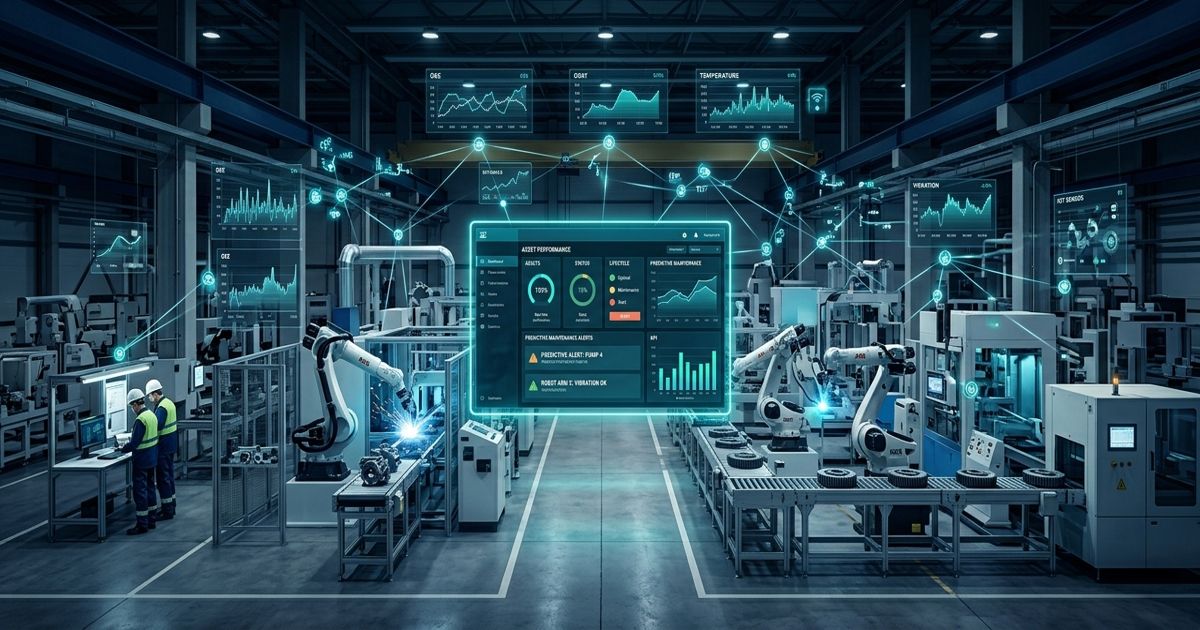
How an OEM IoT Solution Improves Product Performance and Lifecycle Management
 Author
 Date of Publication
 Category
OEM IoT solutions are reshaping the way original equipment manufacturers design, deploy, and support their products in the field. As machines grow more connected, the gap between deployment and insight is closing fast. OEMs that embed IoT capabilities into their products can now access real-time performance data, predict failures before they occur, and deliver outcome-driven service to their customers. This blog explores how an OEM IoT solution improves product performance, supports smarter asset lifecycle management, and helps manufacturers move beyond reactive maintenance into a data-first operating model.
Key Takeaways
- An OEM IoT solution enables real-time monitoring and AI-driven predictive maintenance to reduce unplanned downtime and extend asset life.
- IoT for OEMs unlocks product usage data that supports continuous design improvement, smarter service contracts, and customer-facing analytics.
- OEM Asset Performance Management powered by edge-to-cloud architecture gives manufacturers centralized visibility across distributed deployments.
What Is an OEM IoT Solution and Why Does It Matter?
An OEM IoT solution refers to the integration of Internet of Things technology directly into products manufactured by original equipment manufacturers. Rather than treating IoT as an afterthought, leading OEMs embed sensors, connectivity, and edge intelligence into their machines at the design stage. This allows every deployed unit to communicate operational data back to the manufacturer and the end customer.
The business value is significant. OEMs gain visibility into how their products perform across thousands of real-world environments. They can identify which configurations degrade faster, which usage patterns cause strain, and which firmware versions correlate with improved uptime. According to McKinsey, manufacturers who adopt connected product strategies report measurable improvements in service revenue and customer retention.
For industrial OEMs in particular, this kind of visibility translates directly into competitive differentiation. A connected machine that alerts its operator and its manufacturer simultaneously is far more valuable than one that fails silently.
How IoT for OEMs Enhances Real-Time Product Performance
IoT for OEMs creates a continuous data stream between deployed assets and the teams responsible for keeping them running. Real-time monitoring allows manufacturers to track performance metrics such as temperature, vibration, pressure, energy consumption, and cycle counts without waiting for a service visit or a customer complaint.
This shift from periodic inspection to continuous monitoring is transformative. Anomaly detection algorithms can flag deviations from expected operating ranges the moment they occur. Instead of discovering a problem after it causes downtime, operations teams receive alerts that allow them to intervene proactively. Platforms built on industrial monitoring and control capabilities give OEMs the tools to act on this data at scale.
Edge computing plays a critical role here. By processing data locally at the device level, OEM IoT systems can make real-time decisions without relying solely on cloud connectivity. This is especially important for industrial environments where network reliability may vary. The combination of edge inference and cloud AI ensures that both immediate alerts and long-term trend analysis are possible within a single architecture.
OEM Asset Performance Management Across the Product Lifecycle
OEM Asset Performance Management extends the value of IoT beyond initial deployment. It addresses the full lifecycle of a product, from commissioning and early operation through peak performance, aging, and eventual replacement. When IoT data flows continuously across this lifecycle, OEMs can make smarter decisions at every stage.
During early operation, performance baselines are established automatically. The system learns what normal looks like for each asset type and deployment context. As assets age, deviations from these baselines trigger predictive maintenance workflows rather than waiting for scheduled service intervals. This approach, supported by predictive maintenance strategies, reduces service costs while improving uptime.
Lifecycle management also benefits from centralized device management. OEMs managing fleets of connected products across multiple customer sites need a single pane of glass to understand asset health, firmware status, and service history. Centralized visibility removes the guesswork from fleet-wide decisions and supports outcome-based service contracts where uptime is the guaranteed metric.
From Scheduled Maintenance to AI-Driven Prediction
Traditional maintenance schedules are built on averages. Every asset receives the same service interval regardless of actual wear and usage. This leads to either under-maintenance, where real problems are missed, or over-maintenance, where resources are spent on assets that do not yet need attention.
AI-driven predictive maintenance changes this equation entirely. Machine learning models trained on historical performance data can distinguish between normal operational variation and early indicators of failure. When an anomaly is detected, the system automatically alerts the relevant facility manager or service team with context about the severity and urgency of the issue. This precision reduces unnecessary service visits while catching real problems before they escalate into costly failures.
Using Product Usage Data to Improve Design and Service
One of the most underutilized benefits of an OEM IoT solution is the design feedback loop it creates. When OEMs can see how their products perform across thousands of real-world deployments, they gain engineering insights that lab testing cannot replicate. Which components fail most often? Which usage patterns stress the system beyond its design parameters? Which firmware updates correlate with improved reliability?
This data directly informs the next generation of product design. Engineers can prioritize improvements based on field evidence rather than assumptions. The result is a continuous improvement cycle that accelerates product development and strengthens the OEM's reputation for reliability. AI-driven analytics, as supported by platforms like Merjio, are designed specifically to unlock these customer and usage insights from real product data.
Key Benefits of Embedding IoT in OEM Products
- Real-time performance visibility: Continuous monitoring of deployed assets across all customer sites without manual inspection.
- Predictive maintenance at scale: AI identifies failure patterns early, reducing unplanned downtime across entire product fleets.
- Centralized device management: A single platform to manage firmware, alerts, and asset health across distributed deployments.
- Design improvement feedback: Field data drives engineering decisions and accelerates product iteration cycles.
- Outcome-based service models: IoT-enabled uptime guarantees support premium service contracts and stronger customer relationships.
- Remote diagnostics: Service teams can assess and often resolve issues remotely, reducing the cost and delay of on-site visits.
- Sustainability and energy efficiency: Usage data reveals energy consumption patterns that support both cost reduction and environmental goals.
How Merjio Supports OEM IoT Deployments
Merjio, the AI-powered Industrial IoT platform developed by Lanware Solutions, is designed to address exactly the challenges OEMs face when scaling connected product programs. Its edge-to-cloud architecture means that real-time device inference happens at the asset level while cloud AI handles long-term analytics, trend detection, and centralized reporting.
The platform supports centralized device management across multiple assets and multiple customer sites, making it well suited for OEMs managing large product fleets. Anomaly detection algorithms continuously evaluate operational data and automatically alert facility managers when something deviates from expected norms. The AI is designed to distinguish between normal variation and genuine problems that require attention, reducing alert fatigue while ensuring no critical issue goes unnoticed.
Merjio's design principles of Simplicity, Scalability, and Security are directly relevant to OEM deployments. As a product fleet grows, the platform scales without requiring a corresponding increase in management overhead. Security is built into the cloud infrastructure, which uses both AWS and Azure, ensuring that sensitive operational and customer data is protected. For OEMs exploring IoT connectivity technologies, Merjio provides a structured path from proof of concept to full-scale deployment.
Industry 5.0 Alignment and What It Means for OEMs
The shift toward Industry 5.0 principles adds a new dimension to OEM Asset Performance Management. Beyond efficiency and automation, Industry 5.0 emphasizes human-machine collaboration, sustainability, and resilience. An OEM IoT solution built on these principles does not simply automate maintenance decisions. It provides human operators with the context and intelligence they need to make better decisions faster.
For OEMs, this means designing connected products that support worker safety through real-time alerts, contribute to energy optimization through usage analytics, and build operational resilience through early warning systems. These are not abstract values. They are measurable outcomes that OEM customers increasingly expect as standard features of modern industrial equipment. According to the European Commission, Industry 5.0 represents a framework where technology serves human and societal goals alongside economic ones, a standard that connected OEM products are well positioned to meet.
Conclusion
An OEM IoT solution is no longer a feature reserved for high-end industrial equipment. It is becoming the baseline expectation for any manufacturer that wants to remain competitive in a data-driven market. By embedding IoT at the product level, OEMs gain real-time performance visibility, enable predictive maintenance, and create a continuous feedback loop that improves both product design and customer service. Platforms like Merjio provide the edge-to-cloud architecture, AI-driven analytics, and centralized device management that make scalable IoT for OEMs practical and achievable. To explore how Merjio supports connected product programs across industrial deployments, visit the top benefits of industrial manufacturing monitoring and discover what a modern IIoT platform can deliver for your product ecosystem.
Frequently Asked Questions
What is an OEM IoT solution and how does it work?
An OEM IoT solution embeds sensors, connectivity, and edge intelligence into manufactured products. It enables real-time data collection from deployed assets, which is then analyzed by AI to support predictive maintenance, remote diagnostics, and improved asset reliability across the product fleet.
How does IoT for OEMs improve product lifecycle management?
IoT for OEMs creates a continuous data stream across the entire product lifecycle. Manufacturers can monitor asset health from commissioning through aging, predict failures before they occur, and use field data to inform the next generation of product design and service strategies.
What is OEM Asset Performance Management?
OEM Asset Performance Management refers to using IoT data to monitor, maintain, and optimize the performance of deployed products across their operational life. It combines real-time monitoring, AI-driven predictive maintenance, and centralized fleet visibility to reduce downtime and improve service outcomes.
Why is predictive maintenance important for OEM IoT deployments?
Predictive maintenance allows OEMs to identify failure patterns before they cause downtime. AI models analyze historical and real-time performance data to detect anomalies early, reducing unnecessary service visits and ensuring that genuine problems are addressed before they escalate into costly equipment failures.
How does edge computing support OEM IoT solutions?
Edge computing processes sensor data locally at the asset level, enabling real-time decisions without depending entirely on cloud connectivity. This is critical for industrial environments where network reliability varies. Combined with cloud AI, edge computing supports both immediate alerts and long-term trend analysis within one architecture.
Can OEM IoT platforms manage products deployed across multiple customer sites?
Yes. Platforms built for condition-based monitoring support centralized device management across many assets and sites. OEMs gain a single view of firmware status, asset health, and service history across their entire product fleet, regardless of how widely it is distributed geographically.
What data does an OEM IoT solution collect from deployed products?
An OEM IoT solution typically collects operational metrics such as temperature, vibration, pressure, energy consumption, and cycle counts. This data feeds into AI analytics platforms that identify performance trends, flag anomalies, and generate insights that support both maintenance decisions and product design improvements.
How does IoT help OEMs develop better products over time?
Real-world usage data reveals which components degrade fastest, which configurations perform best, and which failure modes are most common. This engineering feedback loop, impossible to replicate in a lab, allows OEMs to prioritize design improvements based on field evidence, accelerating product development and strengthening reliability.
What role does AI play in an OEM IoT solution?
AI distinguishes between normal operational variation and early indicators of failure. It automates anomaly detection, triggers maintenance alerts with appropriate urgency, and analyzes product usage data at scale. AI also supports smart factory automation outcomes by enabling proactive rather than reactive operational decisions.
How does an OEM IoT solution support outcome-based service contracts?
By continuously monitoring asset health and guaranteeing uptime through predictive maintenance, OEMs can offer service contracts tied to measurable performance outcomes. IoT data provides the evidence needed to demonstrate compliance with agreed service levels, strengthening customer trust and enabling premium service offerings.
Related product
Merjio IIoT Platform by Lanware
Any sensor. Any industry. One unified data layer — explore SKID solutions, AI-driven analytics, and live monitoring on the Merjio platform.
Explore merjio.com