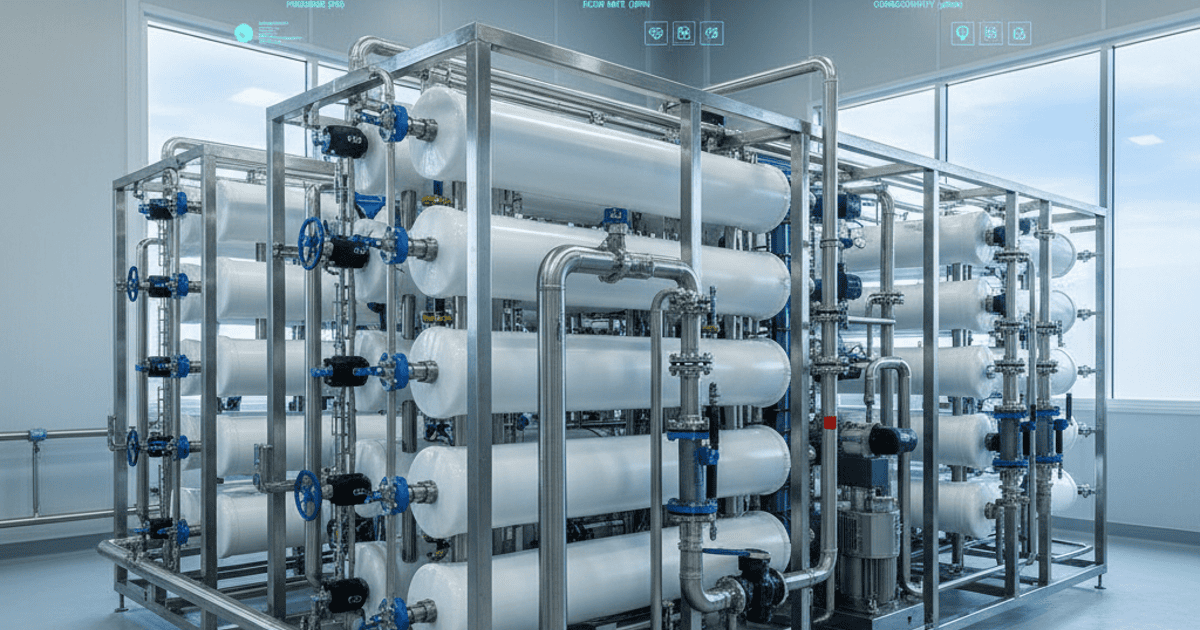
Merjio RO Skid Monitoring for Water Treatment Plants
 Author
 Date of Publication
 Category
Merjio RO Skid Monitoring for Smarter Water Treatment Operations
Merjio, the AI-powered Industrial IoT platform developed by Lanware Solutions, is redefining how water and wastewater treatment facilities manage their most critical assets. Reverse Osmosis (RO) skids are the heart of water purification infrastructure, and any unplanned failure can disrupt operations, compromise water quality, and generate significant recovery costs. With a purpose-built RO Skid Monitoring System powered by Merjio, plant operators gain real-time visibility, intelligent alerts, and predictive control across every stage of the treatment process. This blog explores how Merjio IoT Monitoring for Water Treatment delivers measurable operational benefits for modern treatment plants.
Key Takeaways
- Merjio provides a complete RO Skid Monitoring System using edge-to-cloud architecture, enabling real-time data capture and AI-driven analysis at water treatment facilities.
- IoT Monitoring for Water Treatment Skids allows operators to shift from reactive maintenance to predictive maintenance, reducing unplanned downtime across water and wastewater operations.
- Merjio supports Water and Wastewater/Sewage Treatment environments with centralized device management, anomaly detection, and secure cloud infrastructure built for industrial-grade reliability.
Why RO Skid Monitoring Is Critical in Water Treatment
RO skids integrate high-pressure pumps, membranes, sensors, and control valves into a single compact unit. In water and wastewater treatment, these systems operate continuously under demanding conditions. Without proper monitoring, subtle performance degradations such as pressure drops, flow imbalances, or membrane fouling go undetected until they cause failure.
Traditional monitoring approaches rely on scheduled inspections and manual readings. These methods introduce delays and leave critical data gaps between checks. A dedicated RO Skid Monitoring System like Merjio closes those gaps by capturing and analyzing operational data continuously, enabling operators to act before a minor issue escalates.
According to the Water Online industry resource, unplanned downtime in water treatment facilities is one of the most costly operational challenges plant managers face. Real-time monitoring directly addresses this vulnerability by providing early warning signals and supporting faster response decisions.
How Merjio Powers IoT Monitoring for Water Treatment Skids
Merjio uses an edge-to-cloud architecture that processes sensor data at the device level before transmitting aggregated insights to the cloud. This design ensures that even in low-connectivity environments common at remote treatment sites, real-time inference continues without interruption. For RO skid operations, this means continuous monitoring of pressure, flow rate, conductivity, temperature, and rejection ratios regardless of network conditions.
The platform connects directly to sensors and actuators on the skid, collecting granular data streams from every operational stage. Merjio's AI layer then analyzes these streams to distinguish between normal process variation and early-stage anomalies that require operator attention. This is especially valuable in Water and Wastewater/Sewage Treatment environments where regulatory compliance depends on consistent performance.
Facility managers receive automated alerts when readings deviate from acceptable thresholds. These alerts are context-aware, which means the system accounts for normal operating ranges during startup, steady-state, and shutdown cycles to prevent alert fatigue. For a deeper look at how Merjio handles industrial asset management across complex environments, see how Merjio revolutionizes industrial asset management.
Key Features of Merjio for Water and Wastewater Treatment
Merjio delivers a feature set tailored to the operational demands of water treatment infrastructure. Each capability is designed to reduce risk, improve efficiency, and support compliance in regulated environments.
- Real-Time Parameter Monitoring: Continuous tracking of feed pressure, permeate flow, concentrate flow, conductivity, and system temperature on RO skids.
- AI-Driven Anomaly Detection: Intelligent identification of unusual operational patterns such as membrane fouling trends, pump wear indicators, and valve response delays before they cause failure.
- Predictive Maintenance Scheduling: Merjio replaces fixed maintenance schedules with AI-driven predictions based on actual asset condition, reducing unnecessary service visits and extending equipment life.
- Remote Control and Intelligent Actuation: Operators can adjust setpoints, trigger flushing cycles, and issue control commands remotely through the platform, reducing the need for on-site personnel intervention.
- Centralized Device Management: Multi-site treatment facilities can monitor and manage all connected skids from a single dashboard, improving oversight and reducing operational silos.
- Integrated Reporting: Automated performance reports support regulatory submissions, audit readiness, and operational benchmarking across treatment stages.
- Secure Cloud Infrastructure: Built on AWS and Azure, Merjio stores and processes treatment data securely with scalable access controls for distributed teams.
These capabilities make Merjio a practical fit for both municipal water authorities and industrial water treatment operators managing reverse osmosis, ultrafiltration, and sewage treatment systems. Explore how similar capabilities apply in resource-intensive sectors through Merjio asset tracking for water treatment and mining operations.
Operational Benefits for Sewage and Wastewater Treatment Facilities
Sewage treatment plants face a unique set of monitoring challenges. Unlike clean water RO systems, wastewater applications deal with variable inlet quality, biological load fluctuations, and chemical dosing requirements that must be precisely managed. Merjio's sensor agnosticism and edge processing capability make it adaptable to these complex, variable environments.
With IoT Monitoring for Water Treatment Skids deployed across a wastewater facility, operators gain visibility into aeration performance, sludge levels, chemical feed rates, and effluent quality in real time. The platform's anomaly detection layer flags deviations that could indicate process upsets before they affect effluent compliance. This supports both operational continuity and environmental responsibility.
Energy consumption is another major concern in sewage treatment. Pumping and aeration systems account for the largest share of energy expenditure in most plants. Merjio's real-time data analysis identifies inefficient operating patterns and enables targeted energy optimization, aligning with Industry 5.0 sustainability outcomes that Lanware Solutions explicitly supports within the Merjio platform design.
From Reactive to Predictive: The Merjio Maintenance Advantage
One of the most impactful shifts Merjio enables is the transition from scheduled preventive maintenance to AI-driven predictive maintenance. In traditional water treatment operations, maintenance teams follow fixed service intervals regardless of actual equipment condition. This approach results in either over-maintenance that wastes resources or under-maintenance that misses developing failures.
Merjio continuously evaluates asset health indicators across the RO skid and supporting infrastructure. When the AI detects a degradation pattern consistent with approaching failure, it generates a maintenance recommendation with supporting data. Maintenance teams can then prioritize interventions based on actual risk rather than calendar dates.
This shift reduces unplanned downtime, lowers spare parts consumption, and extends the operational life of high-value components like membranes, pumps, and pressure vessels. For operations teams evaluating IIoT platforms for water applications, the predictive maintenance capability alone often justifies the investment. Learn how edge AI specifically supports industrial sites in our overview of Merjio edge AI built for water treatment and mining sites.
Merjio and Industry 5.0 Alignment in Water Treatment
Water treatment is a safety-critical sector where human oversight remains essential. Merjio is designed around a human-machine collaboration model that augments operator decision-making rather than replacing it. The platform provides AI-generated insights and recommendations, but operators retain full control over actions and responses.
This aligns directly with Industry 5.0 principles of human-centric automation, sustainability, and operational resilience. By providing early-warning systems, energy optimization tools, and remote diagnostics, Merjio helps treatment plants build more resilient operations that can adapt to process variability and infrastructure aging without sacrificing safety or compliance.
Conclusion
Water and wastewater treatment plants are under increasing pressure to improve efficiency, maintain compliance, and reduce operational risk with limited resources. Merjio addresses these demands directly by delivering an intelligent RO Skid Monitoring System that combines real-time IoT data capture, AI-driven anomaly detection, predictive maintenance, and remote control in a single scalable platform. From municipal RO systems to industrial sewage treatment operations, IoT Monitoring for Water Treatment Skids powered by Merjio gives facility teams the visibility and control they need to protect their assets and ensure reliable water supply. To explore the full capabilities of Merjio across industrial sectors, visit the 5 reasons water plants need smart asset tracking and see how the platform can transform your operations.
FAQ
What is an RO Skid Monitoring System and why does it matter?
An RO Skid Monitoring System continuously tracks pressure, flow, conductivity, and temperature across reverse osmosis units. It enables early fault detection, supports compliance, and prevents costly unplanned downtime in water treatment operations.
How does Merjio collect data from RO skids in real time?
Merjio uses an edge-to-cloud architecture where sensors installed on the skid capture data at the device level. This enables continuous inference even in low-connectivity environments, ensuring uninterrupted monitoring at water treatment facilities.
Can Merjio monitor multiple water treatment sites from one dashboard?
Yes. Merjio supports centralized device management across multiple sites, allowing operators to monitor all connected RO skids and treatment assets from a single unified dashboard for improved oversight and operational consistency.
How does AI anomaly detection work in wastewater treatment environments?
Merjio's AI layer analyzes operational data streams and distinguishes normal process variation from early-stage anomalies. It accounts for startup and shutdown cycles to reduce alert fatigue while flagging genuine risks in wastewater treatment systems.
What makes Merjio suitable for sewage treatment plant monitoring?
Merjio's sensor-agnostic design and edge processing adapt to variable wastewater conditions. It monitors aeration, chemical dosing, sludge levels, and effluent quality in real time, supporting the kind of industrial IoT backbone reliability that complex treatment environments demand.
How does Merjio support predictive maintenance for water treatment assets?
Merjio evaluates asset health indicators continuously and generates AI-driven maintenance recommendations when degradation patterns are detected. This helps teams prioritize interventions based on actual risk rather than fixed service intervals.
Is Merjio secure enough for regulated water treatment operations?
Merjio is built on AWS and Azure cloud infrastructure with scalable access controls. Its secure architecture supports data integrity, audit readiness, and compliance reporting requirements typical of regulated water and wastewater treatment operations.
Can operators control RO skid functions remotely through Merjio?
Yes. Merjio includes remote control and intelligent actuation capabilities. Operators can adjust setpoints, initiate flushing cycles, and issue commands remotely, reducing the need for constant on-site personnel presence at treatment facilities.
How does Merjio help reduce energy consumption in water treatment plants?
Merjio's real-time data analysis identifies inefficient patterns in pumping and aeration systems. By pinpointing wasteful operating conditions, the platform supports energy optimization aligned with industrial manufacturing monitoring benefits and Industry 5.0 sustainability goals.
What types of sensors does Merjio integrate with on water treatment skids?
- Merjio integrates with pressure sensors, flow meters, conductivity probes, temperature sensors, and level transmitters. Its sensor-agnostic design allows flexible deployment across diverse RO and wastewater treatment configurations without requiring proprietary hardware.
Related product
Merjio IIoT Platform by Lanware
Any sensor. Any industry. One unified data layer — explore SKID solutions, AI-driven analytics, and live monitoring on the Merjio platform.
Explore merjio.com