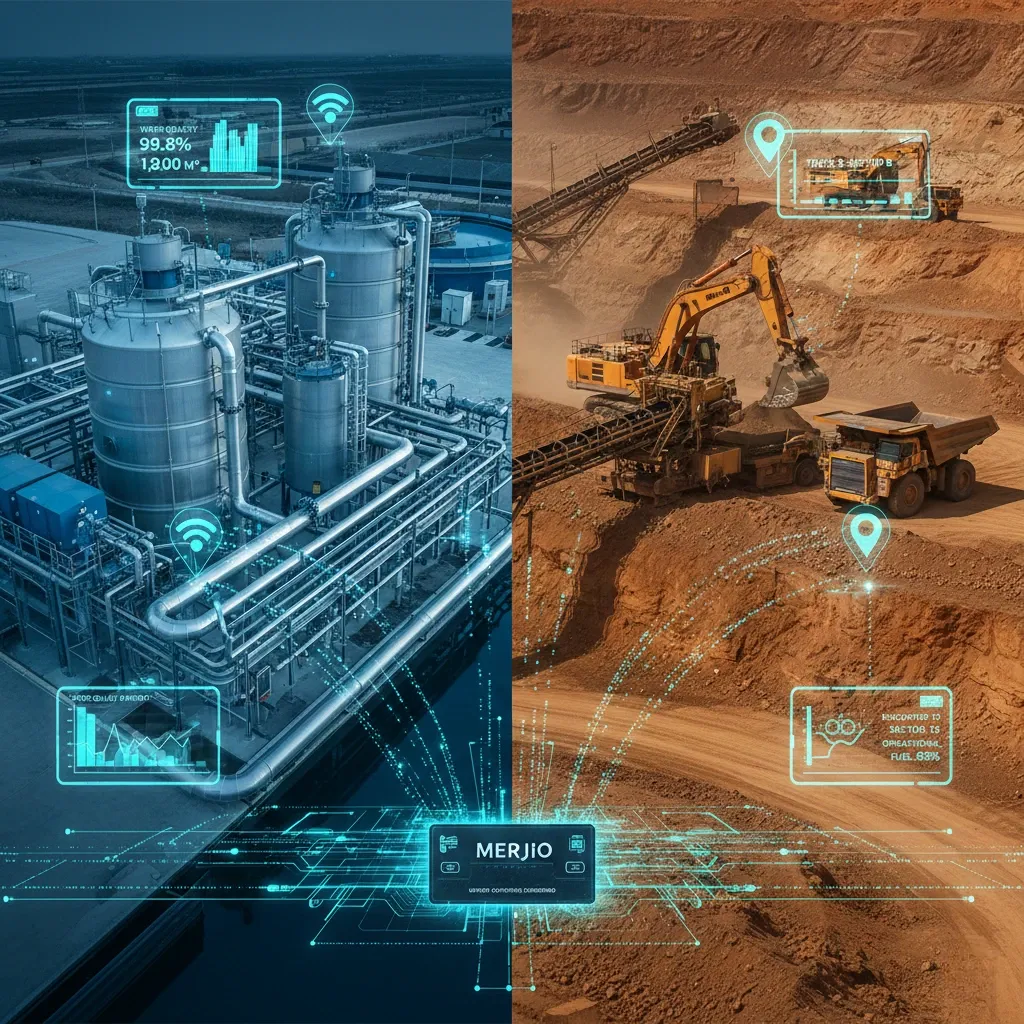
Merjio Asset Tracking for Water Treatment and Mining Operations
 Author
 Date of Publication
 Category
Merjio Asset Tracking for Water Treatment and Mining Operations
Water treatment plants and mining operations run on skid-mounted equipment pumps, blowers, compressors, and dosing systems that cannot afford to fail. When a single STP skid or slurry pump goes down unexpectedly, the consequences ripple through the entire operation. Merjio asset tracking, built on edge computing and AI, gives operations teams real-time visibility into every asset across both environments. This blog explores how Merjio addresses the unique monitoring challenges in water and wastewater treatment and in mining, metals, and cement operations.
Key Takeaways
• Merjio asset tracking delivers real-time visibility into skid-mounted equipment across decentralized water treatment plants and remote mining sites.
•The platform uses edge computing and AI to enable predictive maintenance, reducing unplanned downtime on critical pumps, blowers, and dosing systems.
•Industries with distributed assets and high downtime costs such as water and wastewater and mining are ideal candidates for Merjio's industrial IoT platform.
Why Water and Wastewater Operations Need Industrial IoT Asset Tracking
Decentralized plants, modular expansion, and limited on-site staff make water treatment one of the most demanding environments for asset management.
Water and wastewater facilities including STP, ETP, MBBR, MBR, and SBR process skids operate continuously with minimal downtime tolerance. Many plants are decentralized, meaning assets are spread across multiple sites with limited staffing at each location. A failed sludge dewatering skid or chemical dosing unit can halt an entire treatment cycle, triggering compliance issues and costly remediation. Traditional inspection-based maintenance simply cannot keep pace with the complexity of modern plants. Merjio addresses this directly by connecting pumps, motors, blowers, and RO/UF/ZLD skids to a unified monitoring layer. Operations teams can track asset health across every facility from a single dashboard, receive automated alerts when a parameter drifts out of range, and plan maintenance around actual equipment condition rather than arbitrary schedules. Companies like OnSyte Performance (onsyte.com) represent the type of operators who benefit from this level of distributed asset visibility.
Monitoring Skid Assets in Mining, Metals, and Cement Environments
Harsh environments, remote deployment, and high-value equipment make mining operations uniquely reliant on reliable remote monitoring and predictive maintenance.
Mining, metals, and cement operations deploy a wide range of skid-mounted systems slurry pumping skids, dewatering skids, reagent dosing skids, flotation and thickener skids, and mobile water treatment skids. These assets work in extreme conditions: dust, vibration, moisture, and temperature swings that accelerate wear. Many sites are remote, making it expensive to dispatch technicians for routine checks or unplanned repairs. According to Deloitte's mining industry research, unplanned downtime accounts for as much as 30 to 40 percent of total maintenance costs in mining. Merjio's edge-computing architecture processes sensor data locally, so insights are available even when connectivity is limited. Operators at sites similar to Custom Dredge Workscan monitor equipment health continuously, detect early signs of bearing wear or pressure anomalies, and act before a breakdown forces production to stop.
How Merjio's Edge Computing and AI Power Predictive Maintenance
Merjio processes data at the edge and applies AI to identify failure patterns before they escalate into unplanned downtime.
Merjio's core architecture combines edge computing with AI to create a predictive maintenance engine suited to both water treatment and mining environments. The system collects continuous sensor data vibration, temperature, pressure, flow rate from connected skid assets. Edge devices process this data locally, reducing latency and maintaining functionality even in low-connectivity field environments. AI and machine learning models then analyze patterns across historical and live data to forecast potential failures. For example, if a slurry pump in a mining application begins showing abnormal vibration signatures, Merjio flags the anomaly and recommends a maintenance window before the pump fails completely. Industry research consistently shows that predictive maintenance can reduce maintenance costs by 20 to 30 percent and increase equipment uptime by 10 to 15 percent figures that translate directly into operational savings at both water plants and remote mining sites.
Asset Visibility Across Distributed and Remote Locations
Real-time asset tracking across multiple facilities helps operations teams allocate resources efficiently and respond to issues faster.
One of the most persistent challenges in both water treatment and mining is maintaining visibility across geographically dispersed assets. A water authority managing multiple STP plants across a region, or a mining operator running dewatering skids across several pit zones, needs a single view of all equipment status. Merjio provides 360-degree asset visibility by aggregating data from every connected device into a unified dashboard. Teams can see exactly which assets are operating within normal parameters, which require attention, and which are approaching a maintenance threshold all in real time. This centralized visibility reduces the need for manual field checks, helps plan maintenance schedules more efficiently, and ensures that no critical asset goes unmonitored simply because it is located at a remote or understaffed site. The IoT infrastructure supports a wide range of industrial sensors and protocols, making it adaptable to the diverse equipment found across both industries.
Integration, Deployment, and Getting Started with Merjio
Merjio is designed for phased deployment, integrates with existing operational systems, and scales as your asset portfolio grows.
Deploying an industrial IoT platform does not have to mean replacing existing infrastructure. Merjio is built to integrate with current enterprise applications, SCADA systems, and ERP tools commonly used in water treatment and mining environments. The platform supports standard industrial communication protocols, enabling seamless data flow between Merjio and the systems your teams already rely on. Implementation follows a phased approach: a pilot program connecting a priority set of skid assets for instance, the most critical pumping or dosing systems can typically go live within 4 to 6 weeks. After validating results in the pilot, the rollout expands to additional assets and sites. Hardware installation covers edge devices, industrial sensors, and network infrastructure appropriate for each environment. Lanware Solutions provides end-to-end support through the implementation lifecycle, from initial assessment and hardware integration to staff training and ongoing system optimization.
Conclusion
Water treatment and mining operations share a common challenge: critical skid assets operating in demanding environments where unplanned downtime is expensive and remote monitoring is essential. Merjio asset tracking, powered by edge computing and AI, gives operations teams the real-time visibility and predictive intelligence needed to keep STP skids, slurry pumps, dosing systems, and dewatering units running reliably. As industrial operations grow more distributed and the cost of downtime continues to rise, a robust asset monitoring platform is no longer optional it is a core part of operational strategy. Ready to see how Merjio can work for your water treatment or mining operations? Contact Lanware Solutions to discuss a deployment plan tailored to your assets and sites.
Frequently Asked Questions
What is Merjio and what industries does it serve?
Merjio is an industrial IoT platform that uses edge computing and AI for real-time asset tracking and predictive maintenance. It is specifically suited to water and wastewater treatment and mining, metals, and cement operations where skid assets require continuous monitoring.
How does Merjio help water treatment plants monitor skid equipment?
Merjio connects STP, ETP, MBBR, MBR, RO/UF/ZLD, and chemical dosing skids to a unified monitoring platform. It delivers real-time alerts and predictive maintenance insights, helping decentralized plants reduce unplanned downtime across multiple sites without increasing on-site staffing.
Why is Merjio asset tracking valuable for mining operations?
Mining sites use slurry pumping, dewatering, reagent dosing, and mobile water treatment skids in harsh, remote environments. Merjio provides continuous remote monitoring and AI-driven failure prediction, reducing emergency maintenance costs that Deloitte research estimates account for 30 to 40 percent of total maintenance spend in mining.
Can Merjio work in remote or low-connectivity mining environments?
Yes. Merjio uses edge computing to process sensor data locally at the asset level, so insights remain available even when cloud connectivity is limited or intermittent. This makes it practical for remote mining sites where reliable network coverage cannot be guaranteed. Learn more about Lanware's IoT capabilities.
What types of assets can Merjio monitor in a water treatment facility?
Merjio monitors a wide range of water treatment skid assets including pumps, motors, blowers, compressors, RO and UF systems, ZLD units, sludge dewatering equipment, and chemical dosing systems. Any asset with sensor integration can be connected to the platform for continuous health monitoring.
How does predictive maintenance work in Merjio?
Merjio collects continuous sensor data vibration, temperature, pressure, flow rate and applies machine learning models to identify anomalies and forecast failures before they occur. When a pattern indicates potential equipment degradation, the platform sends automated alerts so maintenance teams can act proactively.
How long does a Merjio deployment take for a water or mining operation?
A pilot program covering priority skid assets typically deploys within 4 to 6 weeks. Full-scale implementations across multiple sites or large asset portfolios may take 3 to 6 months. Lanware Solutions supports phased rollouts so operations are not disrupted during the transition.
Can Merjio integrate with existing SCADA or ERP systems?
Yes. Merjio supports standard industrial communication protocols and provides APIs for custom integration. It connects with SCADA systems, ERP platforms, and manufacturing execution systems commonly used in water treatment and mining, ensuring asset data flows into the tools your teams already use.
Related product
Merjio IIoT Platform by Lanware
Any sensor. Any industry. One unified data layer — explore SKID solutions, AI-driven analytics, and live monitoring on the Merjio platform.
Explore merjio.com