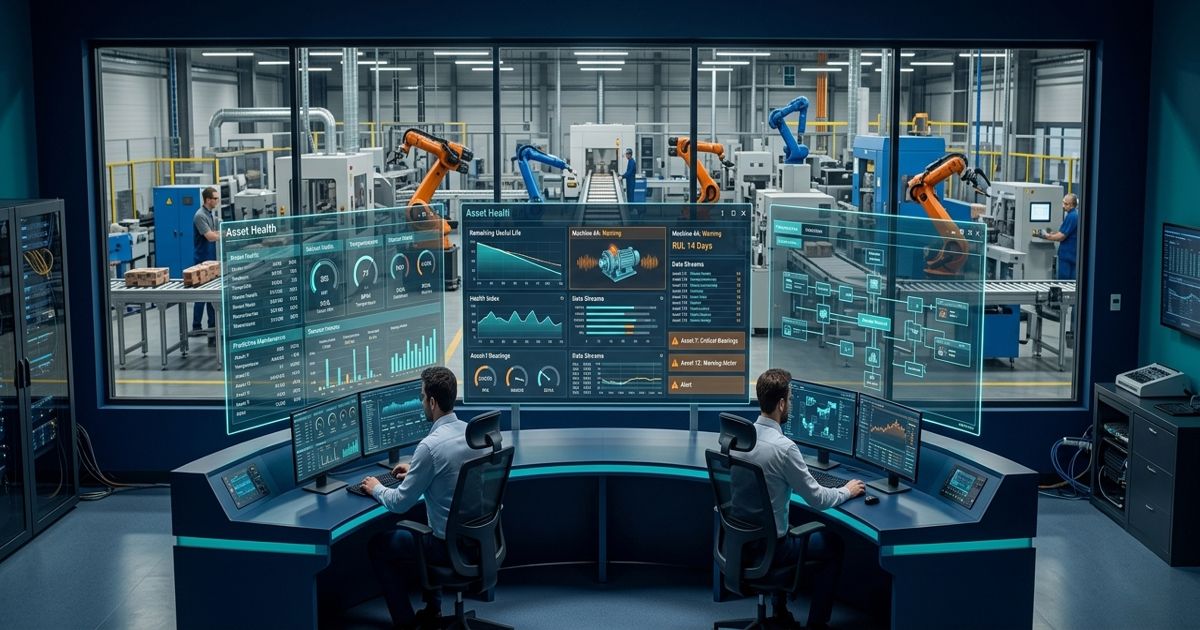
Best Asset Tracking Software: A Complete Guide for 2026
 Author
 Date of Publication
 Category
Finding the best asset tracking software for your industrial operations is no longer optional. Unplanned downtime, mismanaged assets, and reactive maintenance cost manufacturers millions each year. With the rise of AI-powered Industrial IoT platforms, operations teams now have access to real-time visibility, remote control, and intelligent decision-making in one connected system. This guide walks you through what modern asset tracking platforms should include, why AI-based predictive maintenance is central to their value, and how platforms like Merjio are changing industrial operations for good.
Key Takeaways
- Top-tier industrial asset tracking platforms integrate real-time monitoring, remote control, and AI-driven alerts into a single system, replacing reactive maintenance with proactive operational intelligence.
- AI-based predictive maintenance replaces scheduled maintenance cycles with data-driven predictions, reducing unplanned downtime and extending asset life significantly.
- Edge-to-cloud architecture enables faster device inference, better scalability, and secure data access across distributed industrial sites.
What Makes Asset Tracking Software Truly Industrial-Grade?
Not every asset tracking tool is built for industrial environments. Consumer-grade tools track laptops or furniture. Industrial-grade platforms must handle heavy machinery, remote field devices, multi-site deployments, and real-time operational data at scale.
Industrial asset tracking software must provide real-time visibility into equipment status, location, and performance. It must also support remote control, not just passive monitoring. When a compressor operates outside normal thresholds, the system should detect the anomaly, alert the facility manager, and allow corrective action from a central dashboard.
Beyond basic tracking, the platform must integrate AI-based predictive maintenance to move teams from reactive responses to proactive strategies. This means analyzing sensor data continuously to predict equipment failures before they occur. According to McKinsey, predictive maintenance can reduce machine downtime by up to 50% and extend machinery life by years.
Security and scalability round out the requirements. A platform managing hundreds of connected assets must protect operational data while growing easily as new sites or devices come online.
Core Features of a High-Performance Industrial Tracking Platform
The right platform delivers more than a dashboard. It must combine several critical capabilities to deliver genuine operational value. Below are the core features that define top-tier industrial asset tracking solutions.
Real-Time Monitoring and Anomaly Detection
Real-time monitoring forms the foundation of any industrial tracking platform. Operations managers need live data from every connected asset, whether on a factory floor, a maritime vessel, or a distributed vending network. The best platforms go further by embedding anomaly detection directly into the monitoring layer. AI distinguishes between normal operational variations and critical problems that need immediate attention. Facility managers receive automatic alerts before a small deviation becomes a costly failure. This capability transforms monitoring from a passive activity into an active risk management tool.
AI-Based Predictive Maintenance Built Into the Core
Scheduled maintenance is expensive and imprecise. Maintenance teams often service equipment that does not need attention while missing early warning signs in assets that do. AI-based predictive maintenance solves this by continuously analyzing operational data to predict when a component is likely to fail. The system moves maintenance decisions from a calendar to a condition-based trigger. This reduces unnecessary service visits, extends asset life, and prevents unplanned shutdowns. Platforms like Merjio are built to help industrial teams shift from scheduled to AI-driven predictive maintenance workflows, delivering measurable operational improvements.
Centralized Device Management Across Sites
Managing dozens of connected assets across a single plant is challenging. Managing hundreds across multiple facilities in different geographies requires a centralized device management layer. The best industrial tracking platforms provide a unified interface where operations teams can view, control, and configure every connected device from one screen. This eliminates siloed data, reduces IT overhead, and gives leadership a single source of operational truth. Centralized management also supports compliance by maintaining consistent device configurations and audit trails across the entire asset network.
Edge-to-Cloud Architecture for Speed and Scalability
Latency matters in industrial environments. When a machine operates outside safe parameters, the response must be near-instant. Edge computing handles real-time device inference locally, without waiting for a round trip to the cloud. Cloud infrastructure then aggregates data for deeper AI analysis, long-term storage, and reporting. This edge-to-cloud architecture balances speed with scale. It also ensures continuity during network interruptions, keeping local operations running even when cloud connectivity is temporarily unavailable. Industrial teams exploring embedded hardware development for IoT environments will recognize this architecture as central to reliable IIoT deployments.
Integrated Reporting and Operational Intelligence
Data without context is noise. The best asset tracking platforms transform raw operational data into structured reports that support decision-making at every level of the organization. Maintenance engineers get equipment health summaries. Plant managers get production uptime metrics. Executives get sustainability and efficiency dashboards. Integrated reporting removes the need for manual data exports and spreadsheet analysis. It enables faster decisions, better resource allocation, and clearer accountability across the operation. AI-driven analytics also unlock usage patterns that reveal opportunities to optimize processes and reduce energy consumption.
How Merjio Functions as an Asset Tracking and Control Platform
Merjio is an AI-powered Industrial IoT platform developed by Lanware Solutions. It is designed to serve as a connected asset monitoring and control platform for industrial environments, covering manufacturing, maritime, telecommunications, and beyond.
The platform provides real-time monitoring of industrial assets alongside remote and intelligent control capabilities. Its anomaly detection engine uses AI to identify unusual patterns and alert facility managers automatically. Merjio also supports centralized device management, meaning teams can oversee all connected assets from a single interface regardless of physical location.
Its edge-to-cloud architecture enables real-time inference at the device level and cloud-scale AI analysis for longer-term insights. The platform is built on a foundation of simplicity, scalability, and security, making it accessible to operations teams while remaining enterprise-ready. Merjio also supports Industry 5.0 outcomes including worker safety, energy optimization, and human-machine collaboration, aligning technical capability with broader sustainability and resilience goals. You can explore how the platform delivers industrial intelligence through the ways Merjio transforms industrial asset monitoring and control.
Industries That Benefit Most from Smart Asset Tracking
Industrial asset tracking is not limited to one sector. Any operation that relies on connected equipment, distributed assets, or continuous production stands to benefit significantly.
- Manufacturing: Track machine health, monitor production line uptime, and prevent equipment failures before they halt output.
- Maritime: Monitor vessel systems, fuel usage, and onboard equipment from remote locations with real-time visibility.
- Telecommunications: Manage distributed network infrastructure, monitor signal equipment, and predict hardware failures across large geographic footprints.
- Vending and Distributed Operations: Centralize device monitoring across large fleets of field-deployed machines to optimize service cycles and reduce field visits.
- Water Treatment: Monitor process equipment, detect anomalies in real time, and maintain compliance through continuous data capture. Teams managing water treatment assets can benefit from platforms that support RO skid monitoring and control for water treatment environments.
What to Avoid When Evaluating Asset Tracking Platforms
Not all platforms marketed as 'industrial-grade' deliver on that promise. When evaluating options, watch for these common gaps.
- Platforms that offer monitoring only, without remote control or actuation capabilities.
- Solutions that lack native AI capabilities and rely entirely on manual threshold alerts.
- Tools without edge computing support, creating dangerous latency in time-critical environments.
- Vendors that cannot demonstrate scalability beyond a small number of devices or sites.
- Platforms with poor data security posture, especially for cloud-stored operational data.
The Gartner research community consistently highlights data integration, scalability, and AI readiness as the top evaluation criteria for industrial IoT platforms. Use these as your baseline before shortlisting any vendor.
Conclusion
Choosing the best asset tracking software means choosing a platform built for industrial reality, not just one with a polished interface. Real-time monitoring, AI-based predictive maintenance, centralized device management, and a robust edge-to-cloud architecture are not optional features. They are the baseline for any platform serious about reducing downtime and improving operational efficiency. Merjio by Lanware Solutions brings all of these capabilities together in a platform designed around simplicity, scalability, and security. If your team is ready to move from reactive maintenance to AI-driven operations, explore the full capabilities of Merjio and see how it fits your industrial environment.
FAQ
Q1: What is the best asset tracking software for manufacturing plants?
Answer: The strongest option for manufacturing plants combines real-time monitoring, remote control, and AI-based predictive maintenance in one platform. Solutions like Merjio offer centralized device management and anomaly detection, making them well-suited for multi-asset industrial environments where uptime is critical.
Q2: How does AI-based predictive maintenance differ from preventive maintenance?
Answer: Preventive maintenance follows fixed schedules regardless of actual equipment condition. AI-based predictive maintenance uses continuous sensor data analysis to predict failures before they happen. This condition-based approach reduces unnecessary service visits, lowers costs, and prevents unplanned shutdowns more effectively than calendar-driven maintenance cycles.
Q3: What industries benefit most from industrial asset tracking platforms?
Answer: Manufacturing, maritime, telecommunications, water treatment, and distributed vending operations benefit most. Any sector relying on connected equipment across multiple sites gains from real-time visibility, centralized control, and AI-driven alerts that help teams respond faster to equipment issues before they escalate into operational failures.
Q4: What is edge-to-cloud architecture in industrial IoT?
Answer: Edge-to-cloud architecture processes data locally at the device level for real-time responses and sends aggregated data to the cloud for deeper AI analysis and storage. This design reduces latency, ensures continuity during network interruptions, and supports scalable industrial deployments across multiple sites and asset types.
Q5: How does anomaly detection work in industrial asset monitoring?
Answer: Anomaly detection uses AI to continuously analyze operational data streams and identify patterns that deviate from normal behavior. When an unusual reading is detected, the system automatically alerts facility managers. The AI distinguishes between minor variations and critical problems, helping teams prioritize responses and avoid costly unplanned downtime.
Q6: Can asset tracking software support multiple sites and devices simultaneously?
Answer: Yes. Enterprise-grade industrial platforms are built for centralized device management across hundreds of assets and multiple geographic locations. This capability eliminates siloed data, reduces IT management overhead, and gives operations leaders a unified view of every connected asset through a single dashboard interface.
Q7: What security features should industrial asset tracking platforms include?
Answer: Secure cloud infrastructure, encrypted data transmission, role-based access controls, and audit trails are essential. Platforms built on AWS or Azure benefit from enterprise-level security frameworks. Industrial operations also require consistent device configuration management to maintain compliance and protect sensitive operational data from unauthorized access or breaches.
Q8: How does Merjio support Industry 5.0 goals?
Answer: Merjio supports Industry 5.0 by enabling worker safety through real-time alerts, promoting energy optimization through data-driven insights, and facilitating human-machine collaboration through smart plant monitoring and automation capabilities that support traceability, remote diagnostics, and resilient early-warning predictive systems.
Q9: What is the difference between monitoring-only and monitoring and control platforms?
Answer: Monitoring-only platforms display data and send alerts. Monitoring and control platforms like Merjio also allow remote actuation, intelligent control of connected assets, and configuration changes from a central interface. This distinction is critical for industrial teams that need to respond to anomalies without sending personnel to the physical site.
Q10: How do I evaluate whether an IIoT asset tracking platform is scalable?
Answer: Assess whether the platform supports multiple device types, handles large data volumes without performance degradation, and allows easy onboarding of new sites or assets. Platforms built for smart factory automation and IoT monitoring are typically designed for long-term industrial scalability rather than single-site deployments.
Related product
Merjio IIoT Platform by Lanware
Any sensor. Any industry. One unified data layer — explore SKID solutions, AI-driven analytics, and live monitoring on the Merjio platform.
Explore merjio.com