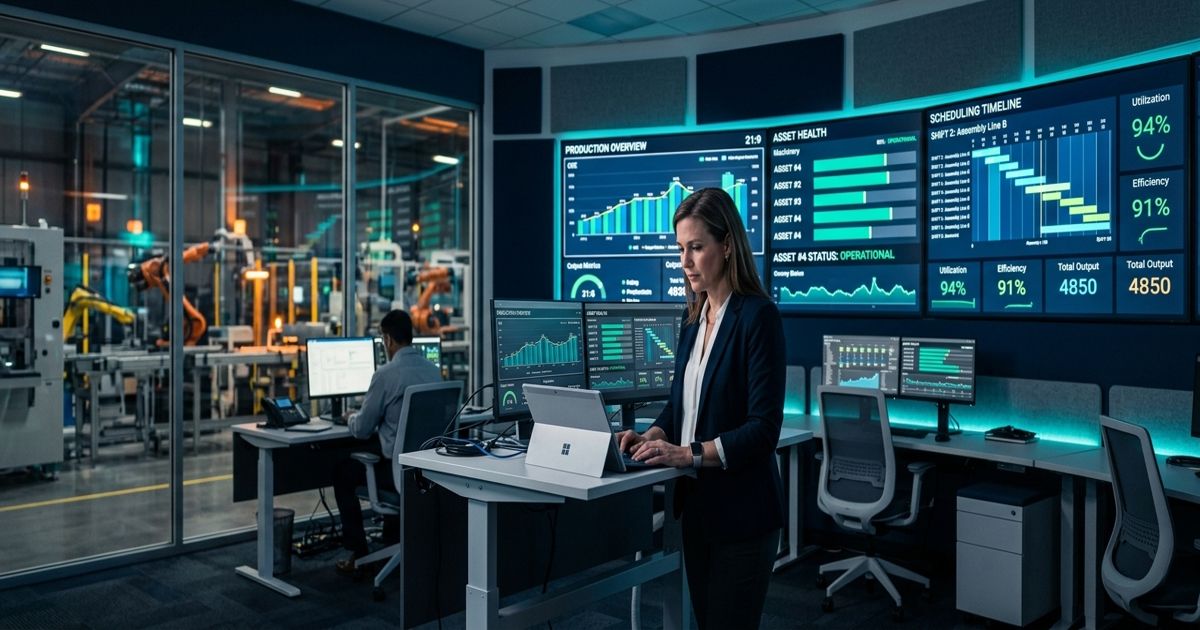
Manufacturing Software Solutions: A Complete Guide for 2026
 Author
 Date of Publication
 Category
Manufacturing Software Solutions: A Complete Guide for 2026
Manufacturing software solutions are no longer optional for industrial operations. They are a core requirement for staying competitive. From real-time asset monitoring to intelligent manufacturing schedule software, digital tools are reshaping how production teams plan, execute, and optimize their work. This guide breaks down the key types of manufacturing software, their benefits, and what to look for when choosing a platform for your facility.
Key Takeaways
- Manufacturing software solutions help production teams monitor assets, automate scheduling, and reduce costly downtime through smarter data use.
- Manufacturing schedule software enables dynamic production planning, reducing bottlenecks and improving throughput across complex workflows.
- AI-powered platforms like Merjio extend software value by adding real-time monitoring and predictive maintenance capabilities to industrial environments.
- Choosing the right solution requires evaluating scalability, integration readiness, and alignment with Industry 4.0 or 5.0 goals.
What Are Manufacturing Software Solutions?
Manufacturing software solutions are digital platforms designed to support and optimize industrial production processes. They cover a wide range of functions, including production planning, asset monitoring, quality control, inventory management, and maintenance scheduling.
These tools collect data from machines, sensors, and operational systems. They then turn that raw data into actionable insights that help plant managers and operations teams make faster, more informed decisions.
Modern solutions go beyond basic automation. They integrate AI, edge computing, and cloud infrastructure to deliver real-time visibility across the entire production environment. According to McKinsey, manufacturers that adopt advanced digital operations can reduce operational costs significantly while improving output quality.
Core Categories of Manufacturing Software
Understanding the landscape of manufacturing software solutions starts with knowing the main categories available to industrial operations teams today.
Production Planning and Manufacturing Schedule Software
Effective scheduling is the backbone of any well-run production facility. Manufacturing schedule software allows operations managers to create, adjust, and optimize production plans in real time. This reduces idle time, prevents resource conflicts, and ensures orders are fulfilled on time.
Advanced scheduling tools use constraint-based algorithms to account for machine availability, workforce capacity, and material supply. When one variable changes, the system recalculates the entire schedule automatically. This agility is critical in environments where demand fluctuates daily. Teams managing multiple production lines benefit most from software that provides a unified view of all schedules in one dashboard.
Real-Time Asset Monitoring and Control Platforms
Asset monitoring software gives facility managers live visibility into machine health, operational status, and performance metrics. Rather than relying on periodic inspections, teams can detect issues as they occur and respond immediately.
Platforms like Merjio go further by combining real-time monitoring with intelligent control capabilities. This means operators can not only observe what is happening across connected assets but also take remote action when needed. The platform uses an edge-to-cloud architecture, which ensures low-latency data processing at the device level while maintaining centralized visibility across all sites.
Merjio also supports anomaly detection, where its AI identifies unusual patterns in operations and distinguishes between normal variations and conditions that require immediate attention. Facility managers receive automated alerts before minor issues escalate into major failures. For a deeper look at how this works in practice, explore the complete guide to Merjio Industrial IoT solutions.
Predictive Maintenance Software
Traditional maintenance relies on fixed schedules, which often leads to either over-maintaining equipment or missing failures entirely. Predictive maintenance software uses sensor data and AI to determine exactly when a machine needs attention based on actual performance trends.
This shift from scheduled to condition-based maintenance reduces unplanned downtime, extends equipment life, and lowers maintenance costs. Merjio supports this capability through its AI-driven predictive maintenance engine, which continuously analyzes data from connected assets and flags components showing early signs of wear or stress. Learn more about how smart manufacturing operations are adopting these approaches at scale.
Inventory and Supply Chain Management Tools
Manufacturing operations depend on precise inventory control. Shortages halt production. Overstocking ties up capital. Inventory management software helps teams track materials in real time, forecast demand, and align procurement with production schedules.
When integrated with manufacturing schedule software, inventory tools create a connected workflow where material availability directly informs production timing. This reduces last-minute procurement issues and improves on-time delivery rates.
Key Benefits of Implementing Manufacturing Software Solutions
Investing in the right manufacturing software solutions delivers measurable operational improvements across several dimensions.
- Reduced unplanned downtime: Real-time monitoring and predictive maintenance catch problems early, keeping production lines running longer.
- Improved scheduling accuracy: Dynamic manufacturing schedule software adjusts plans automatically when conditions change, reducing delays.
- Higher asset utilization: Centralized visibility helps managers identify underused equipment and redistribute workloads more efficiently.
- Energy efficiency: Monitoring platforms track energy consumption at the machine level, helping facilities identify and reduce waste in line with sustainability goals.
- Worker safety: Automated alerts and remote control capabilities reduce the need for workers to interact with hazardous equipment during fault conditions.
- Data-driven decisions: Integrated reporting and AI analytics provide operations teams with the insights needed to continuously improve performance.
These benefits align well with smart factory automation goals that industrial organizations are pursuing as part of their broader Industry 4.0 and 5.0 strategies.
How to Choose the Right Manufacturing Software for Your Facility
With many solutions available, selecting the right platform requires a structured evaluation process. The following factors should guide your decision.
Scalability and Multi-Site Support
Your software should grow with your operations. Look for platforms that support multiple devices, sites, and users without requiring major infrastructure changes. Cloud-based solutions with centralized device management, like Merjio, are designed for this kind of scalability.
Integration Readiness
A new platform must work alongside your existing operational technology. Evaluate how easily the software connects with sensors, controllers, and other systems already deployed on your floor. Edge-to-cloud architectures are particularly well-suited for environments with legacy equipment, as they can process data locally without requiring full system replacements.
AI and Analytics Capabilities
Modern manufacturing software solutions should do more than collect data. They should analyze it. AI-powered platforms offer anomaly detection, predictive alerts, and performance trend analysis that transform raw sensor data into operational intelligence. According to Gartner, AI-driven industrial platforms are among the fastest-growing categories in enterprise technology investment.
Security and Compliance
Industrial software handles sensitive operational data. Choose platforms built on secure cloud infrastructure, with role-based access control and encrypted data transmission. Merjio is built on AWS and Azure infrastructure, two of the most trusted cloud environments in enterprise settings, ensuring that your operational data remains protected and accessible only to authorized users.
Merjio as a Manufacturing Software Platform
Merjio, developed by Lanware Solutions, is an AI-powered Industrial IoT platform built specifically for the demands of modern industrial environments. It combines real-time monitoring, intelligent control, centralized asset management, and predictive maintenance in a single platform.
Its design philosophy centers on three principles: Simplicity, Scalability, and Security. Whether managing a single plant or distributed assets across multiple sites, Merjio provides the visibility and control teams need to maintain uptime and optimize performance.
Merjio also supports Industry 5.0 outcomes, including energy optimization, human-machine collaboration, traceability, and worker safety. This makes it a strong fit for organizations that want their manufacturing software solutions to align with both operational and sustainability goals. Explore how Merjio delivers top benefits for industrial manufacturing monitoring in real-world deployment scenarios.
Conclusion
Manufacturing software solutions are transforming how industrial facilities plan, operate, and maintain their assets. From dynamic manufacturing schedule software to AI-powered monitoring platforms, the right tools reduce downtime, improve efficiency, and support smarter decision-making at every level of the organization. As facilities move toward Industry 5.0, the demand for integrated, intelligent, and scalable platforms will only grow. If you are evaluating options for your facility, the industrial IoT backbone built for demanding environments that Merjio provides offers a proven starting point built for the realities of modern industrial operations.
FAQ
Q1: What are manufacturing software solutions used for?
Answer: Manufacturing software solutions are used to plan production schedules, monitor equipment health, manage inventory, and optimize overall facility performance. They help operations teams reduce downtime, improve scheduling accuracy, and make data-driven decisions that increase efficiency across the production floor.
Q2: How does manufacturing schedule software improve production efficiency?
Answer: Manufacturing schedule software dynamically adjusts production plans based on machine availability, workforce capacity, and material supply. When one variable changes, the system recalculates automatically. This prevents bottlenecks, reduces idle time, and helps teams consistently meet delivery deadlines without manual rescheduling.
Q3: What is the difference between preventive and predictive maintenance in manufacturing?
Answer: Preventive maintenance follows fixed time-based schedules, which can lead to over-maintenance or missed failures. Predictive maintenance uses real-time sensor data and AI to determine when a machine actually needs attention, reducing unplanned downtime and extending equipment life more effectively than traditional approaches.
Q4: Why is real-time asset monitoring important in manufacturing?
Answer: Real-time asset monitoring gives plant managers live visibility into machine health and performance. It enables faster response to faults, reduces unplanned downtime, and supports remote control of connected equipment. Platforms built on embedded hardware and IoT innovation make this level of visibility practical for industrial environments.
Q5: What industries benefit most from manufacturing software solutions?
Answer: Manufacturing, maritime, telecommunications, and facility management sectors benefit greatly from these solutions. Any industry managing distributed assets, production schedules, or equipment maintenance at scale can use manufacturing software solutions to reduce operational costs, improve uptime, and gain real-time visibility across their operations.
Q6: What should I look for when choosing a manufacturing IoT platform?
Answer: Look for scalability, integration readiness, AI-powered analytics, and secure cloud infrastructure. The platform should support multiple sites and devices, offer real-time monitoring and control, and provide predictive maintenance capabilities. Security features like role-based access and encrypted data transmission are also essential for protecting operational data.
Q7: How does anomaly detection work in industrial software?
Answer: Anomaly detection uses AI to continuously analyze operational data from connected assets. It identifies unusual patterns that deviate from normal behavior and distinguishes minor variations from critical issues. Facility managers receive automated alerts, allowing them to investigate and resolve potential problems before they cause production disruptions or equipment failures.
Q8: Can manufacturing software solutions support sustainability goals?
Answer: Yes. Modern platforms track energy consumption at the machine level, identify waste, and support optimization decisions aligned with sustainability targets. Facilities exploring smart plant monitoring and automation as part of their sustainability strategy often find that real-time data visibility is the first step toward meaningful energy reduction.
Q9: What is edge-to-cloud architecture in manufacturing software?
Answer: Edge-to-cloud architecture processes data locally at the device level before sending it to the cloud. This reduces latency, allows real-time decision-making on the production floor, and maintains centralized visibility across all assets. It is particularly useful in environments where immediate responses to machine faults are critical for maintaining production continuity.
Q10: How does Merjio support manufacturing operations?
Answer: Merjio is an AI-powered IIoT platform that provides real-time monitoring, intelligent control, predictive maintenance, and anomaly detection for industrial assets. Built on a scalable edge-to-cloud architecture, it supports centralized device management across multiple sites and aligns with industrial asset management goals including worker safety and energy efficiency.
Related product
Merjio IIoT Platform by Lanware
Any sensor. Any industry. One unified data layer — explore SKID solutions, AI-driven analytics, and live monitoring on the Merjio platform.
Explore merjio.com