Industrial Automation Software: Complete Guide for 2026
 Author
 Date of Publication
 Category
Industrial automation software is no longer a luxury for large-scale plants. It is a core operational necessity for any facility that wants to stay competitive, reduce unplanned downtime, and make smarter decisions in real time. Whether you manage a manufacturing floor, a water treatment plant, or a distributed renewable energy portfolio, the right platform can transform how your assets perform. This guide walks you through what modern industrial automation software delivers and how Merjio stands out as a purpose-built solution.
Key Takeaways
- Industrial automation software enables real-time monitoring, intelligent control, and AI-driven predictive maintenance across industrial assets, from manufacturing floors to remote energy installations.
- Platforms like Merjio use edge-to-cloud architecture to deliver low-latency insights, centralized device management, and AI-powered anomaly detection for measurable operational gains.
- Asset reliability solutions powered by AI help operations teams shift from reactive fixes to proactive, data-driven maintenance strategies that reduce downtime and extend asset lifespan.
What Is Industrial Automation Software and Why Does It Matter Now?
Industrial automation software refers to platforms that integrate sensors, controllers, edge devices, and cloud infrastructure to monitor and control physical assets in real time. The global IIoT market is projected to reach over USD 650 billion by 2030, according to Grand View Research, signaling rapid adoption across sectors.
Modern facilities face pressure from multiple directions. Energy costs are rising. Skilled technicians are harder to retain. Regulatory compliance demands better traceability. Industrial automation software addresses all three by giving operations teams a single, connected view of every asset, process, and alert across their facility.
The shift from manual monitoring to AI-powered automation is not just about efficiency. It is about resilience. Plants that rely on paper logs or disconnected systems are more vulnerable to costly failures. Connected platforms with anomaly detection catch problems before they escalate.
Manufacturing Tracking Software: Real-Time Visibility Across the Floor
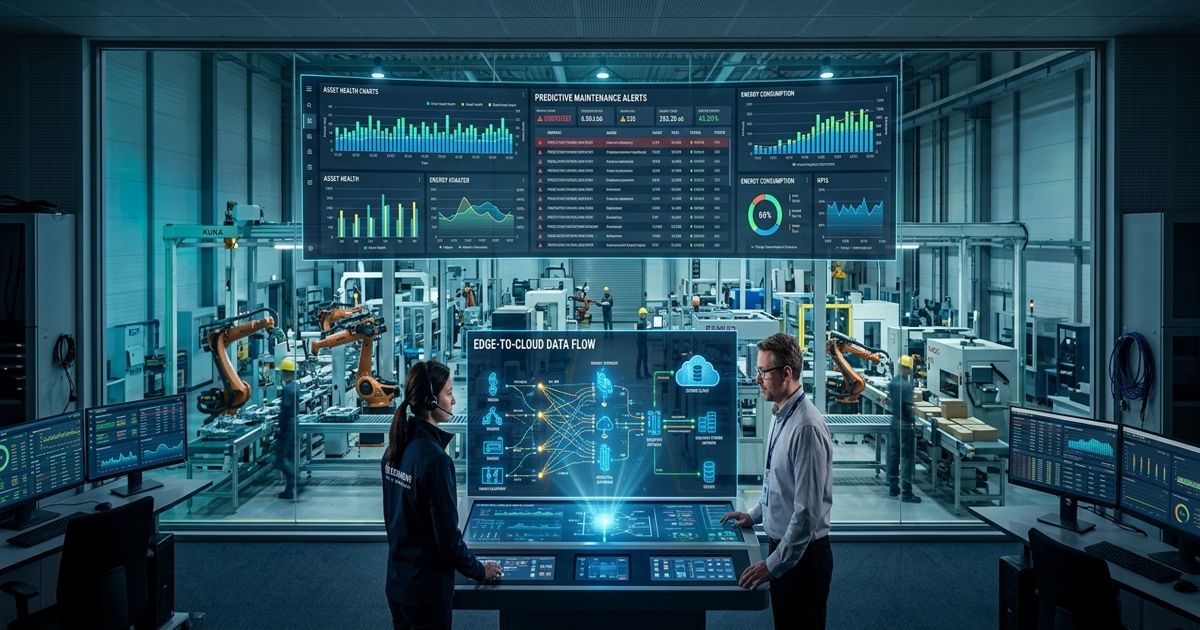
One of the most immediate applications of industrial automation software is manufacturing tracking software. This capability gives production managers a live view of machine status, throughput, cycle times, and asset health from a single dashboard.
Traditional tracking methods create data silos. One system logs machine output. Another tracks maintenance tickets. A third stores energy consumption data. None of them talk to each other. Manufacturing tracking software consolidates all of this into one centralized platform, enabling faster decisions and reducing the lag between a problem occurring and a technician being dispatched.
Merjio delivers this through its centralized data aggregation architecture. As explored in the centralized data aggregation platform case study, connecting distributed assets across a manufacturing environment enables teams to act on real-time signals rather than retrospective reports. This is exactly what manufacturing tracking software should do at scale.
Renewable Energy Asset Management Software: A Growing Priority
The expansion of solar farms, wind installations, and distributed energy grids has created a new demand for renewable energy asset management software. These environments involve assets spread across large geographic areas, often in remote locations with limited on-site staff.
Renewable energy asset management software must handle continuous sensor streams from inverters, turbines, meters, and environmental monitors. It must also flag anomalies that could indicate equipment wear, grid instability, or safety risks. Without intelligent automation, managing these assets at scale is impractical.
Merjio's edge-to-cloud architecture is well suited to this challenge. Edge devices process sensor data locally for low-latency alerts, while the cloud layer handles aggregation, trend analysis, and reporting. This design supports the kind of remote diagnostics and outcome-driven monitoring that renewable energy asset management software requires. Learn more about how Merjio approaches these challenges in Merjio Edge AI built for water treatment and mining sites.
Asset Reliability Solutions: Moving from Reactive to Predictive Maintenance
The true value of industrial automation software becomes clear when examining asset reliability solutions. Most industrial plants still operate on scheduled maintenance cycles. Technicians perform checks at fixed intervals regardless of actual asset condition. This approach is inefficient and misses the early warning signs that precede most failures.
AI-driven asset reliability solutions work differently. They use continuous sensor data to build a baseline of normal operating behavior for each asset. When readings deviate from that baseline, the system flags the anomaly and alerts the relevant team. The AI distinguishes between minor fluctuations that are within normal range and deviations that signal a developing problem.
Merjio supports this shift from scheduled to predictive maintenance through its AI-powered anomaly detection engine. Facility managers receive alerts before failures occur, giving them time to schedule targeted interventions. This reduces unplanned downtime, extends asset lifespan, and lowers overall maintenance costs. For a deeper look at how these capabilities apply in practice, visit the blog on key benefits of the industrial monitoring and control platform.
How Merjio Delivers Industrial Automation at Scale
Merjio is an AI-powered Industrial IoT platform developed by Lanware Solutions. It is designed around three core principles: Simplicity, Scalability, and Security. These principles guide every layer of the platform, from device onboarding to cloud-based reporting.
The platform supports real-time monitoring and intelligent control of connected assets, making it more than a passive data collection tool. Operators can remotely adjust parameters, receive AI-generated recommendations, and act on alerts without being physically present at the asset location. This is a critical capability for facilities managing assets across multiple sites.
Merjio also aligns with Industry 5.0 goals. It supports worker safety through real-time hazard alerts, energy optimization through consumption monitoring, and human-machine collaboration through AI guidance that supports rather than replaces human decision-making. For teams evaluating industrial automation software for smart factory use cases, the blog on Merjio smart factory and modern industrial IoT solutions provides a useful operational perspective.
What Makes Merjio Different from Generic IIoT Platforms?
Generic IIoT platforms offer connectivity. Merjio offers intelligence. The difference lies in how data is processed and acted upon. Many platforms collect data and display dashboards. Merjio applies AI at the edge and in the cloud to convert raw sensor data into actionable operational insight.
The platform also supports centralized device management, which is essential for operations running dozens or hundreds of connected assets. IT and OT teams can manage firmware updates, connectivity status, and alert thresholds from a single interface. This reduces the overhead of managing distributed infrastructure manually.
Security is embedded by design. With industrial environments increasingly targeted by cyber threats, Merjio's secure cloud-based infrastructure built on AWS and Azure ensures that data in transit and at rest is protected. According to the International Energy Agency, cybersecurity in industrial systems is now one of the top concerns for energy sector operators globally, making this a non-negotiable feature for any serious industrial automation software platform.
Is Your Operation Ready for Industrial Automation Software?
If your facility is still managing assets through spreadsheets, manual inspection rounds, or disconnected monitoring tools, the operational risk is real. Unplanned downtime costs industrial manufacturers an estimated USD 50 billion annually, according to industry research. The question is not whether to adopt industrial automation software, but how quickly you can do it effectively.
Merjio is built to onboard quickly and scale across sites. Its edge-to-cloud design means you do not need to overhaul your existing infrastructure to get started. You can begin with priority assets and expand as your team builds confidence in the platform.
For operations teams ready to move from reactive monitoring to proactive intelligence, industrial automation software like Merjio offers a practical and scalable path forward. The combination of real-time visibility, AI-driven predictive maintenance, and centralized control makes it one of the most complete platforms available for industrial environments today.
Conclusion
Industrial automation software is transforming how plants, factories, and energy facilities operate. From manufacturing tracking software that unifies floor-level data, to renewable energy asset management software that monitors remote assets in real time, to asset reliability solutions that predict failures before they happen, the capabilities are broad and the benefits are measurable. Merjio brings all of these capabilities together in one platform, designed for the complexity of modern industrial operations. If you are ready to improve uptime, reduce costs, and take control of your assets, explore the full range of Lanware's connected solutions on the Lanware products page today.
Frequently Asked Questions
What is industrial automation software used for in manufacturing?
is used to monitor machine health, track production output, manage alerts, and control assets remotely. It consolidates data from multiple sources so operations teams can act faster, reduce downtime, and improve overall equipment effectiveness across the manufacturing floor.
How does Merjio support asset reliability solutions?
Merjio uses AI-powered anomaly detection to continuously compare live sensor data against normal operating baselines. When deviations are detected, the system alerts facility managers before a failure occurs. This approach supports condition-based monitoring strategies that reduce reactive maintenance and extend asset lifespan.
What is the difference between preventive and predictive maintenance in IIoT?
Preventive maintenance follows fixed schedules regardless of actual asset condition. Predictive maintenance uses real-time sensor data and AI to identify early warning signs of failure. Predictive approaches reduce unnecessary interventions, lower costs, and improve asset uptime compared to traditional time-based maintenance programs.
Can Merjio be used as renewable energy asset management software?
Yes. Merjio's edge-to-cloud architecture supports remote asset monitoring across distributed energy installations. Its anomaly detection and real-time alerting capabilities make it well suited for monitoring inverters, turbines, and meters in solar and wind environments where on-site staffing is limited.
What industries benefit most from industrial automation software?
Manufacturing, renewable energy, water treatment, mining, maritime, and telecommunications all benefit significantly. Any industry managing large numbers of physical assets across multiple sites gains from real-time visibility, predictive maintenance, and centralized control that industrial automation software platforms provide.
How does edge computing improve industrial automation software performance?
Edge computing processes sensor data locally at the device level, reducing latency and enabling real-time responses even in low-connectivity environments. When combined with cloud analytics, as seen in platforms like Merjio, it creates a robust smart plant monitoring architecture that balances speed with deep analytical capability.
What makes manufacturing tracking software different from basic monitoring tools?
Manufacturing tracking software goes beyond data display. It integrates machine output, maintenance history, energy use, and asset status into one platform. This unified view helps production managers identify bottlenecks, predict equipment issues, and make operational decisions backed by real-time data rather than delayed reports.
Is Merjio suitable for small and mid-sized manufacturing operations?
Merjio is designed around simplicity and scalability, which makes it accessible for operations of varying sizes. Teams can start by connecting priority assets and expand the deployment over time without overhauling existing infrastructure, making adoption practical for mid-sized facilities exploring industrial automation software for the first time.
How does Merjio align with Industry 5.0 goals?
Merjio supports Industry 5.0 outcomes including worker safety, energy optimization, and human-machine collaboration. Its AI provides guidance rather than replacing human judgment. Facilities using the platform also benefit from improved traceability and compliance, both of which are core priorities within the smart factory automation and IoT monitoring framework.
What should operations teams look for in asset reliability solutions?
Look for platforms that offer continuous sensor monitoring, AI-based anomaly detection, real-time alerting, and integration with existing OT infrastructure. The ability to distinguish between normal operational variation and genuine failure signals is critical. Scalability across multiple sites and secure cloud infrastructure are also essential selection criteria for reliable asset reliability solutions.
Related product
Merjio IIoT Platform by Lanware
Any sensor. Any industry. One unified data layer — explore SKID solutions, AI-driven analytics, and live monitoring on the Merjio platform.
Explore merjio.com