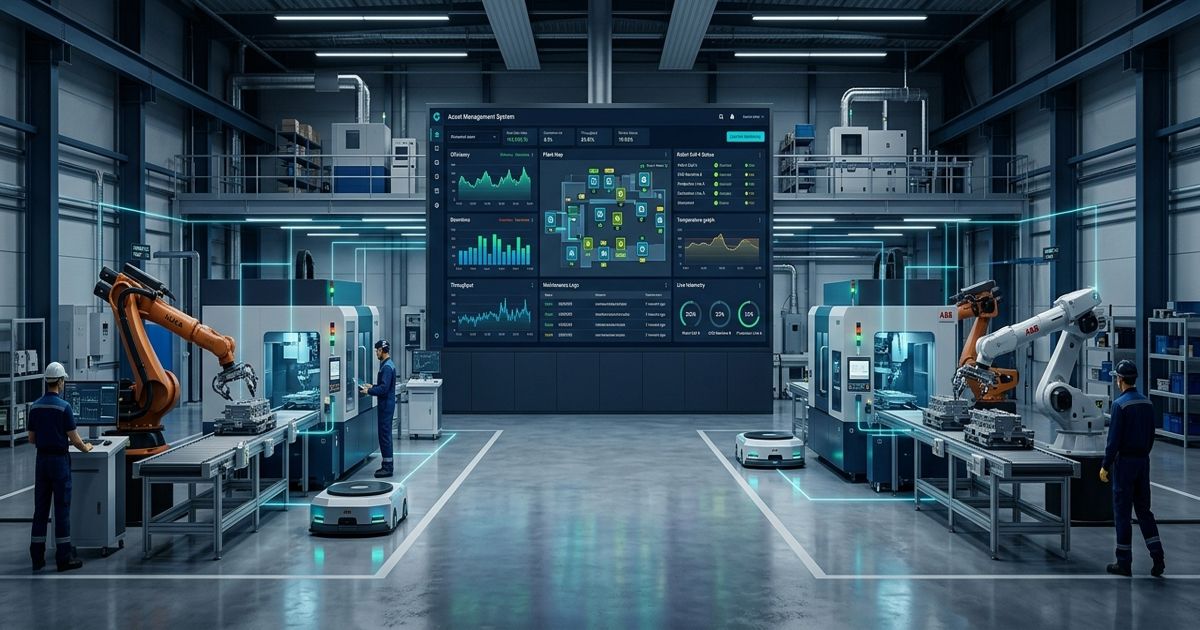
Asset Management System: Enhances Industrial Automation and Smart Manufacturing
 Author
 Date of Publication
 Category
Asset Management System technologies are reshaping how industrial facilities operate, maintain equipment, and drive smart manufacturing outcomes. As factories evolve toward connected, data-driven environments, the ability to monitor, control, and optimize assets in real time has become a critical competitive advantage. This blog explores how a modern asset management system integrates with industrial automation frameworks, what capabilities matter most, and how platforms like Merjio deliver measurable operational improvements across manufacturing and industrial sectors.
Key Takeaways
- A robust Asset Management System enables real-time visibility, predictive maintenance, and centralized control across industrial assets and production lines.
- A connected Device Management System reduces unplanned downtime by consolidating equipment data and enabling intelligent, automated responses to operational anomalies.
- Modern Asset Tracking Solutions bridge the gap between operational technology and information technology, supporting smarter, safer, and more sustainable manufacturing environments.
What Is an Asset Management System in Industrial Automation?
An Asset Management System is a technology platform that provides centralized oversight of physical assets throughout their operational lifecycle. In industrial automation, this means tracking machines, sensors, controllers, and production equipment in real time. The system collects operational data, analyzes performance patterns, and enables plant managers to make proactive decisions rather than reactive ones.
In smart manufacturing, assets are no longer managed in isolation. They are interconnected through Industrial IoT (IIoT) networks that feed continuous data into a central platform. Industry research consistently shows that manufacturers adopting connected asset monitoring can reduce maintenance costs while improving overall equipment effectiveness. The shift from manual tracking to automated, AI-driven management is at the core of Industry 4.0 and Industry 5.0 adoption.
Modern platforms combine edge computing with cloud infrastructure to ensure that data is processed close to the source for immediate alerts, while longer-term analytics are handled in the cloud. This architecture supports both speed and scale, which are essential requirements for large industrial environments. Learn more about how industrial automation software is evolving to meet these demands.
How a Device Management System Drives Operational Efficiency
A Device Management System is the operational backbone of any connected industrial environment. It handles the configuration, monitoring, and control of all connected devices across a facility or across multiple sites. Without centralized device management, teams face fragmented data, inconsistent firmware, and reactive maintenance cycles that drive up costs and reduce throughput.
Centralized device management enables plant managers to push updates, monitor device health, and respond to faults from a single interface. This eliminates the need for manual, on-site interventions for routine diagnostics. For operations that span multiple facilities or geographic locations, this capability is transformative. It allows engineering teams to manage hundreds or thousands of endpoints without proportionally scaling their workforce.
Merjio, developed by Lanware Solutions, offers centralized device management as a core capability within its AI-powered IIoT platform. The system is designed around simplicity, scalability, and security, ensuring that industrial teams can manage complex device ecosystems without requiring deep IT expertise at the edge. This is particularly valuable for OEMs and plant managers overseeing distributed asset networks.
Asset Tracking Solutions for Real-Time Visibility and Control
Asset Tracking Solutions go beyond simple location monitoring. In a smart manufacturing context, they provide continuous operational data including utilization rates, performance metrics, condition indicators, and maintenance histories. This level of visibility allows operations teams to optimize asset deployment, reduce idle time, and extend equipment lifespan through proactive interventions.
Real-time asset tracking integrates directly with predictive maintenance systems. When a sensor detects an anomaly, such as abnormal vibration or temperature drift, the asset tracking layer immediately flags the affected asset and correlates the event with historical performance data. AI models then determine whether the anomaly signals an imminent failure or falls within acceptable variation ranges. This intelligent filtering reduces false alarms and focuses maintenance resources where they are genuinely needed.
Platforms like Merjio use AI-driven anomaly detection to distinguish between normal operational variations and conditions that require intervention. Facility managers receive real-time alerts that are contextualized and actionable, not just raw data notifications. This approach reflects the Industry 5.0 principle of human-machine collaboration, where AI augments human decision-making rather than replacing it. Explore how Merjio revolutionizes industrial asset management through intelligent tracking and control.
Predictive Maintenance: Moving Beyond Scheduled Servicing
Traditional maintenance schedules are built on fixed intervals, which often result in either premature servicing or missed failure points. Predictive maintenance, powered by an Asset Management System, changes this model fundamentally. It uses real-time sensor data, machine learning models, and historical failure patterns to predict when an asset is likely to fail, then schedules maintenance at the optimal moment.
This shift delivers measurable benefits. Unplanned downtime drops because failures are anticipated rather than discovered after the fact. Maintenance labor is deployed more efficiently because technicians work on assets that actually need attention. Spare parts inventory can be optimized because procurement is based on predicted demand rather than blanket safety stock policies.
Optimized maintenance scheduling is widely recognized as a key lever for improving energy efficiency and reducing operational waste in industrial facilities. Merjio's AI-driven predictive maintenance capability is purpose-built for this outcome, enabling manufacturers to move away from costly time-based servicing toward condition-based, data-driven maintenance programs. For more on this approach, see our detailed overview of condition-based monitoring software.
Smart Manufacturing Integration: OT and IT Convergence
One of the most significant challenges in deploying an Asset Management System within a smart manufacturing environment is bridging operational technology (OT) and information technology (IT). Historically, these two domains operated in silos. OT teams managed physical equipment and control systems, while IT teams managed data networks, servers, and enterprise applications. Smart manufacturing demands that they work together seamlessly.
IIoT platforms address this convergence by providing a unified data layer that aggregates signals from OT systems and makes them accessible through IT-friendly interfaces including dashboards, APIs, and cloud analytics tools. This enables IT and OT teams to collaborate on performance optimization, compliance reporting, and digital transformation initiatives without requiring wholesale replacement of existing equipment.
Merjio's edge-to-cloud architecture is specifically designed to support this convergence. Edge nodes process data locally for real-time control decisions, while cloud infrastructure handles historical analytics, reporting, and AI model training. This dual-layer approach ensures that latency-sensitive operations are not disrupted by network variability, while long-term intelligence is continuously refined. Understanding the key benefits of industrial monitoring and control platforms is essential for teams planning this integration.
Industry 5.0 Alignment: Safety, Sustainability, and Resilience
Modern Asset Management Systems are increasingly designed to support Industry 5.0 goals, which extend beyond automation efficiency to encompass worker safety, sustainability, and organizational resilience. This alignment reflects a broader shift in industrial strategy, where technology is evaluated not just for productivity gains but for its contribution to people and the environment.
Worker safety improves when asset management systems provide real-time alerts about equipment conditions that could pose hazards. Energy optimization becomes possible when the system identifies high-consumption assets and recommends operational adjustments. Traceability and compliance are supported through integrated reporting that captures asset histories and maintenance records across the entire operational lifecycle.
Merjio is developed with these outcomes in mind. The platform supports remote diagnostics, early-warning systems, and outcome-driven service models that align with the resilience and sustainability priorities of modern industrial organizations. For manufacturers evaluating their digital transformation roadmap, this alignment with Industry 5.0 principles represents a strategic differentiator.
Conclusion
An effective Asset Management System is no longer optional for manufacturers pursuing smart, connected operations. From centralized Device Management System capabilities that reduce downtime to intelligent Asset Tracking Solutions that enable predictive maintenance, these platforms are the foundation of modern industrial automation. Merjio by Lanware Solutions delivers these capabilities through an AI-powered, edge-to-cloud architecture built for simplicity, scalability, and security. Whether you are managing a single facility or a distributed industrial network, the right asset management platform transforms operational data into decisive action. To explore how Merjio can support your manufacturing goals, visit Merjio for smart factory and industrial IoT solutions.
Frequently Asked Questions
What is an Asset Management System in manufacturing?
An Asset Management System is a platform that tracks, monitors, and manages physical assets across their lifecycle. In manufacturing, it provides real-time operational data, maintenance histories, and performance insights that help plant managers reduce downtime and optimize equipment utilization efficiently.
How does a Device Management System reduce industrial downtime?
A Device Management System centralizes control of all connected devices, allowing teams to monitor device health, push updates, and respond to faults remotely. By eliminating reactive maintenance cycles, facilities experience fewer unexpected equipment failures and more predictable production outcomes across operations.
What are Asset Tracking Solutions used for in smart factories?
Asset Tracking Solutions provide continuous visibility into asset location, utilization, and condition. In smart factories, they feed data into predictive maintenance systems and AI analytics platforms, enabling operations teams to optimize asset deployment and intervene before failures occur, reducing operational waste significantly.
How does predictive maintenance differ from preventive maintenance?
Preventive maintenance follows fixed time-based schedules, which can result in premature servicing or missed failures. Predictive maintenance uses real-time sensor data and AI models to anticipate failures based on actual equipment conditions, making maintenance scheduling far more precise, cost-effective, and operationally efficient.
What is edge-to-cloud architecture in an IIoT Asset Management System?
Edge-to-cloud architecture processes data locally at the device level for real-time decisions, while cloud infrastructure handles long-term analytics and AI model training. This dual-layer approach ensures that latency-sensitive control operations remain fast, while strategic insights are continuously refined using aggregated historical data.
How does AI-driven anomaly detection improve asset performance?
AI-driven anomaly detection distinguishes between normal operational variations and conditions that signal potential failures. By filtering out false alarms and delivering contextualized alerts, it allows maintenance teams to focus resources precisely where needed, supporting the human-machine collaboration model central to manufacturing software solutions.
Can an Asset Management System support multiple industrial sites?
Yes. Modern platforms like Merjio are designed for scalability across multiple sites and asset types. Centralized dashboards aggregate data from distributed locations, enabling plant managers and engineering teams to monitor and control operations across their entire industrial network from a single unified interface.
What industries benefit most from Asset Tracking Solutions?
Manufacturing, maritime, telecommunications, and vending operations benefit significantly from Asset Tracking Solutions. Any sector managing distributed physical assets across multiple locations can use these platforms to improve visibility, reduce maintenance costs, and support data-driven operational decisions, as explored through enterprise application development for industrial sectors.
How does an Asset Management System support Industry 5.0 goals?
Industry 5.0 prioritizes worker safety, sustainability, and resilience alongside productivity. Asset management platforms contribute by providing real-time safety alerts, energy optimization recommendations, and traceability reporting. These capabilities help organizations meet compliance requirements while building more resilient and environmentally responsible industrial operations.
What should manufacturers look for when selecting an Asset Management System?
Manufacturers should evaluate real-time monitoring capabilities, AI-driven predictive maintenance, centralized device management, scalability across sites, and secure cloud infrastructure. An edge-to-cloud architecture that supports OT and IT convergence is particularly valuable for organizations pursuing digital transformation in complex industrial environments.
Related product
Merjio IIoT Platform by Lanware
Any sensor. Any industry. One unified data layer — explore SKID solutions, AI-driven analytics, and live monitoring on the Merjio platform.
Explore merjio.com