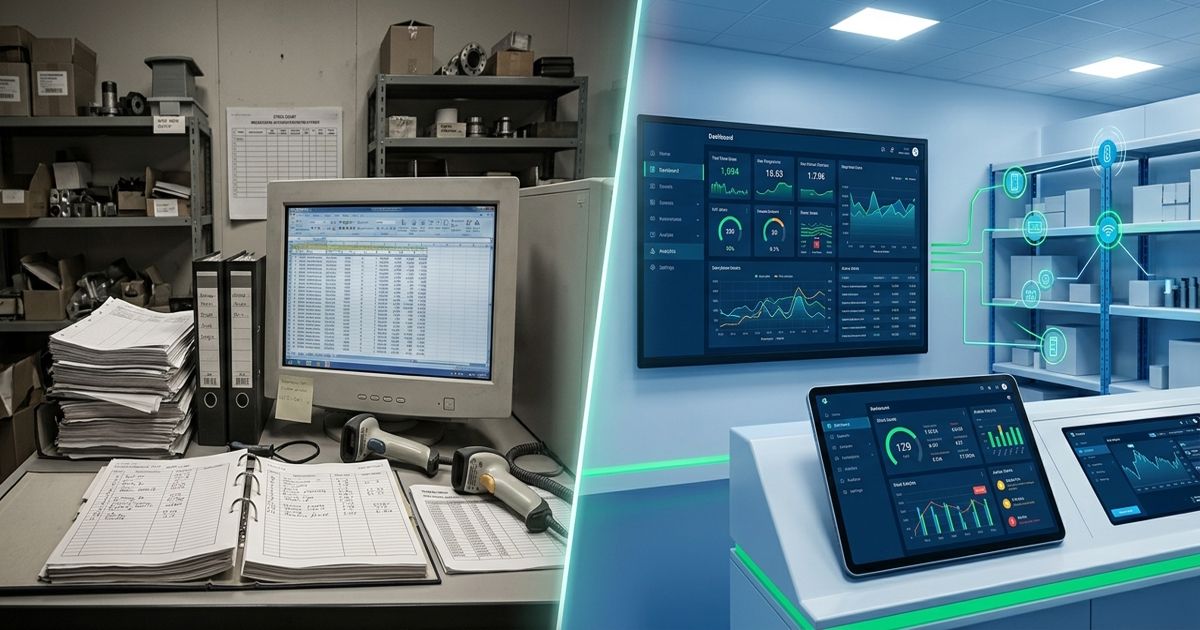
Inventory Management System vs Traditional Inventory Tracking
 Author
 Date of Publication
 Category
Inventory management system adoption is accelerating across industries as businesses face growing pressure to reduce waste, improve accuracy, and respond faster to demand shifts. Traditional inventory tracking methods, built on spreadsheets and manual counts, simply cannot keep pace with modern operational demands. This blog breaks down the core differences between the two approaches, explores how inventory management software delivers measurable advantages, and explains how smart industrial automation is reshaping the way businesses track and manage their assets in real time.
Key Takeaways
- A modern inventory management system replaces manual tracking with real-time, automated data capture, reducing errors and improving operational visibility.
- Inventory management software enables predictive restocking, centralized control, and integration with industrial IoT platforms for smarter decision-making.
- Traditional methods are prone to human error, delayed reporting, and scalability limitations that modern software directly addresses.
What Is Traditional Inventory Tracking?
Traditional inventory tracking refers to manual processes used to record, monitor, and manage stock levels. These methods typically rely on paper logs, spreadsheets, periodic physical counts, and barcode scanners operated by warehouse staff. While these approaches served businesses adequately for decades, they come with significant limitations in today's fast-moving industrial environments.
Manual tracking is time-intensive and vulnerable to human error. A miskeyed entry, a skipped count, or a delayed update can cascade into stock discrepancies, production delays, or costly overstock situations. For manufacturers managing hundreds of SKUs across multiple facilities, traditional tracking creates operational blind spots that are difficult to recover from.
According to research from McKinsey and Company, companies that rely on manual supply chain processes face significantly higher operational costs and slower response times compared to those using digitized systems. The gap between manual and automated inventory control is widening every year.
What Is a Modern Inventory Management System?
A modern inventory management system is a software-driven platform that automates the capture, processing, and analysis of inventory data in real time. Unlike spreadsheets or periodic audits, these systems continuously track stock movements, generate alerts for low-stock or anomaly conditions, and provide actionable insights through dashboards and reports.
At its core, inventory management software integrates with sensors, RFID readers, barcode scanners, and IoT-connected devices to collect data automatically. This eliminates the reliance on manual entry and ensures that inventory records are always up to date. Advanced platforms also layer in AI-driven analytics to forecast demand, identify waste patterns, and optimize reorder points.
For industrial environments, the benefits extend well beyond simple stock counts. Platforms like Merjio, which is designed to revolutionize industrial asset management, combine real-time monitoring with intelligent control capabilities to give operations teams a complete picture of their assets and inventory at all times. This edge-to-cloud approach ensures data is captured at the source and processed centrally for enterprise-wide visibility.
Key Differences: Inventory Management System vs Traditional Tracking
Accuracy and Data Integrity
Traditional tracking depends on human input, which introduces the risk of transcription errors, omissions, and outdated records. A physical count conducted once a week or once a month may miss intraday stock movements entirely. In contrast, an inventory management system captures every transaction as it happens, maintaining a continuous and accurate record without relying on manual intervention.
In manufacturing environments, this difference is critical. A component that goes unrecorded during a shift can halt a production line hours later. Automated systems prevent these gaps by logging every movement in real time, creating an audit trail that supports both operational and compliance requirements.
Real-Time Visibility vs Periodic Reporting
One of the most significant limitations of traditional inventory tracking is its reliance on periodic reporting. Managers receive snapshots of inventory status rather than live data, making it difficult to respond quickly to shortages, surpluses, or unusual consumption patterns.
Modern inventory management software provides continuous, real-time visibility across all inventory locations. Dashboards display current stock levels, movement trends, and exception alerts the moment they occur. This shift from reactive to proactive management is one of the primary drivers behind adoption of smart industrial automation in manufacturing and logistics. Learn how smart factory automation solutions are enabling this kind of real-time operational intelligence across industrial settings.
Scalability and Multi-Site Management
Traditional methods struggle to scale. Managing inventory across two or three locations with spreadsheets is complex enough. Across ten sites or hundreds of assets, it becomes unmanageable. Data must be manually consolidated, creating delays and inconsistencies that undermine decision-making.
An automated inventory management system is built for scale. Centralized platforms aggregate data from all connected sites and assets into a single interface, giving managers enterprise-wide visibility without the overhead of manual consolidation. This is especially relevant for manufacturers and OEMs managing distributed equipment fleets. Explore how manufacturing operations are leveraging connected platforms to manage assets and inventory at scale.
Integration with Industrial IoT and Predictive Capabilities
Traditional inventory tracking operates in isolation. It does not connect to machinery, sensors, or operational data streams. This means inventory decisions are made without the context of actual production conditions, consumption rates, or equipment health.
Modern systems integrate directly with IIoT platforms, enabling inventory management to respond dynamically to real-world conditions. When a machine consumes materials at a higher-than-expected rate due to an anomaly, an AI-powered platform can flag the issue, adjust projected inventory needs, and trigger a reorder automatically. This kind of intelligence is only possible when inventory management is connected to the broader operational data ecosystem.
According to Gartner, organizations that integrate inventory management with IoT-enabled supply chain platforms achieve significantly better forecast accuracy and lower carrying costs compared to those using standalone systems. The convergence of IIoT and inventory intelligence is a defining trend in smart industrial automation.
How Merjio Supports Smarter Inventory and Asset Management
Merjio, developed by Lanware Solutions, is an AI-powered Industrial IoT platform that supports streamlined asset and inventory management as part of its core feature set. By combining edge computing with cloud AI, Merjio gives operations teams real-time visibility into both assets and the inventory of consumables, spare parts, and materials tied to those assets.
The platform's anomaly detection capability identifies unusual patterns in equipment performance or consumption and alerts facility managers before they escalate into larger problems. This proactive intelligence reduces unplanned downtime and helps teams maintain optimal inventory levels without overstocking or running short. The platform is built on the principles of Simplicity, Scalability, and Security, making it accessible for industrial operations of varying sizes and complexity.
For teams exploring how IIoT platforms integrate with broader manufacturing operations, the complete guide to Merjio industrial IoT solutions provides a detailed overview of the platform's capabilities and deployment model. For broader context on how manufacturing software is evolving, the manufacturing software solutions resource offers useful comparative perspective.
Which Approach Is Right for Your Business?
The right choice depends on the scale, complexity, and growth ambitions of your operation. Small businesses with limited SKUs and single locations may manage adequately with basic software tools. However, any organization managing industrial assets, multiple facilities, or real-time production environments will quickly outgrow manual or semi-automated methods.
If your business is experiencing stockouts, reconciliation errors, delayed reporting, or difficulty scaling inventory oversight across sites, transitioning to a modern inventory management system is the logical next step. The combination of automation, AI, and IIoT integration provides a level of operational intelligence that traditional tracking simply cannot replicate.
Conclusion
The difference between a modern inventory management system and traditional inventory tracking comes down to speed, accuracy, and intelligence. Traditional methods are reactive, error-prone, and difficult to scale. Modern inventory management software, particularly when integrated with smart industrial automation platforms, delivers real-time visibility, predictive insights, and centralized control that transform how businesses manage their operations. For industrial organizations looking to reduce waste, improve uptime, and gain full asset visibility, adopting a connected inventory and monitoring platform is a competitive necessity. To learn how Merjio can support your operational goals, contact the Lanware Solutions team today.
Frequently Asked Questions
What is the main difference between an inventory management system and traditional tracking?
A modern inventory management system automates data capture in real time, while traditional tracking relies on manual entry and periodic counts. Automated systems reduce errors, provide continuous visibility, and scale across multiple sites, which manual methods simply cannot achieve efficiently.
How does inventory management software reduce human error?
Inventory management software eliminates manual data entry by connecting directly to sensors, RFID readers, and IoT devices. Every stock movement is logged automatically and instantly. This creates an accurate, continuous audit trail that reduces transcription mistakes and prevents discrepancies from compounding over time.
Can a small manufacturing business benefit from an inventory management system?
Yes. Even smaller manufacturers benefit from reduced stockouts, faster reconciliation, and better demand forecasting. As operations grow, an inventory management system scales without the need to add administrative overhead, making it a cost-effective investment for businesses planning to expand their production capacity.
What role does smart industrial automation play in inventory management?
Smart industrial automation connects inventory systems to live production data. When machinery consumption rates change or anomalies occur, automated platforms adjust inventory forecasts and trigger reorders dynamically. This integration ensures inventory levels align with actual operational conditions rather than historical averages or scheduled counts.
How does an IIoT platform like Merjio improve asset and inventory tracking?
Merjio combines edge computing with cloud AI to provide real-time monitoring and control of industrial assets, including inventory of spare parts and consumables. Its anomaly detection alerts facility managers to unusual consumption patterns, helping teams maintain optimal stock levels and avoid costly unplanned downtime across distributed operations.
What are the biggest limitations of traditional inventory tracking methods?
Traditional methods are slow, error-prone, and difficult to scale. Periodic counts miss intraday movements, spreadsheets create version control issues, and manual consolidation across sites is time-consuming. These limitations result in stock discrepancies, delayed decisions, and reduced responsiveness to demand changes in fast-moving industrial environments.
How does real-time inventory visibility improve operational decision-making?
Real-time visibility gives managers live data on stock levels, consumption trends, and exception alerts the moment they occur. This enables faster, more accurate decisions about restocking, production scheduling, and resource allocation. Businesses using industrial automation software for inventory intelligence report significantly faster response times to supply disruptions.
Is it difficult to transition from traditional inventory tracking to a modern system?
The transition requires data migration, staff training, and integration with existing equipment or sensors. However, platforms designed for industrial environments are built for scalability and straightforward deployment. Working with an experienced technology partner simplifies the process and helps organizations realize value from their inventory management system quickly.
What industries benefit most from automated inventory management systems?
Manufacturing, maritime, telecommunications, and logistics sectors see the greatest benefits. These industries manage large volumes of assets, consumables, and spare parts across multiple locations. Automated systems provide the centralized control and real-time intelligence needed to keep operations running smoothly. Explore how industrial manufacturing monitoring delivers measurable operational gains.
How does predictive maintenance connect to inventory management in industrial settings?
Predictive maintenance uses AI to forecast when equipment will require servicing, allowing teams to pre-position the right spare parts before a failure occurs. This direct link between machine health data and inventory planning reduces emergency procurement costs and ensures maintenance teams have what they need exactly when they need it.
Related product
Merjio IIoT Platform by Lanware
Any sensor. Any industry. One unified data layer — explore SKID solutions, AI-driven analytics, and live monitoring on the Merjio platform.
Explore merjio.com