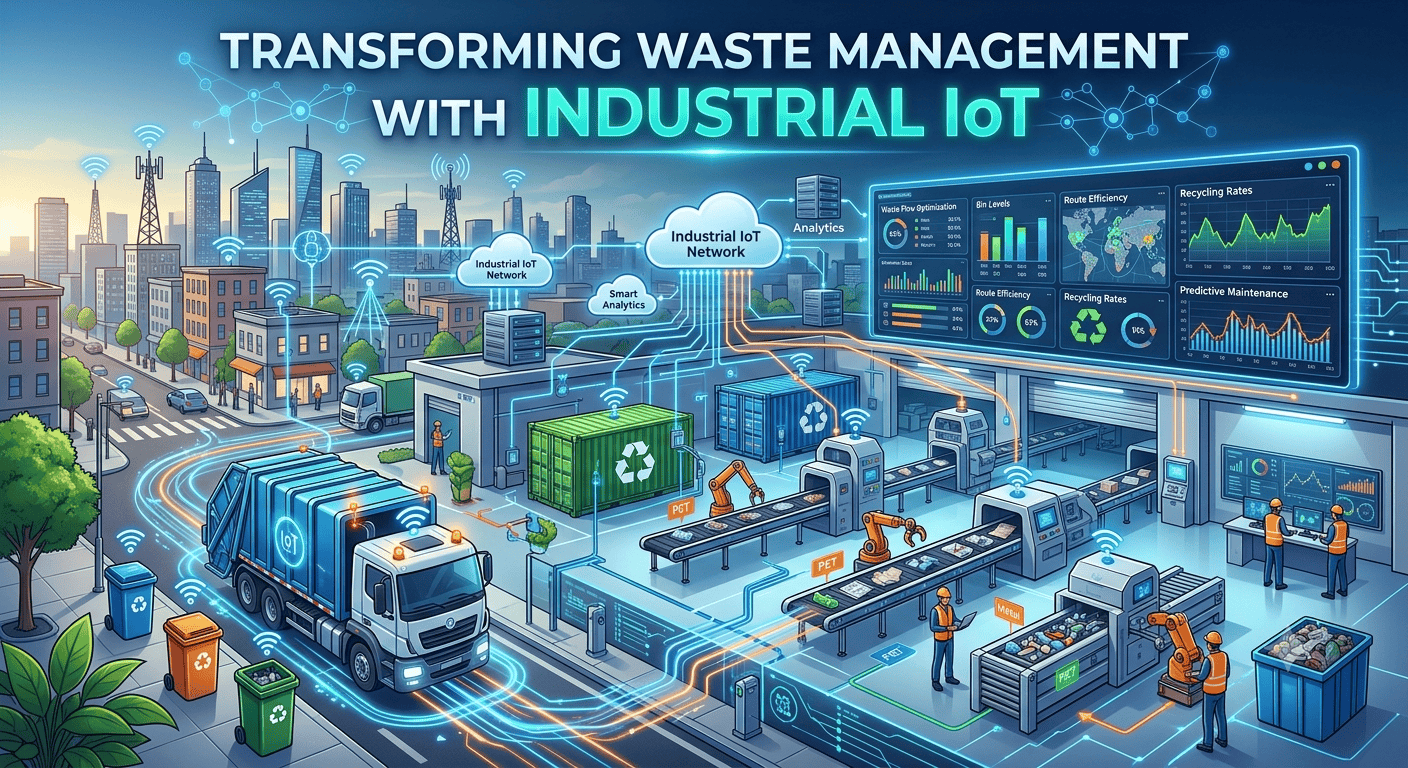
Transforming Waste Management with Industrial IoT
 Category
 Service Line
How Adlis and Merjio Built a Scalable Smart Waste Monitoring Platform
Executive Summary
Traditional waste management operations often depend on fixed collection schedules, manual inspections, and reactive maintenance. While these approaches may work for basic waste collection, they become increasingly inefficient when organizations manage large numbers of waste bins across multiple locations. Without real-time visibility into bin status, operators may face overflowing bins, unnecessary collection trips, delayed fault detection, higher operational costs, and inconsistent service quality.
Adlis Intelligent Waste Management addressed these challenges by developing an IoT-enabled Smart Bin solution and integrating it with the Merjio Industrial IoT Platform. The resulting solution transformed conventional waste management into a connected and data-driven operation by continuously collecting operational data from smart bins and making that information available through a centralized platform.
The Merjio platform provides device and asset management, real-time telemetry, centralized dashboards, configurable alerts, remote device management, analytics, and historical reporting. This enables operations teams to monitor distributed smart-bin deployments from a single interface, identify issues earlier, reduce dependency on manual inspections, and make better-informed maintenance and operational decisions.
The Challenge: A Reactive Approach to Waste Management
Waste collection is traditionally driven by predetermined schedules rather than actual demand. As a result, collection teams may visit bins that do not require servicing while other bins become full before the next scheduled collection.
For organizations such as municipal corporations, airports, campuses, hospitals, and commercial facilities, this creates several operational challenges. Operators may have limited visibility into the real-time status of individual bins, while equipment failures can remain undetected until a field inspection or customer complaint occurs.
The absence of centralized monitoring also creates difficulties when smart bins are deployed across geographically distributed locations. Teams need to coordinate multiple assets manually, making it harder to understand overall fleet health, identify recurring problems, and prioritize maintenance activities.
The key challenges identified for the project included:
- No real-time visibility into waste-bin status.
- Fixed collection schedules that did not reflect actual fill levels.
- Overflowing bins affecting cleanliness and customer experience.
- Equipment failures being identified only after inspections or complaints.
- Manual coordination across multiple deployment locations.
- Lack of a centralized system for asset monitoring and reporting.
- Preventive maintenance activities resulting in unnecessary service visits.
- Limited operational data for optimizing routes and resource allocation.
This reactive model made it difficult for waste-management operators to move from simply responding to problems toward proactively managing their assets.
The Objective: Moving Toward Connected Operations
The primary objective was to digitize waste-management operations and create continuous visibility into the condition and performance of smart bins.
The project focused on enabling remote monitoring, reducing manual inspection efforts, improving equipment uptime, centralizing geographically distributed deployments, and supporting data-driven maintenance and operational decisions.
Another important objective was scalability. The solution needed to provide a foundation that could support future AI capabilities rather than functioning only as a basic monitoring system.
The Solution: IoT-Enabled Smart Bins Powered by Merjio
Adlis combined its Smart Bin hardware with the Merjio Industrial IoT Platform to establish a connected monitoring architecture.
Each Smart Bin is equipped with a custom control board that continuously collects telemetry from onboard sensors. The operational data is securely published to Merjio, where it is received, stored, processed, and visualized in near real time.
This architecture creates a continuous flow of information from the physical waste-management asset to the digital platform. Instead of relying on manual checks, operators can access current asset information through a centralized system and use alerts, dashboards, analytics, and remote management capabilities to respond to operational conditions.
The architecture effectively connects the Smart Bin, connectivity layer, Merjio platform, and operations teams, creating a single source of information for the waste-management fleet.
Digital Asset Management Across the Waste Fleet
A key capability of the solution is the representation of every deployed Smart Bin as a digital asset within Merjio.
The platform supports a hierarchical asset structure covering the location, Smart Bin, controller, motor, battery, and sensors. This structure allows organizations to manage individual components while maintaining visibility across the broader asset hierarchy.
The solution also supports device lifecycle management, including device registration, provisioning, mapping, health monitoring, and secure communication.
For organizations managing Smart Bins across multiple sites, this provides a scalable approach to organizing and monitoring the entire deployment rather than treating each device as an isolated unit.
Real-Time Telemetry for Smarter Waste Management
One of the most important improvements introduced by the solution is continuous access to operational telemetry.
Merjio captures and visualizes parameters including:
- Fill level
- Battery capacity
- Power status
- Compression count
- Motor operating status
- Motor operating time
- Lid status
- Cleaning-door status
- UV lamp status
- LED status
- Fault status
- Sensor health
- Communication status
This data gives operators visibility into both the waste-management function and the condition of the equipment supporting it.
For example, fill-level information can help identify bins approaching capacity, while battery and motor information provides insight into equipment health. Communication and sensor status can also help teams identify devices that may require attention. The platform therefore turns raw sensor data into operational information that can support faster and more informed decisions.
Centralized Monitoring Through a Single Dashboard
Managing a distributed Smart Bin fleet becomes significantly easier when information is consolidated into one platform.
The Merjio dashboard allows operations teams to monitor total deployed bins, online and offline devices, active alarms, battery health, fill-level trends, device utilization, historical telemetry, and fault history.
Instead of relying on separate monitoring processes for different locations, teams can access fleet-level information through a single web portal. This centralized view improves operational visibility and provides a foundation for comparing performance, identifying trends, and prioritizing action.
Remote Device Management and Diagnostics
The solution also extends beyond monitoring by enabling remote device management.
Operators can execute device commands, monitor controller health, configure operational parameters, and diagnose equipment issues remotely. This reduces the need for field teams to physically visit devices simply to investigate or address certain operational conditions.
Remote management is particularly valuable when Smart Bins are deployed across multiple locations. By providing operators with access to device-level information and controls from a centralized platform, Merjio helps reduce field dependency and supports faster operational response.
Proactive Alerts and Notifications
Merjio provides configurable alerts based on operational thresholds and abnormal conditions.
Alerts can be generated for:
- High fill levels
- Low battery
- Motor faults
- Sensor failures
- Communication loss
- Device offline status
- Abnormal operating conditions
This changes the operational model from one based on complaints and manual inspections to one where teams can receive information about potential issues as they occur.
For example, a high fill-level alert can draw attention to a bin that requires collection, while a motor or sensor alert can help maintenance teams identify equipment issues earlier.
Business Value Delivered
The implementation provides benefits across four major areas: operational efficiency, maintenance optimization, data-driven decision-making, and customer experience.
Operational Efficiency:
Centralized monitoring reduces dependence on manual inspections and gives teams faster visibility into operational issues. The ability to monitor multiple deployment locations through one platform supports more coordinated fleet management.
Maintenance Optimization:
Early identification of equipment failures allows teams to plan maintenance more effectively. Historical telemetry provides additional information for service planning, while remote diagnostics can reduce unnecessary field visits and emergency maintenance activities.
Data-Driven Decision-Making:
Historical telemetry, device utilization reports, operational trends, and location-level information provide a stronger foundation for planning. Instead of relying solely on assumptions or fixed schedules, operators can use actual asset data to understand fleet performance.
Improved Customer Experience:
Better visibility into fill levels and equipment condition can help reduce overflowing bins, improve equipment availability, and support faster responses to operational issues. These improvements contribute to cleaner public spaces and more consistent service quality.
From Monitoring to Operational Intelligence
The significance of the Merjio platform extends beyond collecting sensor readings. The platform is designed to convert continuous telemetry into actionable operational intelligence.
Fill-level information can support collection planning, battery data can help teams monitor capacity and replacement requirements, and motor performance data can highlight unusual runtime or compression behavior. Connectivity information can identify offline devices and communication failures, while hygiene-related telemetry can provide visibility into UV lamp, cleaning-door, and lid sensor conditions.
Historical utilization and performance trends can also help organizations understand location-wise behavior and asset utilization over time.
The Next Evolution: AI-Powered Waste Management
The solution establishes a foundation for future AI-driven capabilities.
The roadmap includes AI-based anomaly detection, which can identify unusual patterns such as unexpected battery drain, abnormal motor behavior, communication failures, sensor anomalies, and repeated fault conditions.
The platform can also evolve toward predictive maintenance, using historical operating data and usage patterns to forecast potential component failures. Potential applications include motor-wear prediction, battery replacement forecasting, sensor degradation detection, compression-mechanism health monitoring, and remaining-useful-life estimation.
Another planned capability is a Conversational AI Assistant. Instead of navigating multiple dashboards, operations teams could ask natural-language questions such as:
- Which bins require maintenance today?
- Why is Bin 204 offline?
- Which bins have battery levels below 20%?
- Which locations generated the most faults this week?
- What is the current fleet health?
This represents the next step in the evolution from connected assets to intelligent operations.
A Scalable Industrial IoT Foundation
Although the initial application focuses on Smart Waste Management, Merjio is designed as an industry-agnostic Industrial IoT platform.
The same platform architecture can be extended to water and wastewater treatment, smart buildings, home automation, industrial equipment monitoring, energy management, healthcare devices, environmental monitoring, and fleet and asset tracking.
New use cases can be supported by configuring asset models, telemetry tags, dashboards, and business rules without significant redevelopment. This provides organizations with a reusable foundation for expanding connected-asset initiatives beyond the original Smart Bin deployment.
Conclusion
The integration of Adlis Smart Bins with the Merjio Industrial IoT Platform demonstrates how IoT can transform traditional waste management from a reactive, manually monitored process into a connected and data-driven operation.
By combining custom IoT hardware with digital asset management, real-time telemetry, centralized dashboards, configurable alerts, remote device management, and historical analytics, the solution gives operators greater visibility across their waste-management fleet.
More importantly, the architecture establishes a foundation for future AI capabilities, including anomaly detection, predictive maintenance, and conversational operational assistance.
The result is not simply a smarter waste bin. It is a scalable connected-operations platform that enables organizations to monitor assets, identify issues earlier, optimize maintenance, improve operational decision-making, and build toward the next generation of intelligent smart-city infrastructure.
Frequently Asked Questions
- What is the Merjio Smart Waste Management solution?
The solution combines Adlis Smart Bins with the Merjio Industrial IoT Platform to provide real-time monitoring, centralized asset management, alerts, analytics, and remote device management. - How does IoT improve waste management operations?
IoT enables Smart Bins to continuously transmit operational data, helping teams monitor fill levels, equipment health, battery status, connectivity, and other parameters in near real time. - What information can Merjio monitor from Smart Bins?
Merjio can monitor fill level, battery capacity, power status, compression count, motor performance, lid status, UV lamp status, sensor health, communication status, and fault conditions. - Can multiple Smart Bins be monitored from one platform?
Yes. Merjio provides a centralized web portal through which operations teams can monitor Smart Bins deployed across multiple locations. - Does the platform provide alerts for full or faulty bins?
Yes. Merjio can generate configurable alerts for high fill levels, low battery, motor faults, sensor failures, communication loss, offline devices, and abnormal operating conditions. - Can Smart Bins be managed remotely using Merjio?
Yes. Operators can remotely execute device commands, monitor controller health, configure operational parameters, and diagnose equipment issues, helping reduce unnecessary field visits. - How does Merjio help optimize Smart Bin maintenance?
Real-time telemetry and historical data help identify equipment issues earlier, improve service planning, reduce emergency maintenance, and support more data-driven maintenance decisions. - Can Merjio help reduce overflowing waste bins?
Yes. Monitoring fill levels and generating high-fill alerts can help operators identify bins that require collection, supporting better collection planning and helping reduce overflow incidents. - Can the Smart Waste Management solution support AI capabilities?
Yes. The roadmap includes AI-based anomaly detection, predictive maintenance, and a conversational AI assistant for querying fleet health, maintenance requirements, battery status, and device faults. - Can the Merjio platform be used for industries other than waste management?
Yes. The platform is industry agnostic and can be extended to areas such as water and wastewater treatment, smart buildings, industrial equipment monitoring, energy management, healthcare devices, environmental monitoring, and fleet and asset tracking.