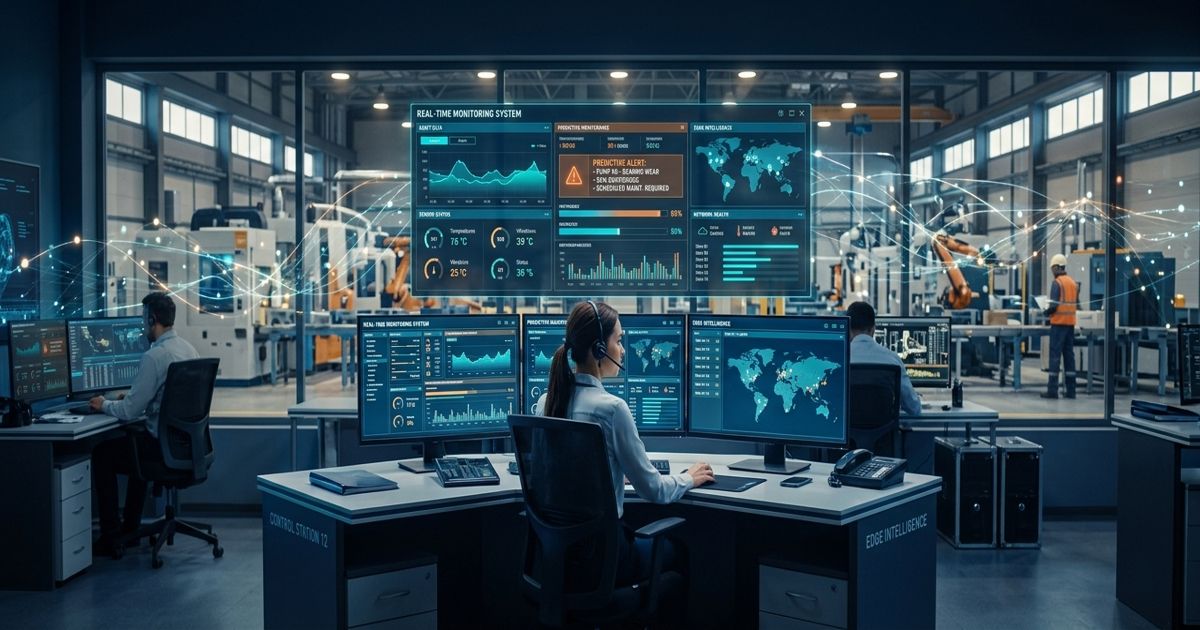
Remote Monitoring System: How AI, IoT, and Edge Intelligence Enable Smarter Asset Management
 Author
 Date of Publication
 Category
Remote monitoring systems have become a foundational layer of modern industrial operations. As facilities grow more complex and assets become more distributed, the ability to observe, analyze, and act on real-time data from anywhere is no longer optional. It is a competitive necessity. This blog explores how AI, IoT, and edge intelligence come together to power smarter remote asset monitoring solutions, reduce unplanned downtime, and give operations teams the visibility they need to make faster, better decisions.
Key Takeaways
- A modern remote monitoring system combines IoT sensors, edge computing, and AI analytics to deliver real-time operational visibility across distributed industrial assets, enabling predictive maintenance and reducing unplanned downtime.
- Remote diagnostics systems powered by AI can distinguish between normal operational variation and genuinely critical issues, reducing alert fatigue and improving response times across complex industrial environments.
What Is a Remote Monitoring System in an Industrial Context?
A remote monitoring system is a connected technology framework that collects operational data from industrial assets, transmits it across a network, and delivers actionable insights to operators and managers regardless of their physical location. In industrial settings, this means tracking machinery health, environmental conditions, process parameters, and energy consumption in real time.
Modern systems go far beyond simple telemetry. They integrate IoT sensors at the asset level, edge computing for local data processing, and cloud-based AI for deeper pattern recognition. This layered architecture ensures that time-sensitive decisions can be made at the edge while longer-term analytics and reporting happen in the cloud.
According to a McKinsey report on reimagining manufacturing operations, predictive maintenance enabled by connected monitoring systems can reduce machine downtime by up to 50% and extend the life of machinery by years. These outcomes make the case for investing in intelligent monitoring infrastructure compelling for plant managers and operations leaders alike.
How IoT and Edge Intelligence Power Remote Asset Monitoring Solutions
The backbone of any effective remote asset monitoring solution is a well-designed IoT architecture. Sensors placed on equipment capture real-time readings covering temperature, vibration, pressure, flow rate, and dozens of other variables. This raw data is the foundation on which all intelligence is built.
Edge intelligence adds a critical layer. Rather than sending every data point to the cloud for processing, edge devices perform initial analysis locally. This dramatically reduces latency, lowers bandwidth costs, and ensures that anomalies triggering immediate action are caught without waiting for a round-trip to a central server.
The combination of edge processing and cloud AI is what separates modern platforms from legacy monitoring tools. Platforms built on an edge-to-cloud architecture like Merjio can perform real-time device inference at the edge while simultaneously feeding enriched data streams to cloud models that identify long-term degradation patterns across entire fleets of assets.
Key Capabilities Enabled by IoT and Edge Intelligence
- Real-time anomaly detection that flags unusual patterns before they escalate into failures
- Centralized device management for controlling and updating connected assets across multiple sites from a single interface
- AI-driven alerts that differentiate between normal operational variation and genuinely critical problems
- Automated reporting for operational performance metrics that support compliance and continuous improvement
- Streamlined asset and inventory tracking for full lifecycle visibility
The Role of AI in Remote Diagnostics Systems
A remote diagnostics system powered by artificial intelligence takes monitoring beyond dashboards and data feeds. It interprets what the data means, identifies the root cause of deviations, and recommends or even initiates corrective actions. This transforms monitoring from a passive activity into an active operational capability.
AI models trained on historical asset behavior can predict failure modes days or weeks before they occur. This enables maintenance teams to plan interventions at convenient times, procure the right parts in advance, and avoid the costly consequences of unplanned downtime. The shift from scheduled preventive maintenance to AI-driven predictive maintenance is one of the most measurable ROI drivers in industrial digital transformation.
Equally important is AI's role in managing alert quality. In large industrial environments, operators can be overwhelmed by thousands of sensor readings per hour. AI filters this noise by learning what normal looks like for each specific asset and environment, then escalating only those signals that genuinely require human attention. This capability is central to how platforms like Merjio approach condition-based monitoring, ensuring facility managers receive meaningful alerts rather than noise.
How AI Distinguishes Normal Variation from Critical Problems
One of the most practically valuable capabilities of an AI-powered remote monitoring system is its ability to learn asset-specific baselines. A compressor running at 72 degrees Celsius may be perfectly normal for one installation and a warning sign for another. AI models account for these contextual differences, reducing false positives and ensuring alerts carry genuine operational weight.
This contextual intelligence supports outcome-driven service level agreements, where response commitments are tied to actual asset condition rather than arbitrary schedules. It also enables remote diagnostics to be performed before a technician is dispatched, saving time and travel costs while improving first-time fix rates.
Industry 5.0 and the Evolution of Remote Asset Monitoring
The conversation around industrial monitoring is shifting from pure automation toward human-machine collaboration, sustainability, and resilience. These are the defining principles of Industry 5.0, and they are reshaping what organizations expect from their remote asset monitoring solutions.
Worker safety is a direct beneficiary of advanced monitoring. Real-time alerts about equipment anomalies, hazardous environmental conditions, or process deviations allow teams to intervene before incidents occur. Energy optimization is another dimension. Monitoring platforms that track consumption patterns across assets can identify waste, benchmark performance, and support sustainability targets.
Traceability and compliance also improve substantially with connected monitoring. Every sensor reading, alert, and intervention is logged and timestamped, creating an auditable record that supports regulatory reporting and continuous improvement programs. Platforms designed with these outcomes in mind, such as Merjio, align monitoring capability with broader operational and organizational goals rather than treating it as a standalone technology function. You can explore how this plays out in practice through the asset reliability solutions discussed in related industry content.
Choosing the Right Remote Monitoring System for Your Operations
Selecting a remote monitoring system requires clarity about what you are trying to achieve. The right platform should match the complexity of your asset base, integrate cleanly with your existing operational technology, and scale as your needs evolve. There are several practical dimensions to evaluate.
Architecture Fit
Decide whether an edge-to-cloud approach makes sense for your environment. If you operate in locations with limited connectivity, edge processing is essential. If your operations are centralized and bandwidth is abundant, a cloud-first architecture may work well. The best platforms support both models.
AI and Analytics Depth
Evaluate what the platform's AI capabilities actually cover. Can it perform anomaly detection at the asset level? Does it support predictive maintenance across different asset types? Can it distinguish between operational variation and genuine faults? These questions will determine whether the platform can replace reactive maintenance workflows with proactive ones.
Scalability and Device Management
If you manage assets across multiple sites, centralized device management is non-negotiable. Look for platforms that allow you to onboard new assets, push firmware updates, and monitor device health from a single interface. Platforms designed for scalability from the ground up, like Merjio, support multi-site, multi-customer deployments without architectural trade-offs. Learn more about how asset management systems can streamline operations and optimize efficiency in distributed environments.
Security and Compliance
Industrial data is sensitive. Any remote diagnostics system or monitoring platform must provide robust security at every layer, from device authentication at the edge to encrypted data in transit and at rest in the cloud. Evaluate how the platform handles access controls, audit logging, and regulatory compliance requirements relevant to your industry.
Conclusion
A well-designed remote monitoring system does more than collect data. It transforms raw sensor readings into operational intelligence that helps teams prevent failures, optimize performance, and make faster decisions. The integration of IoT, edge computing, and AI has fundamentally changed what remote asset monitoring solutions can deliver, moving the discipline from passive observation to active management. As Industry 5.0 principles shape the next wave of industrial transformation, platforms that combine real-time monitoring, intelligent control, and predictive analytics will define the standard for operational excellence. If your organization is ready to move beyond scheduled maintenance and reactive troubleshooting, exploring purpose-built IIoT platforms like Merjio is a practical first step toward smarter, more resilient operations.
Frequently Asked Questions
What is a remote monitoring system used for in industrial operations?
A remote monitoring system collects real-time data from industrial assets, transmits it over a network, and delivers operational insights to managers anywhere. It supports predictive maintenance, anomaly detection, and centralized device management across distributed facilities and equipment fleets.
How does edge computing improve remote asset monitoring solutions?
Edge computing processes sensor data locally on the device before sending it to the cloud. This reduces latency, lowers bandwidth consumption, and ensures time-sensitive alerts are triggered immediately. It is especially valuable in remote or low-connectivity industrial environments where response speed is critical.
What is the difference between predictive and preventive maintenance in remote monitoring?
Preventive maintenance follows fixed schedules regardless of asset condition. Predictive maintenance, enabled by AI in a remote monitoring system, uses real-time and historical data to forecast failures before they occur, allowing teams to intervene at exactly the right time and avoid unnecessary downtime.
How does AI reduce false alerts in a remote diagnostics system?
AI learns the normal operating baseline for each specific asset. A remote diagnostics system using AI can distinguish between expected variation and genuinely critical deviations, filtering noise and ensuring operators receive only meaningful, actionable alerts rather than an overwhelming volume of false alarms.
What industries benefit most from remote asset monitoring solutions?
Manufacturing, maritime, telecommunications, and energy sectors benefit greatly from remote asset monitoring solutions. Any industry managing distributed or high-value assets can use these platforms to reduce downtime, improve maintenance planning, and gain real-time visibility into equipment health and operational performance.
Can a remote monitoring system support multiple sites and asset types?
Yes. Modern platforms are designed for multi-site, multi-asset deployment. Centralized device management allows operators to monitor and control diverse equipment across locations from one interface, and asset management systems built for scalability support growing operational footprints without architectural compromise.
How does a remote monitoring system support worker safety?
By detecting equipment anomalies, hazardous process deviations, and environmental threshold breaches in real time, a remote monitoring system alerts teams before incidents occur. This supports proactive safety protocols, reduces exposure to dangerous conditions, and aligns with Industry 5.0 goals around human-centric industrial operations.
What security features should a remote diagnostics system include?
A reliable remote diagnostics system should include device-level authentication, encrypted data transmission, role-based access controls, audit logging, and secure cloud storage. These layers protect sensitive operational data from unauthorized access and ensure compliance with industry and regulatory data security requirements.
How does remote asset monitoring contribute to energy efficiency?
Monitoring platforms track energy consumption across assets in real time, identifying waste and benchmarking performance. Teams using smart factory IoT monitoring solutions can pinpoint inefficient equipment, schedule high-consumption operations strategically, and build data-driven sustainability programs aligned with organizational environmental targets.
What should organizations consider when evaluating a remote monitoring system?
Key evaluation criteria include edge-to-cloud architecture fit, AI analytics depth, anomaly detection capability, scalability for multi-site deployment, security across all data layers, and ease of device management. Organizations should also assess whether the platform supports the shift from scheduled to predictive maintenance workflows.
Related product
Merjio IIoT Platform by Lanware
Any sensor. Any industry. One unified data layer — explore SKID solutions, AI-driven analytics, and live monitoring on the Merjio platform.
Explore merjio.com