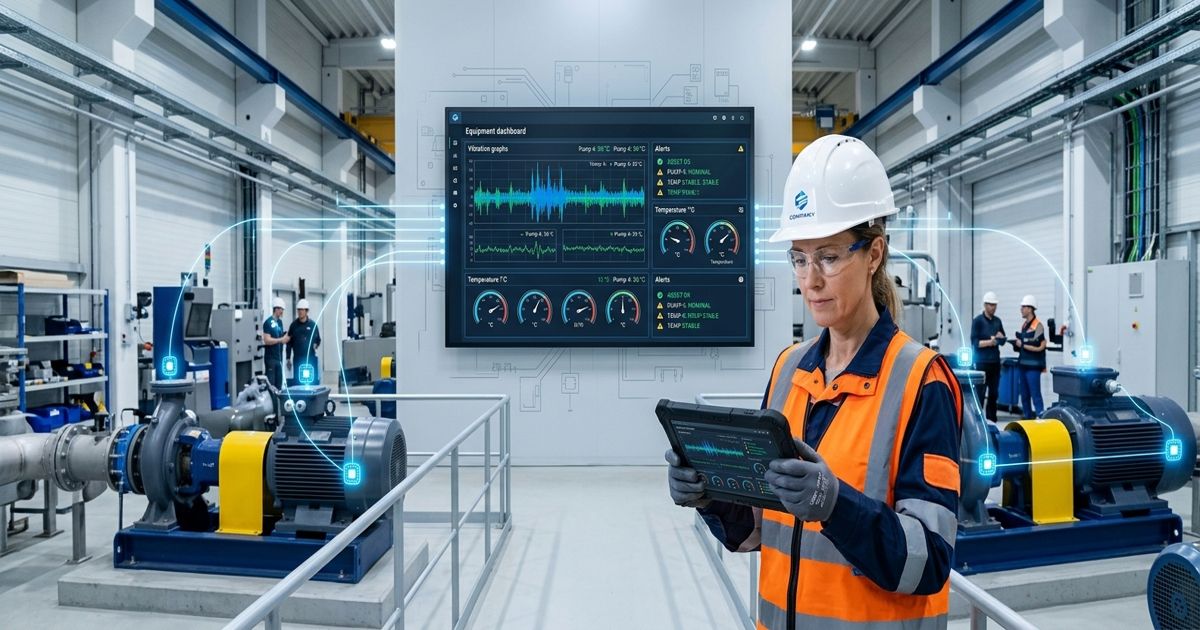
How Predictive Maintenance Improves Asset Reliability and Operational Efficiency
 Author
 Date of Publication
 Category
Predictive maintenance is no longer a future concept reserved for large enterprises with deep pockets. It is a practical operational strategy that industrial facilities of all sizes are adopting today. When equipment fails unexpectedly, the cost is not just the repair itself. It includes lost production time, safety risks, and strained maintenance teams. This blog explores how a well-implemented predictive maintenance approach, supported by an AI-powered IIoT platform, can significantly improve asset reliability and overall operational efficiency.
Key Takeaways
- A predictive maintenance strategy uses real-time data and AI to anticipate equipment failures before they occur, reducing unplanned downtime.
- A robust predictive maintenance platform integrates edge computing, anomaly detection, and cloud analytics to deliver actionable operational insights.
- Transitioning from scheduled to AI-driven predictive maintenance systems helps industrial operations improve asset reliability, lower maintenance costs, and support Industry 5.0 goals.
What Is Predictive Maintenance and Why Does It Matter?
Traditional maintenance falls into two categories. Reactive maintenance means fixing equipment after it breaks. Preventive maintenance means servicing equipment on a fixed schedule regardless of its actual condition. Both approaches have well-known drawbacks. Reactive maintenance leads to costly unplanned downtime. Preventive maintenance can result in unnecessary servicing of equipment that still has useful life remaining.
Predictive maintenance takes a different approach. It uses real-time sensor data, AI-driven analytics, and machine learning models to monitor equipment health continuously. By identifying patterns that indicate early-stage degradation, a predictive system can alert maintenance teams before a failure occurs. The result is maintenance that happens exactly when it is needed, not too early and not too late.
According to McKinsey and Company, predictive maintenance can reduce equipment downtime by up to 50 percent and lower maintenance costs by 10 to 25 percent. These numbers reflect why industrial operations leaders are investing in predictive maintenance systems at a growing rate.
The Role of a Predictive Maintenance Platform in Industrial Operations
A predictive maintenance platform is the technological backbone that makes continuous condition monitoring possible at scale. It connects sensors on industrial assets to a centralized data pipeline, processes incoming data at the edge for low-latency alerts, and sends aggregated information to the cloud for deeper AI-driven analysis.
Platforms like Merjio, the AI-powered Industrial IoT solution developed by Lanware Solutions, are purpose-built for this function. Merjio monitors industrial assets in real time, detects anomalies automatically, and distinguishes between normal operational variations and conditions that require immediate attention. This level of intelligence reduces false alarms and allows maintenance teams to prioritize their response effectively.
Key capabilities of a well-designed predictive maintenance platform include:
- Continuous real-time monitoring of equipment health indicators such as vibration, temperature, pressure, and current draw
- AI-based anomaly detection that flags deviations from normal operating patterns
- Automated alerts delivered to facility managers and maintenance teams
- Centralized device management across multiple assets and sites
- Integrated reporting for tracking maintenance history and operational performance
- Secure cloud-based data storage with scalable access across the organization
How Predictive Maintenance Improves Asset Reliability
Asset reliability refers to the probability that a piece of equipment will perform its intended function without failure over a given period. Predictive maintenance directly improves this metric by catching problems early, before they escalate into full failures.
Consider a manufacturing plant with dozens of rotating machines such as pumps, compressors, and conveyor motors. Each of these assets generates continuous streams of operational data. Without a monitoring system in place, abnormal vibration or rising bearing temperature may go unnoticed until the machine stops working entirely. With a predictive maintenance system in place, these early warning signs are captured automatically and surfaced to maintenance engineers in near real time.
Merjio's edge-to-cloud architecture plays a critical role here. By processing data at the edge, the platform can generate alerts within milliseconds of detecting an anomaly, without waiting for data to travel to a remote cloud server and back. This speed matters enormously in industrial environments where a brief window of early intervention can prevent hours or days of unplanned downtime. For a deeper look at how smart factory platforms support asset reliability, explore this resource on asset reliability solutions for industrial operations.
Operational Efficiency Gains from a Predictive Maintenance System
Improving asset reliability is one side of the equation. The other side is operational efficiency. A well-deployed predictive maintenance system reduces the waste that comes from both unplanned breakdowns and over-servicing of healthy equipment.
Operational efficiency gains typically include:
- Reduced unplanned downtime: Failures are anticipated and addressed during scheduled maintenance windows rather than causing unexpected production stoppages.
- Optimized maintenance scheduling: Maintenance work is planned based on actual equipment condition, which reduces labor hours and parts consumption.
- Extended asset lifespan: Equipment that is maintained at the right intervals rather than run to failure tends to last longer, improving return on capital investment.
- Energy optimization: Degraded equipment often consumes more energy. Early detection of issues helps keep machines running at their designed efficiency levels.
- Improved worker safety: Real-time alerts allow facility managers to remove workers from the vicinity of failing equipment before a dangerous incident occurs.
These outcomes align directly with Industry 5.0 principles, which emphasize sustainability, human-machine collaboration, and operational resilience. Merjio is designed with these goals in mind, supporting energy optimization, worker safety improvements, and traceability across assets and processes. To understand how IIoT platforms drive these outcomes in smart factory environments, see this overview of smart factory automation solutions.
Moving from Scheduled to AI-Driven Predictive Maintenance
One of the most significant shifts enabled by modern predictive maintenance platforms is the transition away from calendar-based maintenance schedules toward condition-based, AI-driven decision-making. This transition requires three things: reliable sensor coverage, a capable data processing architecture, and an intelligent analytics layer that can interpret the data meaningfully.
Merjio addresses all three requirements. Its edge-to-cloud architecture ensures that sensor data is processed locally for speed and forwarded to the cloud for long-term trend analysis. Its AI layer distinguishes between normal operational variation and conditions that indicate genuine risk. And its centralized device management capability means that operators can oversee assets across multiple facilities from a single interface.
This shift also changes the role of maintenance teams. Rather than following fixed schedules, technicians receive data-driven work orders that tell them which asset needs attention, what the likely issue is, and how urgent the intervention is. This makes maintenance teams more effective and reduces the time and cost associated with unnecessary preventive work. To explore how IIoT monitoring and control supports this kind of intelligent operations, visit this page on Merjio smart factory modern industrial IoT solutions.
Predictive Maintenance Across Industries
While manufacturing is the most widely cited industry for predictive maintenance adoption, the benefits extend across multiple sectors. Water treatment facilities use predictive systems to monitor pump health and chemical dosing equipment. Maritime operators track engine performance and hull systems in real time. Telecommunications infrastructure managers monitor power systems and cooling units in network sites. Even vending and distributed asset operators use IIoT-powered monitoring to manage fleets remotely and reduce service calls.
Merjio has been deployed across these types of use cases, supporting organizations that manage assets in distributed or remote locations where sending a technician for every inspection is not practical. The platform's secure, scalable cloud infrastructure and centralized device management make it well suited to multi-site operations. For reference on how real-time IIoT monitoring applies in industrial water treatment contexts, see this resource on IoT monitoring and control for water treatment skids.
The International Energy Agency has highlighted industrial digitalization, including predictive maintenance adoption, as a key lever for improving energy efficiency and reducing emissions in the industrial sector. This positions predictive maintenance not only as an operational tool but as part of a broader sustainability strategy.
Conclusion
Predictive maintenance represents a fundamental shift in how industrial organizations think about equipment health and operational continuity. By moving from reactive repairs and fixed schedules to continuous, AI-driven condition monitoring, facilities can reduce unplanned downtime, extend asset lifespan, optimize energy use, and improve worker safety. A capable predictive maintenance platform like Merjio brings together edge computing, anomaly detection, and cloud analytics into a single, scalable solution designed for the complexity of modern industrial operations. If your organization is ready to move beyond scheduled maintenance and build a more resilient, data-driven operational model, exploring an AI-powered predictive maintenance system is the right place to start. Contact the Lanware Solutions team to learn how Merjio can support your asset reliability and operational efficiency goals.
Frequently Asked Questions
What is the difference between predictive maintenance and preventive maintenance?
Preventive maintenance follows a fixed schedule regardless of equipment condition. Predictive maintenance uses real-time sensor data and AI to service assets only when indicators suggest a failure is approaching, making it more precise and cost-effective for industrial operations.
How does a predictive maintenance platform collect equipment data?
A predictive maintenance platform collects data through sensors attached to industrial assets. These sensors measure parameters like temperature, vibration, pressure, and current draw. Data is processed at the edge for fast alerts and forwarded to the cloud for deeper trend analysis and reporting.
Can predictive maintenance reduce unplanned downtime in manufacturing?
Yes. By detecting early signs of equipment degradation, a predictive maintenance system focused on asset reliability and uptime can alert maintenance teams before a full failure occurs, allowing repairs to be scheduled during planned windows rather than causing unexpected production stoppages.
What industries benefit most from predictive maintenance systems?
Manufacturing, water treatment, maritime, telecommunications, and distributed asset operations such as vending all benefit significantly. Any industry that relies on continuous equipment uptime and cannot afford unplanned failures is a strong candidate for a predictive maintenance system.
How does edge computing improve predictive maintenance outcomes?
Edge computing processes sensor data locally on or near the asset. This reduces the latency between detecting an anomaly and issuing an alert. For industrial operations where a few seconds can prevent significant damage, edge processing is a critical component of an effective predictive maintenance platform.
What role does AI play in a predictive maintenance system?
AI analyzes continuous streams of sensor data to distinguish between normal operational variation and patterns that indicate genuine risk. It generates prioritized alerts, helps predict remaining useful life of components, and supports maintenance teams in making data-driven decisions rather than relying on fixed schedules.
Is predictive maintenance suitable for small and mid-sized industrial facilities?
Yes. Modern predictive maintenance platforms are designed for scalability, meaning they can be deployed across a single facility or expanded to cover multiple sites. Cloud-based infrastructure reduces the need for large upfront hardware investments, making the approach accessible to a wider range of industrial operators.
How does predictive maintenance support worker safety?
Real-time anomaly detection alerts facility managers to dangerous equipment conditions before they escalate. This allows workers to be relocated away from failing assets in time. Platforms aligned with smart factory IoT monitoring benefits specifically highlight worker safety as a key operational outcome alongside efficiency.
What data is typically monitored in a predictive maintenance program?
Common monitored parameters include vibration, temperature, pressure, electrical current, flow rate, and acoustic emissions. The specific data points depend on the asset type. Rotating equipment like pumps and motors typically requires vibration and temperature monitoring as primary health indicators for reliable prediction.
How long does it take to implement a predictive maintenance platform?
Implementation timelines vary depending on the number of assets, existing sensor infrastructure, and integration requirements. Cloud-based platforms with centralized device management can accelerate deployment. Organizations that start with a pilot on critical assets often see measurable results within the first few months of operation.
Related product
Merjio IIoT Platform by Lanware
Any sensor. Any industry. One unified data layer — explore SKID solutions, AI-driven analytics, and live monitoring on the Merjio platform.
Explore merjio.com