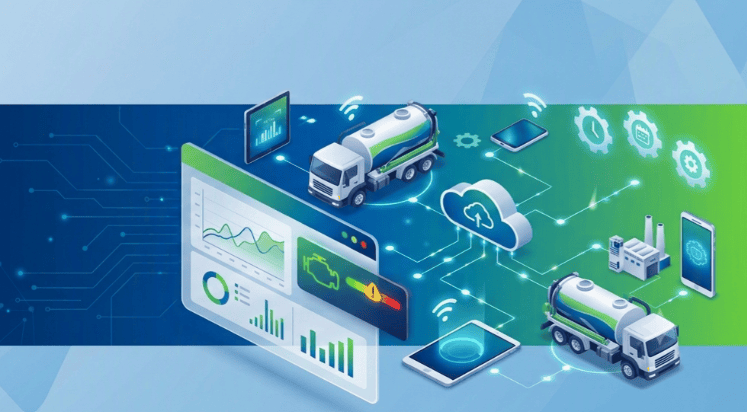
Predictive Maintenance Platform: How Merjio Digitized Mobile Septage Treatment Operations Seamlessly
 Category
 Service Line
Introduction
Predictive Maintenance Platform is not a mere workflow add-on today. Here we can explain why Municipal Operations Can No Longer Depend on Manual Processes and do stay with us.
According to MarketsandMarkets, the global market for Predictive Maintenance is expected to exceed USD 47 billion by 2030, driven by rapid investments in Industrial IoT, artificial intelligence, and connected infrastructure. Research from McKinsey also indicates that organisations implementing predictive maintenance strategies can reduce equipment downtime by 30 to 50 percent, lower maintenance costs by nearly 25 percent, and extend asset life by as much as 40 percent.
We demonstrate how Merjio redesigned the complete operational ecosystem for Bhouma by implementing a modern Predictive Maintenance Platform supported by an intelligent Remote Monitoring System, Machine Monitoring Software, and a scalable Industry 4.0 Platform. Instead of digitizing individual departments, Merjio connected the entire service lifecycle into one unified operational framework.
Customer Overview
About Bhouma
Bhouma is an environmental services organisation responsible for operating Mobile Septage Treatment Units (MTUs) across multiple municipalities. Its services play an important role in supporting sanitation infrastructure by collecting, transporting, and treating septage through mobile treatment facilities deployed across different operational locations.
Unlike conventional utility operations, every assignment requires continuous coordination between several stakeholders.
These include:
- Customers requesting services
- Call centre executives
- Field operators
- Mobile Septage Treatment Units
- Technical maintenance teams
- Municipal authorities
- Operational management
Every successful service depends on accurate communication, timely approvals, workforce availability, equipment readiness, customer verification, and complete regulatory documentation.
As operations expanded across municipalities, maintaining consistency through manual coordination became increasingly difficult.
Project Objective
The organisation wanted to move beyond fragmented operations and establish a connected digital ecosystem capable of supporting future growth.
Rather than implementing multiple independent software applications, the objective was to create one integrated operational platform capable of managing every stage of service delivery.
Merjio proposed a centralized Industrial IoT Solution that could digitize customer interactions, automate operational workflows, strengthen compliance, improve equipment visibility, and support intelligent maintenance planning through a unified IIoT Platform.
The long-term vision extended beyond automation.
It focused on building a scalable operational framework capable of supporting future municipal expansion while improving service quality and governance.
Operational Ecosystem Before Digital Transformation
Before Merjio's implementation, daily operations depended on continuous manual coordination between multiple departments.
The service workflow typically followed this sequence:
Customer Request
Customers contacted the call centre through different communication channels to raise service requests.
Call Centre Coordination
Operators manually recorded requests before communicating with field teams.
Field Operator Assignment
Assignments were shared through phone calls or messaging applications based on operator availability.
Service Execution
Field teams completed the work while manually reporting progress back to supervisors.
Completion and Verification
Payments, customer confirmation, operational reports, maintenance records, and compliance documentation were processed independently.
Although the workflow appeared straightforward, every transition introduced delays, duplicated information, and operational blind spots.
As service demand increased, these inefficiencies became increasingly difficult to manage.
Merjio's Digital Transformation Vision
Merjio's objective extended beyond replacing paper-based processes.
The company wanted to create a digital operating model where every activity could be monitored, measured, validated, and continuously improved.
The implementation focused on five strategic outcomes.
Create a Single Source of Truth
Bring every operational activity into one connected Industrial IoT Platform instead of multiple disconnected systems. Consolidating service requests, field activities, approvals, maintenance records, and customer interactions into a single platform eliminated duplicate data entry and improved information accuracy. This provided management with a reliable source of operational data for faster reporting and better business decisions.
Improve Real Time Operational Visibility
Enable supervisors to monitor services, vehicles, workforce, and equipment through a centralized Remote Monitoring System. Live dashboards provided instant visibility into service progress, operator availability, vehicle movement, and pending tasks across multiple municipalities. This reduced response time, improved resource planning, and enabled faster operational interventions whenever required.
Strengthen Workforce Accountability
Digitally verify attendance, service execution, geo tagged activities, and operational timelines using the Machine Monitoring Software and mobile application. Every service milestone was recorded with location, time stamps, photographs, and operator details, creating a transparent audit trail. This improved workforce discipline, reduced manual verification, and strengthened compliance across field operations.
Support Intelligent Asset Management
Lay the foundation for AI driven Predictive Maintenance through structured equipment data, maintenance history, and inspection records. Instead of relying solely on calendar based servicing, the organization established a digital asset history that supports better maintenance planning and future condition based interventions. This improved equipment reliability while creating a scalable framework for long term asset management.
Build a Scalable Industry 4.0 Platform
Develop an operational framework capable of supporting additional municipalities without increasing operational complexity. The Industry 4.0 Platform was designed to standardize workflows, automate routine processes, and centralize operational data across locations. This enabled the organization to expand services efficiently while maintaining consistent service quality, operational control, and regulatory compliance, regardless of the number of field teams or service regions.
Challenges Before Merjio
As Bhouma expanded its Mobile Septage Treatment Unit operations across multiple municipalities, the complexity of managing people, vehicles, customers, equipment, and compliance increased significantly.
The challenge was not the availability of resources.
It was the absence of one connected operational ecosystem.
Every department worked efficiently within its own process. However, information rarely moved efficiently between departments. Teams depended heavily on manual communication, making daily operations slower, less transparent, and increasingly difficult to scale.
Merjio began the engagement by conducting a detailed operational assessment. The objective was to understand where delays occurred, why coordination consumed so much management effort, and how digital transformation could create measurable operational improvements through an integrated Industrial IoT Platform.
Multiple Platforms Reduced Operational Visibility Across Municipal Operations
As the organisation expanded, different departments adopted different applications to perform specific tasks.
None of these systems communicated with one another.
Operations, finance, customer support, technical teams, and field operators maintained their own information separately.
Disconnected Information Created Operational Silos
- Customer requests remained in one application.
- Maintenance records were maintained elsewhere.
- Service approvals followed another process.
- Reporting relied on spreadsheets.
Because information remained fragmented, supervisors spent considerable time validating data before making operational decisions.
Instead of enabling efficiency, technology had unintentionally increased administrative effort.
No Single Operational Dashboard
Without a centralized Industrial IoT Platform, management had no unified view of ongoing activities.
Simple questions often required multiple phone calls.
- Which vehicle is available?
- Which operator completed today's assignments?
- Which municipality has pending requests?
- Which equipment requires servicing?
Answering these questions consumed valuable operational time that could have been invested in improving service delivery.
Excel-Based Service Tracking Limited the Value of an Industry 4.0 Platform
Excel spreadsheets served as the primary method for tracking service requests.
While spreadsheets worked during the organisation's early growth phase, they became increasingly difficult to manage as operational volumes expanded.
Manual Updates Increased Human Error
Every request required manual entry.
Status changes depended on individuals remembering to update records.
Duplicate entries became common.
Information often became outdated before reaching decision-makers.
As service requests increased, spreadsheet-based tracking could no longer provide the operational visibility required for efficient municipal service delivery.
Historical Data Became Difficult to Analyse
Management wanted to identify operational trends.
- Service turnaround times.
- Peak workload periods.
- Municipality-wise demand.
- Operator productivity.
Unfortunately, spreadsheet-based reporting made meaningful analysis extremely time-consuming.
Without reliable operational data, strategic planning became increasingly difficult.
Separate Call Centre Software Delayed Customer Service Management
Customer interactions began inside a dedicated call centre application.
Field operations, however, continued through completely different communication channels.
The two systems remained disconnected.
Customer Information Had to Be Shared Repeatedly
Once a request was received, operators manually communicated details to field teams.
- Customer addresses.
- Service schedules.
- Special instructions.
- Payment details.
Every handover increased the possibility of communication errors.
Small mistakes frequently resulted in delayed service execution and unnecessary follow-up calls.
Service Updates Were Not Visible in Real Time
Customers expected timely updates.
Unfortunately, call centre executives often depended on field operators to manually provide progress reports.
Without a connected Remote Monitoring System, customer support teams could not independently verify service status.
This reduced response speed while affecting overall customer experience.
Need Better Visibility Across Distributed Field Operations?
Municipal operations become increasingly difficult to manage when information remains fragmented across departments.
Merjio helps organisations build connected digital ecosystems that improve visibility, strengthen accountability, and simplify complex operational workflows through one centralized platform.
Heavy Dependence on WhatsApp and Phone Calls Slowed Industrial Automation
Without an integrated IIoT Platform, operational communication remained fragmented. Assignments, service updates, approvals, and urgent schedule changes relied on mobile calls, making coordination difficult as field operations expanded across multiple municipalities.
Critical Information Was Difficult to Track
Phone calls leave no structured operational history.
WhatsApp messages become difficult to retrieve.
Important instructions often remained inside personal devices instead of organisational systems.
As operations expanded across municipalities, communication became increasingly difficult to monitor.
Operational Decisions Became Person Dependent
When supervisors were unavailable, operational information became difficult to access.
Knowledge remained with individuals rather than within organisational systems.
Merjio recognised that sustainable growth required process-driven operations instead of person-dependent coordination.
No Real Time Visibility Reduced the Value of the Remote Monitoring System
Field operations lacked a centralized Remote Monitoring System to track activities in real time. Supervisors relied on manual communication to monitor vehicle movement, operator productivity, service status, and job completion, making timely intervention and performance monitoring difficult.
Managers Worked Reactively Instead of Proactively
Without live operational information, management could only respond after problems occurred.
- Unexpected delays.
- Vehicle breakdowns.
- Route deviations.
- Service interruptions.
Most operational issues became visible only after customers reported them.
This reactive model significantly reduced operational efficiency.
Decision Making Became Slower
Every operational decision required information gathering.
Managers first collected updates.
Then verified them.
Only afterwards could action be taken.
Merjio identified this as one of the most significant opportunities for operational improvement through a centralized Remote Monitoring System.
Safety Compliance Was Difficult Without a Condition Monitoring System
Before Merjio, field safety processes relied heavily on manual supervision and operator declarations. Safety checklists were maintained separately, while evidence of compliance was collected through photographs and phone-based communication. Without an Industry 4.0 Platform to digitize inspections and approvals, management could not consistently monitor whether standard operating procedures were followed across every service location. This created gaps in accountability, increased compliance risks, and made safety audits more time-consuming than necessary.
Safety Policies Were Not Consistently Followed
Operators completed field activities under varying operational conditions.
Without structured digital verification, supervisors found it difficult to confirm whether mandatory safety procedures had been followed before, during, and after service execution.
This increased operational risk while making compliance audits considerably more challenging.
Limited Documentation Increased Audit Risk
Regulatory inspections increasingly require documented operational evidence.
Paper-based checklists rarely provide complete verification.
Merjio recognised the need for a digital Condition Monitoring System capable of capturing structured compliance records throughout every service lifecycle.
Validating Field Work Became Increasingly Difficult
Management needed confidence that services were completed according to operational standards.
Unfortunately, verification depended largely on verbal confirmation.
Limited Evidence Reduced Accountability
Without geo tagged photographs, timestamps, or digital verification, supervisors had limited evidence supporting completed field activities.
Customer disputes required lengthy investigations.
Operational quality became difficult to measure consistently.
Customer Confidence Was Affected
Municipal customers increasingly expect transparency.
Digital service validation improves confidence by providing documented evidence of completed work.
Merjio identified this as an essential requirement for long-term operational governance.
Manual Payment Verification Delayed Financial Operations
Before implementing Merjio's Industrial IoT Platform, the finance team spent considerable time verifying whether a service had actually been completed before processing payments. Field operators submitted photographs, work confirmations, and supporting documents separately through phone calls, emails, and messaging applications. Supervisors often had to validate service completion manually before forwarding approvals to finance.
This multi step process delayed invoice verification, increased administrative effort, and created uncertainty whenever supporting records were incomplete or unavailable. By digitizing the entire approval and payment workflow, Merjio connected field operations with finance, allowing every completed service to be verified through geo tagged evidence, timestamps,s and digital approvals, significantly improving operational transparency and payment accuracy.
Financial Workflows Became Time Consuming
Payment verification required cross checking operational records with customer confirmations.
Incomplete documentation delayed approvals.
Administrative workload increased as service volumes expanded.
Merjio identified an opportunity to integrate operational and financial workflows within one connected platform.
Preventive Maintenance Was Managed Without Equipment Monitoring Software
Maintenance activities lacked operational intelligence. Servicing followed predefined calendar schedules instead of actual equipment condition, resulting in unnecessary maintenance for some assets while others remained at risk of delayed intervention.
Historical service records were maintained across multiple systems, limiting visibility into equipment performance trends. Inspection schedules relied on manual coordination, making preventive maintenance difficult to monitor consistently. This fragmented approach reduced asset reliability, increased administrative effort, and limited the organization's ability to make informed maintenance decisions.
Maintenance Was Reactive Instead of Predictive
Vehicles often received servicing only after visible operational issues appeared.
Unexpected breakdowns affected field schedules.
Emergency maintenance increased operational costs while reducing service availability.
Merjio recommended implementing Equipment Monitoring Software within its Predictive Maintenance System to improve maintenance planning.
Limited Asset Visibility Reduced Planning Accuracy
Without centralized maintenance history, technical teams found it difficult to analyse long-term equipment performance.
- Historical servicing.
- Inspection frequency.
- Recurring issues.
- Asset reliability.
Much of this information remained fragmented across manual records.
Reporting and Compliance Consumed Significant Management Time
Preparing operational reports required collecting information from several departments.
Every report involved manual consolidation.
Every compliance review required additional validation.
Decision Makers Waited for Historical Reports
Management often reviewed operational performance several days after activities had already been completed.
Real-time insights were unavailable.
Strategic decisions therefore relied on historical information instead of live operational intelligence.
Compliance Became Resource Intensive
Environmental service providers operate under strict reporting obligations.
Generating audit documentation manually increased administrative effort while exposing the organisation to avoidable compliance risks.
Merjio concluded that digital reporting and centralised operational records would significantly improve governance while supporting future municipal expansion.
A Growing Organisation Needed More Than Software
The assessment revealed an important conclusion.
Bhouma did not need another application.
It needed an integrated Predictive Maintenance Platform capable of connecting customers, call centres, field operators, maintenance teams, finance, compliance, and management through one intelligent operational ecosystem.
Only then could the organisation achieve the visibility, accountability, scalability, and operational control required for the next phase of growth.
Solution: Digital Service Lifecycle Powered by a Predictive Maintenance Platform
One of the biggest improvements delivered through Merjio's Predictive Maintenance Platform was the ability to digitize every operational stage instead of managing isolated activities.
Earlier, every department worked independently.
- The call centre recorded complaints.
- Field teams relied on phone calls.
- Supervisors updated Excel sheets.
- Payments were verified manually.
- Management received reports only after the work was completed.
Merjio transformed this fragmented process into one connected digital workflow powered by an Industrial IoT Platform and intelligent automation.
Every stakeholder could now work from one centralized system.
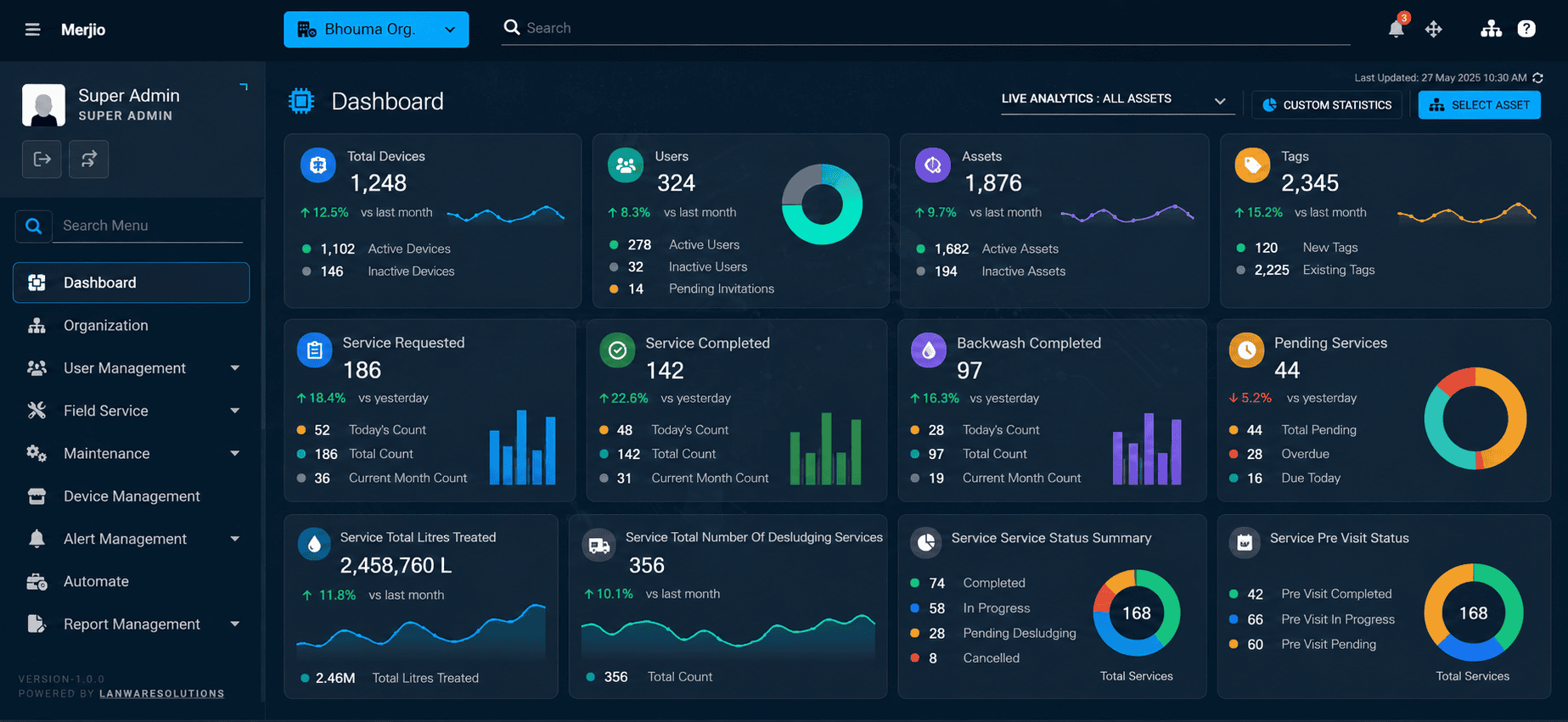
Customer Request
AI Driven Predictive Maintenance Starts with Accurate Service Capture
Every service request entered through the call centre immediately became part of the centralized Remote Monitoring System.
- Instead of maintaining separate registers or spreadsheets, requests were logged digitally with complete customer information.
- The system automatically generated service IDs, assigned priorities, and created a digital history for every customer.
- This reduced duplicate requests while giving supervisors complete visibility across municipalities.
Service Request Management
Machine Monitoring Software Improves Service Coordination
- Once the request entered the system, Merjio automatically classified and organized every service requirement.
- Instead of manually searching for available operators, supervisors could instantly view available teams, nearby MTUs, and current workloads.
- The Machine Monitoring Software also considered vehicle availability and operating status before assignments were made.
This significantly reduced coordination delays while improving overall resource utilization.
Intelligent Assignment
Industrial Automation Reduces Manual Decision Making
Merjio introduced automated assignment workflows based on predefined operational rules.
Assignments considered:
- Operator availability
- Vehicle location
- Route optimization
- Municipality allocation
- Equipment readiness
Because every assignment was digitally recorded, management could monitor response times without relying on manual updates.
This level of Industrial Automation improved accountability while reducing unnecessary communication between departments.
Pre-Visit Verification
Condition Monitoring System Improves Operational Readiness
Before leaving for customer locations, field operators completed digital verification through the mobile application. The Condition Monitoring System ensured that required inspections were completed before dispatch.
Operators confirmed:
- Vehicle readiness
- Safety equipment availability
- Personal protective equipment
- Equipment inspection
- Job acceptance
Instead of discovering operational issues after arriving at customer locations, supervisors could resolve them before deployment.
Digital Approval Workflow
Industry 4.0 Platform Creates Transparent Governance
- Approvals previously depended on multiple phone calls and WhatsApp confirmations.
- Merjio replaced these manual processes with structured approval workflows.
- Managers could approve assignments, monitor exceptions, and verify requests directly from dashboards.
- The Industry 4.0 Platform recorded every approval with timestamps, creating complete accountability across departments.
This eliminated confusion while significantly improving operational governance.
Digital Payment Verification
Industrial IoT Solution Eliminates Manual Financial Verification
- Payment verification had traditionally consumed considerable administrative effort.
- Merjio digitized this workflow by integrating payment status directly into service completion.
- Field teams no longer needed to wait for multiple confirmations.
- Management could instantly verify completed payments before closing service requests.
- The Industrial IoT Solution reduced administrative delays while improving revenue tracking accuracy.
Service Execution
Remote Monitoring System Provides Complete Operational Visibility
Field execution became completely transparent after deployment.
Using the Remote Monitoring System, supervisors could monitor:
- Vehicle movement
- Live GPS tracking
- Process duration
- Geo-tagged checkpoints
- Service progress
Unlike traditional operations where managers waited for end-of-day updates, Merjio provided continuous operational intelligence throughout the service lifecycle.
Customer Feedback Collection
AI Driven Predictive Maintenance Improves Service Quality
- Customer satisfaction became part of the operational workflow instead of a separate activity.
- Immediately after completion, customers submitted feedback digitally.
- Management could identify recurring issues, operator performance, and service quality trends.
- The AI driven Predictive Maintenance environment continuously collected operational intelligence that helped improve future service delivery.
Backwash Monitoring
Equipment Monitoring Software Extends Asset Performance
- Backwash activities directly influence equipment efficiency and long term reliability.
- Merjio digitally monitored every backwash process through the Equipment Monitoring Software.
- Maintenance history became immediately available.
- Managers could verify whether procedures were completed correctly while improving equipment utilization across municipalities.
Completion and Reports
IIoT Platform Delivers Real Time Reporting
Once services were completed, reports were automatically generated.
Instead of spending hours preparing spreadsheets, supervisors could instantly access:
- Completed jobs
- Pending requests
- Vehicle utilization
- Operator productivity
- Municipality performance
- Service turnaround time
The centralized IIoT Platform significantly improved reporting accuracy while supporting faster management decisions.
Key Capabilities Delivered Through the Predictive Maintenance Platform
Field Operations
Machine Monitoring Software Connected Every Field Operator
Merjio transformed field operations through one connected mobile application.
- Operators could mark attendance, update job progress, capture geo tagged photographs, and monitor service timers from a single interface.
- Live vehicle GPS tracking and camera feeds provided supervisors with complete operational visibility.
- The Machine Monitoring Software eliminated uncertainty by ensuring every activity could be verified digitally instead of relying on verbal updates.
Service Management
Industrial IoT Platform Simplified Every Service Workflow
Managing requests across multiple municipalities became significantly easier.
Merjio centralized:
- Service requests
- Scheduling
- Resource allocation
- Approval workflows
- Payment tracking
The Industrial IoT Platform ensured every department worked from the same information, reducing communication delays while improving customer response times.
Compliance Management
Condition Monitoring System Improved Operational Compliance
Compliance became an integrated operational process rather than an administrative activity.
Digital safety checklists, vehicle inspections, preventive maintenance records, customer acknowledgements, and photographic evidence created complete operational transparency.
The Condition Monitoring System helped management verify that field teams consistently followed operational procedures and municipal compliance requirements.
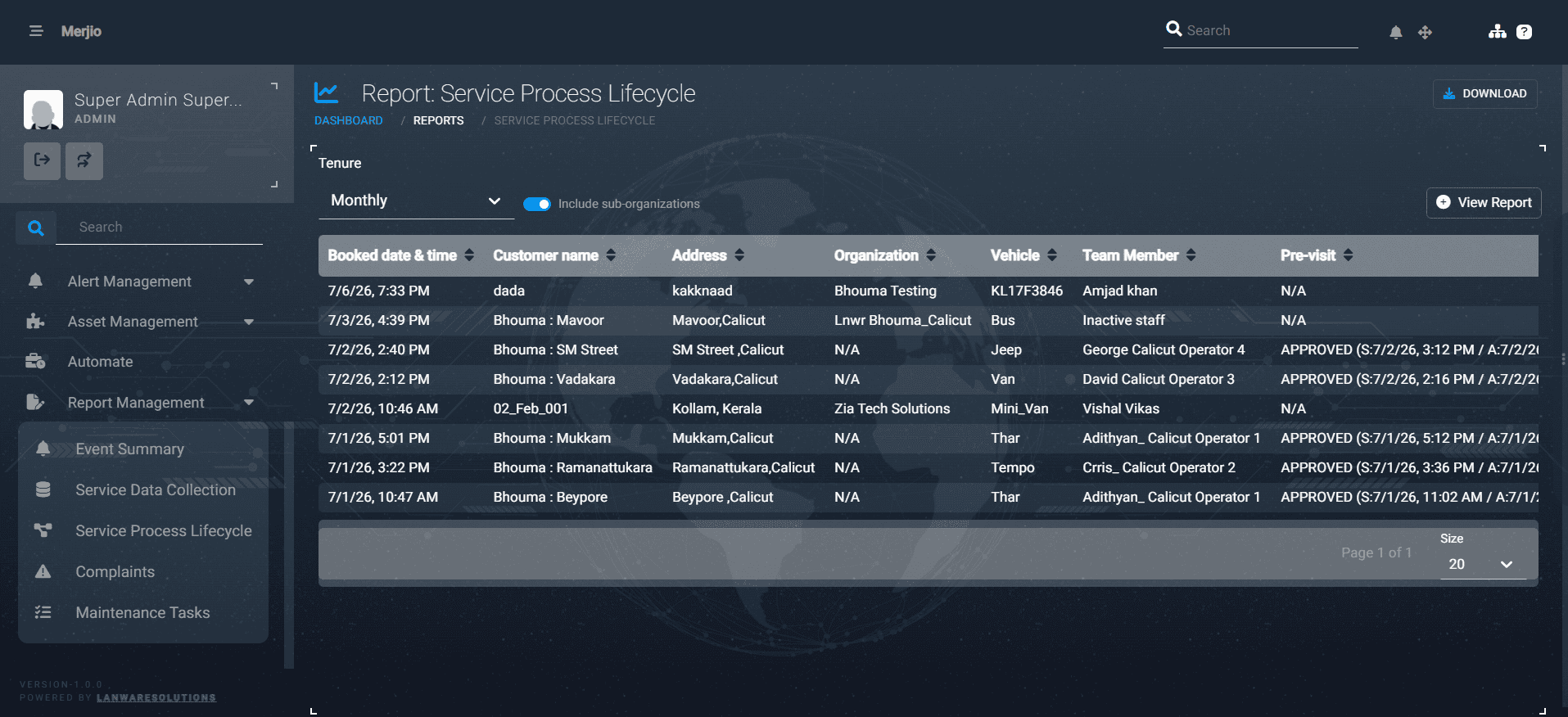
Management Dashboard
Predictive Maintenance Using AI Supports Faster Decisions
Executives no longer waited for weekly reports. Interactive dashboards displayed operational KPIs in real time.
Management monitored:
- Active requests
- Delayed services
- Vehicle status
- Operator productivity
- Municipality performance
- Preventive maintenance schedules
With Predictive Maintenance using AI, decision-makers could identify operational bottlenecks much earlier than traditional reporting systems allowed.
Business Transformation After Merjio Deployment
Before Merjio
- Operations relied heavily on manual coordination.
- Different teams worked on disconnected software platforms.
- Excel sheets became the primary reporting system.
- Phone calls and WhatsApp formed the communication backbone.
- Preventive maintenance schedules were manually maintained.
- Management had limited visibility into ongoing field operations.
- Service accountability remained difficult to verify.
After Merjio
- The organization now operates through one integrated Predictive Maintenance Platform.
- Every activity is digitally connected.
- Field operations are visible in real time.
- Approvals are automated.
- Reports are generated instantly.
- Preventive maintenance follows structured digital schedules.
- Every service creates a completegeo-taggedd audit trail.
- Managers receive actionable operational intelligence throughout the day instead of after operations conclude.
Measurable Business Benefits
Single Source of Truth
Instead of multiple software applications, Merjio established one centralized operational platform.
Every stakeholder accessed identical real-time information.
This reduced duplicate records while improving organizational consistency.
Real Time Operational Visibility
Supervisors could now monitor field activities as they happened.
Vehicle locations, operator status, and job progress became immediately available.
This significantly improved operational responsiveness.
Improved Workforce Accountability
Every operator activity became digitally traceable. Geo-tagged updates, timestamps, and photo evidence created complete transparency.
Operational accountability improved without increasing supervision.
Reduced Manual Coordination
Phone calls and WhatsApp communication reduced substantially.
Automated workflows simplified scheduling, approvals,s and reporting.
Teams spent more time executing services and less time coordinating them.
Better Safety Compliance
Digital checklists ensured operators consistently followed safety procedures before beginning work.
Management could immediately identify incomplete inspections and resolve issues proactively.
Strong Audit Trail
Every operational event generated a permanent digital record.
Customer requests, approvals, payments, inspections, and completion reports remained securely stored for future audits and compliance verification.
Faster Decision Making
Live dashboards replaced manual reporting.
Managers responded to operational issues immediately rather than waiting for end-of-day summaries.
Improved Customer Experience
Customers received quicker updates, faster service execution, and improved communication throughout the service lifecycle.
This strengthened trust while improving municipal service delivery.
Scalable Digital Platform
Merjio established a technology foundation capable of supporting future municipality expansion without significantly increasing administrative complexity.
Why Organizations Choose Merjio
Organizations adopting Predictive Maintenance, Industrial Automation, Remote Monitoring Systems, and IIoT Solutions require more than monitoring software.
They need complete operational visibility.
Merjio combines Machine Monitoring Software, Equipment Monitoring Software, workflow automation, compliance management, and intelligent reporting into one connected platform.
Whether managing municipal services, manufacturing operations or distributed field assets, Merjio enables organizations to improve efficiency, strengthen governance and make faster operational decisions through one integrated digital ecosystem.
Frequently Asked Questions
1. What is a Predictive Maintenance Platform?
A Predictive Maintenance Platform continuously monitors equipment and operational data to identify maintenance requirements before failures occur, reducing downtime and improving asset reliability.
2. How does Predictive Maintenance using AI improve operations?
Predictive Maintenance using AI analyses historical and real time operational data to detect patterns that indicate potential equipment issues, allowing organizations to intervene before failures happen.
3. What is the difference between a Remote Monitoring System and Machine Monitoring Software?
A Remote Monitoring System provides centralized visibility across distributed assets, while Machine Monitoring Software focuses on monitoring equipment performance, operational status, and utilization.
4. Why is an Industrial IoT Platform important?
An Industrial IoT Platform connects machines, operators, and management into one digital ecosystem, enabling real-time monitoring, reporting, and automation.
5. How does a Condition Monitoring System reduce maintenance costs?
A Condition Monitoring System detects equipment performance changes early, allowing maintenance teams to address issues before major failures occur.
6. Which industries benefit from Industrial Automation?
Manufacturing, utilities, municipal services, logistics, water treatment, environmental services, and smart infrastructure projects all benefit from Industrial Automation.
7. Can an IIoT Platform support multiple operating locations?
Yes. An IIoT Platform enables centralized monitoring of operations across multiple facilities, municipalities, or production sites through one unified dashboard.
8. How does Equipment Monitoring Software improve compliance?
Equipment Monitoring Software records inspections, maintenance schedules, and operational history, creating reliable documentation for audits and regulatory compliance.
9. Is AI driven Predictive Maintenance suitable for municipal services?
Absolutely. AI driven Predictive Maintenance improves fleet management, equipment utilization, service quality, and preventive maintenance scheduling across municipal operations.
10. Why should organizations invest in a Predictive Maintenance Platform?
Organizations implementing a Predictive Maintenance Platform reduce unplanned downtime, improve operational visibility, enhance workforce accountability, and build scalable digital operations that support long term growth.