Mining Software Solutions: A Complete Guide for Operations
 Author
 Date of Publication
 Category
Mining software solutions are reshaping how extraction operations are managed, monitored, and optimized. From tracking mining fleet equipment across vast sites to managing mining support equipment in real time, the right software platform reduces downtime, improves safety, and drives smarter decision making. This guide explores how AI powered Industrial IoT platforms are transforming mining operations and what operations leaders need to know before choosing a solution.
Key Takeaways
- Mining software solutions enable real time monitoring and control of assets, including mining fleet equipment and mining support equipment.
- AI driven predictive maintenance helps mining operations shift away from costly scheduled maintenance cycles.
- Edge to cloud platforms offer scalable, secure visibility across distributed and remote mining sites.
Why Mining Operations Need Dedicated Software Solutions
Mining environments are among the most demanding industrial settings in the world. Equipment failures, unplanned downtime, and disconnected data systems create significant operational risks. Mining software solutions address these challenges by centralizing asset data, enabling remote monitoring, and applying AI to detect anomalies before they escalate.
Traditional approaches rely on manual inspections and scheduled maintenance, which often miss early warning signs. A connected monitoring and control platform changes this dynamic entirely. It provides continuous visibility into every asset, from heavy excavators to auxiliary pumps, and flags issues the moment they appear.
According to McKinsey and Company, mining companies that invest in digital operations can reduce equipment downtime by significant margins while improving productivity across their sites. The path to those gains begins with the right software infrastructure.
Real Time Monitoring of Mining Fleet Equipment
Managing mining fleet equipment across large, remote sites is one of the most complex operational challenges in the industry. Vehicles and heavy machinery must operate reliably under extreme conditions, and any unplanned failure can halt production for hours or days.
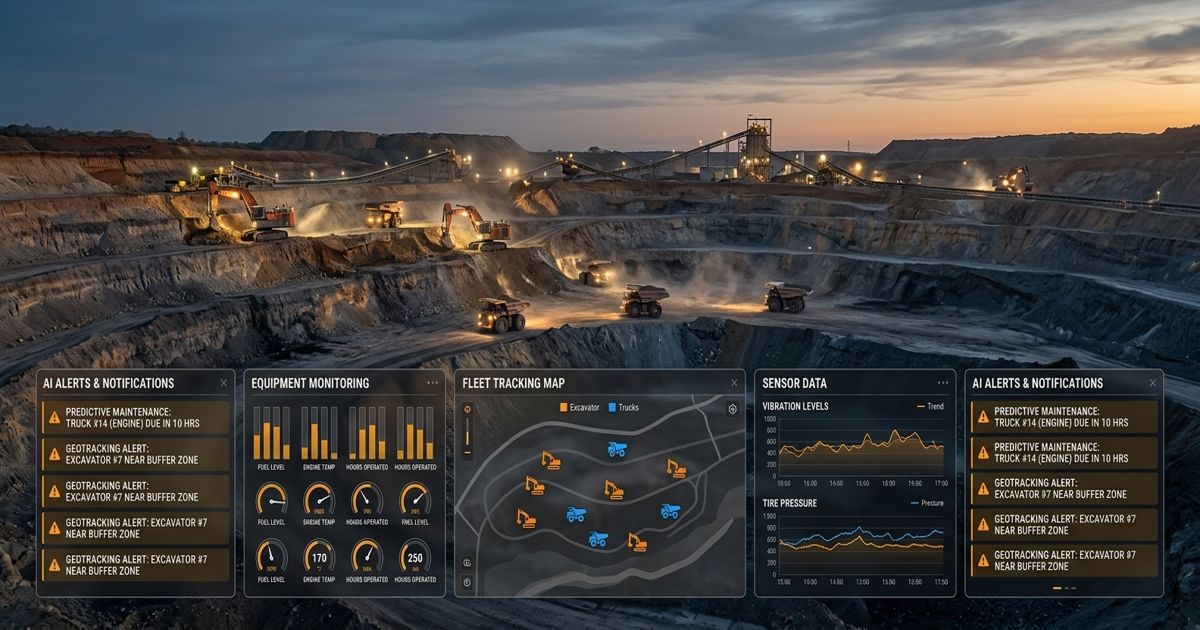
An AI powered IIoT platform like Merjio provides real time data streams from connected fleet assets. Operators can monitor engine performance, fuel consumption, vibration patterns, and temperature levels from a centralized dashboard. When anomalies appear, the system automatically alerts facility managers before a critical failure occurs.
This edge to cloud architecture is particularly valuable in mining. Sensors at the machine level process data locally at the edge, ensuring low latency responses even in areas with limited connectivity. Aggregated data then flows to the cloud for historical analysis and AI driven insights.
- Continuous monitoring of engine health, hydraulics, and drive systems
- Real time alerts for abnormal vibration or temperature readings
- Remote diagnostics to reduce time spent on site inspections
- AI driven anomaly detection that distinguishes normal variation from critical issues
- Centralized dashboard visibility across multiple vehicles and sites
Managing Mining Support Equipment with IIoT Platforms
Mining support equipment such as water treatment skids, pumping systems, ventilation units, and power distribution assets are critical to keeping core operations running. Yet these assets are often under monitored compared to primary fleet machinery.
IIoT platforms extend the same level of visibility to support infrastructure. Merjio water treatment monitoring capabilities demonstrate how connected sensors and intelligent control systems can manage complex support processes automatically. Real time data enables operators to adjust parameters remotely, reducing the need for manual intervention in hazardous or hard to reach areas.
When mining support equipment fails unexpectedly, the downstream impact on production can be severe. Predictive maintenance powered by AI allows engineering teams to schedule repairs based on actual equipment condition rather than arbitrary time intervals. This approach extends asset lifespan and reduces unnecessary maintenance costs.
How AI Driven Predictive Maintenance Transforms Mining Operations
Predictive maintenance is one of the most compelling applications of mining software solutions. Instead of reacting to failures after they happen or replacing components on a fixed schedule, AI continuously analyzes operational data to forecast when a part or system is likely to fail.
Merjio's AI engine evaluates patterns across multiple data streams simultaneously. It learns what normal operational behavior looks like for each asset and flags deviations that indicate developing problems. This capability applies equally to mining fleet equipment and mining support equipment, making it a unifying tool across the entire operation.
The shift from scheduled to predictive maintenance delivers measurable benefits. Teams are dispatched only when needed, spare parts are ordered in advance, and production schedules are protected from sudden disruptions. For remote mining sites, this capability is especially valuable because technician travel time is a significant cost factor.
Platforms built on smart plant monitoring and automation principles ensure that predictive insights are not just generated but acted upon through automated control responses and integrated reporting workflows.
Key Features to Look for in Mining Software Solutions
Not all mining software solutions are built the same. Selecting a platform that fits the complexity of mining operations requires evaluating several critical capabilities.
- Real time asset monitoring: The platform must provide live data from all connected assets without latency delays that compromise decision making.
- Edge computing support: In remote mining environments, edge processing ensures continuous operation even when cloud connectivity is limited.
- Anomaly detection and alerting: AI should distinguish between normal operational variation and genuine failure indicators to reduce alert fatigue.
- Centralized device management: Operators need a single interface to manage all connected sensors, controllers, and assets across multiple sites.
- Scalable cloud infrastructure: As operations grow, the platform must scale without requiring significant re engineering of the data architecture.
- Integrated reporting: Performance data should feed directly into operational reports that support compliance, planning, and investment decisions.
- Worker safety integration: Alerts and remote diagnostics should help protect field workers by reducing exposure to dangerous environments during inspections.
Lanware Solutions has applied these principles across industrial verticals through Merjio, an industrial IoT solution designed for modern industrial environments. The platform is built around the principles of Simplicity, Scalability, and Security, which are priorities that align directly with the operational demands of mining.
Industry 5.0 and the Future of Mining Technology
The mining industry is moving beyond the automation focus of Industry 4.0 toward Industry 5.0 principles. This evolution emphasizes human and machine collaboration, sustainability, and resilience alongside efficiency.
Modern mining software solutions support these goals in practical ways. Real time monitoring reduces energy waste by identifying inefficient equipment operation. Worker safety improves when AI driven alerts reduce the need for manual inspections in hazardous zones. Human operators remain in control, but they are supported by AI insights that make their decisions faster and more informed.
According to the World Economic Forum, digital transformation in mining is increasingly tied to sustainability outcomes, with connected platforms playing a central role in reducing the environmental footprint of extraction operations.
An edge to cloud IIoT platform supports traceability and compliance, two requirements that are growing in importance for mining operators facing tighter regulatory environments. When every asset interaction is logged and every anomaly is documented, audit trails become straightforward to produce and verify.
Conclusion
Mining software solutions are no longer optional for operations that need to stay competitive, safe, and efficient. From tracking mining fleet equipment in real time to maintaining mining support equipment with AI driven predictive tools, the right platform transforms how mining organizations manage their assets. Merjio, developed by Lanware Solutions, delivers the edge to cloud monitoring and intelligent control capabilities that mining environments demand. To explore how a connected asset monitoring platform can be applied to your operations, visit the Merjio mining IoT page and discover what real time industrial intelligence looks like in practice.
FAQ
Q1: What are mining software solutions and why are they important?
Answer: Mining software solutions are digital platforms that monitor, control, and optimize mining assets and operations. They reduce unplanned downtime, improve worker safety, and support data driven decisions. Operations using industrial monitoring tools consistently see stronger asset performance and lower maintenance costs.
Q2: How does real time monitoring improve mining fleet equipment management?
Answer: Real time monitoring provides continuous data on engine health, fuel use, and vibration for each piece of mining fleet equipment. AI powered anomaly detection flags developing issues before failures occur, allowing maintenance teams to act proactively and protect production schedules from unexpected disruptions.
Q3: What types of mining support equipment can be monitored with IIoT platforms?
Answer: IIoT platforms can monitor water treatment skids, ventilation systems, pumping units, and power distribution assets. These are critical mining support equipment categories that directly affect core production. Connected sensors provide live status updates and trigger automated alerts when performance deviates from normal ranges.
Q4: What is predictive maintenance and how does it apply to mining?
Answer: Predictive maintenance uses AI to analyze equipment data and forecast failures before they happen. In mining, this means engineers only intervene when asset condition data indicates a real need, reducing unnecessary maintenance cycles and extending the operational lifespan of both fleet and support equipment.
Q5: How does an edge to cloud architecture benefit remote mining sites?
Answer: Edge computing processes sensor data locally at the machine level, ensuring real time responses even when cloud connectivity is limited. This is essential for remote mining locations where network reliability is inconsistent. Cloud infrastructure then handles historical analysis, AI model training, and centralized reporting across all sites.
Q6: Can mining software solutions improve worker safety on site?
Answer: Yes. AI driven alerts and remote diagnostics reduce the need for manual inspections in hazardous areas. Workers receive early warnings about equipment issues through connected systems, lowering exposure to dangerous conditions. Platforms aligned with Industry 5.0 principles specifically prioritize human safety alongside operational efficiency and sustainability outcomes.
Q7: What should operations managers look for when evaluating mining software platforms?
Answer: Managers should evaluate real time monitoring capabilities, edge computing support, anomaly detection accuracy, centralized device management, and scalable cloud infrastructure. Integrated reporting and worker safety features are also important. Embedded systems expertise in the platform provider adds significant technical depth to IIoT deployments.
Q8: How does AI anomaly detection work in mining operations?
Answer: AI anomaly detection learns normal operational patterns for each asset and continuously compares live data against those baselines. When readings deviate beyond acceptable thresholds, the system alerts facility managers in real time. It distinguishes between routine variation and critical indicators, reducing false alarms and alert fatigue for operations teams.
Q9: Is Merjio suitable for managing assets across multiple mining sites?
Answer: Yes. Merjio is designed for centralized device management across multiple assets and sites. Its edge to cloud architecture aggregates data from distributed locations into a single platform. Operations leaders can monitor all connected assets and manage maintenance workflows from one interface, as detailed on the Lanware products page.
Q10: How do mining software solutions support sustainability goals?
Answer: Connected platforms reduce energy waste by identifying inefficient equipment operation in real time. They support traceability and compliance reporting, both of which are increasingly required by regulators. Data analytics capabilities within IIoT platforms help mining companies track their environmental footprint and make informed decisions that align with sustainability commitments.