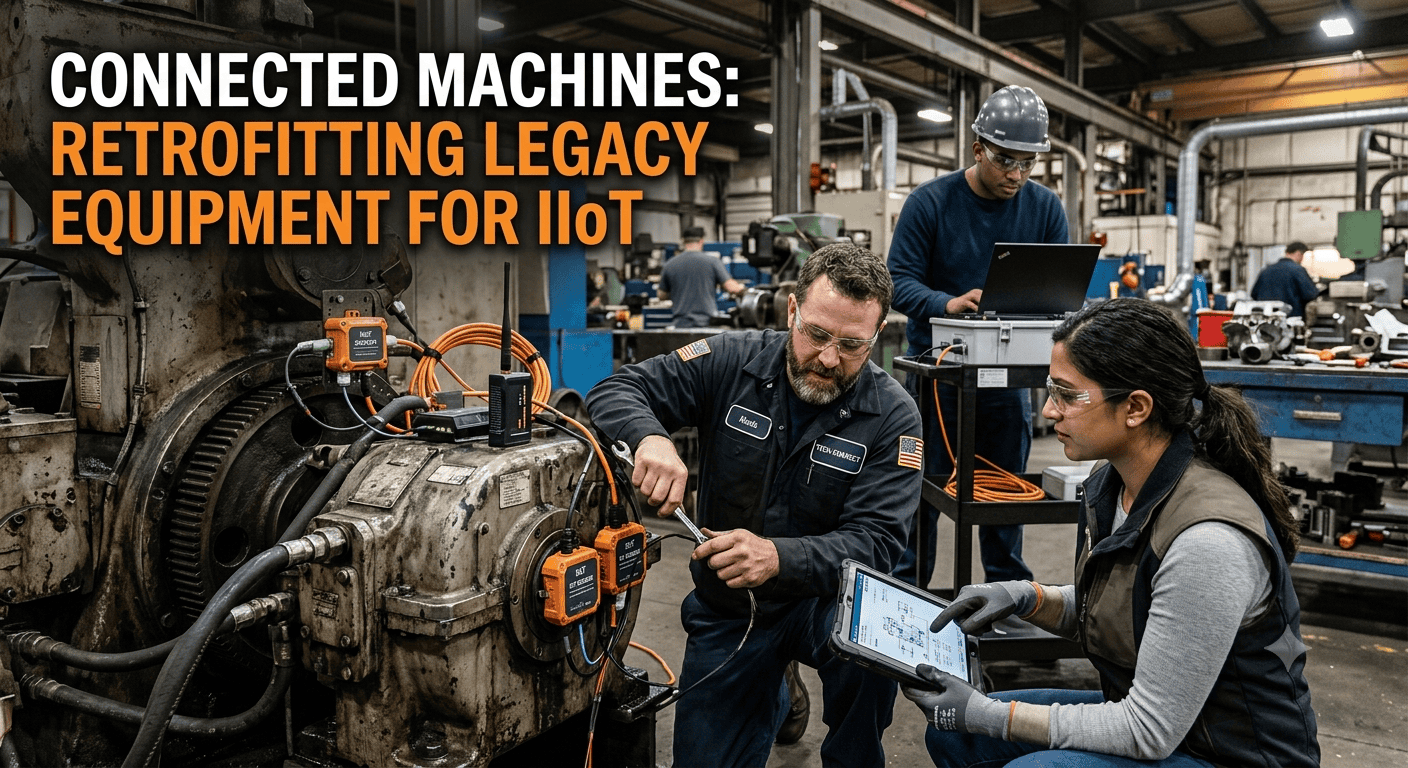
Connected Machines: Retrofitting Legacy Equipment for IIoT
 Author
 Date of Publication
 Category
Connected machines are usually described as a greenfield ambition, as though every plant were about to replace its equipment. Almost nobody is. The real work is brownfield: making machines installed in 1998 report useful data without disturbing production. This article covers the three routes to connecting legacy equipment, how to choose between them, and the practical traps that make retrofit projects overrun.
Key Takeaways
There are three routes to connected machines: read the existing controller, tap the electrical supply, or add independent sensors. Cost and intrusiveness rise in that order.
The hardest assets are usually the oldest and most critical ones, where documentation is missing and downtime for installation is hardest to obtain.
Never modify a control system to obtain data. Read alongside it. Anything that can influence control changes the safety case and the conversation that goes with it.
Three Routes to Connecting a Legacy Machine
Every connected machines retrofit falls into one of three approaches, and choosing correctly at the start saves a great deal of expense later. The right choice depends on what the machine already exposes and how much downtime you can obtain for the installation.
The first route is reading the existing controller. If the machine has a programmable logic controller with a spare communications port, the data may already exist and simply need collecting. This is the cheapest option by a wide margin and the least intrusive, since nothing physical changes on the machine.
The second is tapping the electrical supply. Current transformers clamped around motor supply cables provide a surprisingly rich signal without touching the machine at all, since load, cycle timing and several developing faults are visible in the current signature. Installation happens in the electrical panel rather than on the production floor.
The third is adding independent sensors: accelerometers, thermocouples, pressure transducers mounted directly on the asset. This gives the best data and costs the most, in money and in the access needed to fit them properly. Lanware's hardware services team specifies this route where the first two cannot reach the failure mode that actually matters.
Reading a Controller Without Touching Control
Where a controller can be read, the protocol is usually Modbus on older equipment or OPC UA on anything more recent. Both are well documented and widely supported, which makes this route attractive whenever it is available.
The absolute rule is to read alongside the control system, never through it, and never in a way that could write to it. A monitoring gateway that shares a control network segment and polls aggressively can degrade control performance, which is a serious matter on a machine that moves. Use a separate port, a passive tap or a properly configured read only connection, and prove the polling load is acceptable before going live.
The practical obstacle is documentation. Register maps on older equipment are frequently missing, inaccurate, or held only by a contractor who left years ago. Recovering that knowledge means tracing signals and validating each reading against a calibrated reference, which is slow work that belongs in the plan rather than the contingency. Teams who budget for it finish roughly on time, and teams who assume the drawings are accurate discover otherwise during commissioning, when being wrong is at its most expensive.
When the Machine Has No Digital Interface at All
A large share of the equipment destined to become connected machines exposes nothing digital. Older presses, pumps, compressors and packaged skids frequently have local gauges and relay logic and nothing else. For these assets, becoming one of the site's connected machines is a hardware exercise before it is a software one, and the budget needs to reflect that from the outset.
The productive question is not what data the machine could theoretically produce, but which specific failure you are trying to catch. A pump that fails on bearing wear needs vibration. A heat exchanger that fouls needs differential temperature and flow. Starting from the failure mode keeps sensor counts low and the business case clear. Starting from a wish to instrument everything produces a large bill and a great deal of data nobody uses. Reviewing the last three years of maintenance records is usually the fastest way to establish which failures actually recur on a given asset class, and it costs nothing beyond an afternoon of somebody's attention.
Power and mounting are the practical constraints. Many of these assets sit far from a convenient supply, which pushes the design toward battery powered wireless sensors and a duty cycle that trades reporting frequency against battery life. Mounting matters just as much: an accelerometer fixed to a guard instead of a bearing housing produces plausible data with almost none of the diagnostic content the analysis actually needs. Lanware's embedded and firmware services team handles both the device design and the placement survey together, because the two decisions are not really separable.
Proving Value Before Scaling Connected Machines Across a Site
The most reliable way to fund a connected machines programme is to make the first phase small enough to measure. Pick one asset class with a documented failure history and a known cost per incident, connect every unit of that class, and run it for two or three quarters before extending further.
A single asset class works better than a representative sample across many types. It gives you several machines behaving in comparable ways, which makes an outlier genuinely meaningful, and it keeps the installation work repeatable so the second unit costs considerably less than the first. Spreading the same budget thinly across a dozen different machine types produces a set of unrelated data streams and no basis for comparison at all.
Decide in advance what result would justify expansion and what result would not. Response time to a developing fault is usually the honest measure, because avoided downtime is real but hard to attribute when the failure never occurs. Agreeing that measure with the people funding the work, before any connected machines are installed, prevents the awkward review meeting where nobody can agree whether the pilot succeeded. Writing that single sentence down at the start is worth more than any amount of reporting assembled afterwards to justify a decision that has already been taken.
What Makes Retrofit Projects Overrun
Connected machines projects overrun in consistent enough ways to plan around. Access is the first cause. Fitting sensors requires the machine stopped, and production schedules rarely offer that window when the project wants it. Sequencing installation around planned maintenance shutdowns is far more realistic than requesting dedicated downtime, even though it stretches the calendar.
The second is the assumption that the newest assets are the easy ones. Frequently they are, but modern equipment sometimes ships with closed proprietary interfaces and a supplier who charges heavily for access to data generated by a machine you already own. Confirm data access rights during procurement of new equipment, because that clause is far cheaper to negotiate before purchase than afterwards.
The third is scope drift. Once a site sees value from its first connected machines, the natural response is to instrument everything. Resist it. Rank assets by what a failure genuinely costs and connect downward from the top of that list. Blanket coverage generates alerts on assets nobody will act on, which erodes trust in the whole system. Lanware's work on embedded hardware development for industrial innovation covers the device side of this in more detail.
Conclusion
Turning legacy equipment into connected machines is mostly a question of choosing the least intrusive route that reaches the failure mode you care about. Read the controller where you can, tap the electrical supply where you cannot, and add sensors only where the specific failure demands direct measurement. Start from the failure mode rather than the wish to instrument everything, and sequence installation around shutdowns that are already scheduled. If you are planning a retrofit across mixed vintage equipment, talk to the Lanware team about an asset survey before committing to hardware.
Frequently Asked Questions
What are connected machines?
Connected machines are industrial assets that report their condition and activity to a monitoring system. Most are legacy equipment retrofitted for connectivity rather than new machines bought with the capability already built into them.
Can old equipment really be connected?
Yes, and most industrial connectivity work is exactly this. Options range from reading an existing controller to clamping current transformers on the supply, to fitting independent sensors where no usable digital interface exists at all.
Is it safe to read data from a control system?
It is, provided you read alongside control rather than through it, with no write capability. Use a separate port or passive tap, and verify the polling load does not degrade control performance before the system goes into production.
What if the register documentation is missing?
That is common on older assets. Recovering it means tracing signals and validating readings against a calibrated reference. Budget this as planned work rather than contingency, because it reliably takes longer than teams expect it to.
Which protocol should a retrofit target?
Modbus on older controllers and OPC UA on newer ones cover most installed equipment. Both are well documented and widely supported, so the constraint is usually what the machine exposes rather than what the gateway can speak to it.
How many sensors does a machine actually need?
Fewer than most projects assume. Start from the specific failure you want to catch and instrument only for that. Sensor counts driven by failure modes stay low, and the resulting business case stays legible to whoever is funding it.
What about machines far from a power supply?
Battery powered wireless sensors handle these, trading reporting frequency against battery life. Site survey work matters here, since radio coverage across a metal dense plant is rarely as good as a coverage map initially suggests it will be.
How long does a retrofit programme take?
Installation is usually paced by shutdown availability rather than by engineering effort. Sequencing work around planned maintenance windows is the realistic approach. Our consulting services team builds the schedule around shutdowns already committed.
Do new machines avoid this problem entirely?
Not always. Some modern equipment ships with closed proprietary interfaces and charges separately for access to data your own machine generates. Negotiate data access rights during procurement, particularly for manufacturing lines you intend to monitor.
Related product
Merjio IIoT Platform by Lanware
Any sensor. Any industry. One unified data layer — explore SKID solutions, AI-driven analytics, and live monitoring on the Merjio platform.
Explore merjio.com