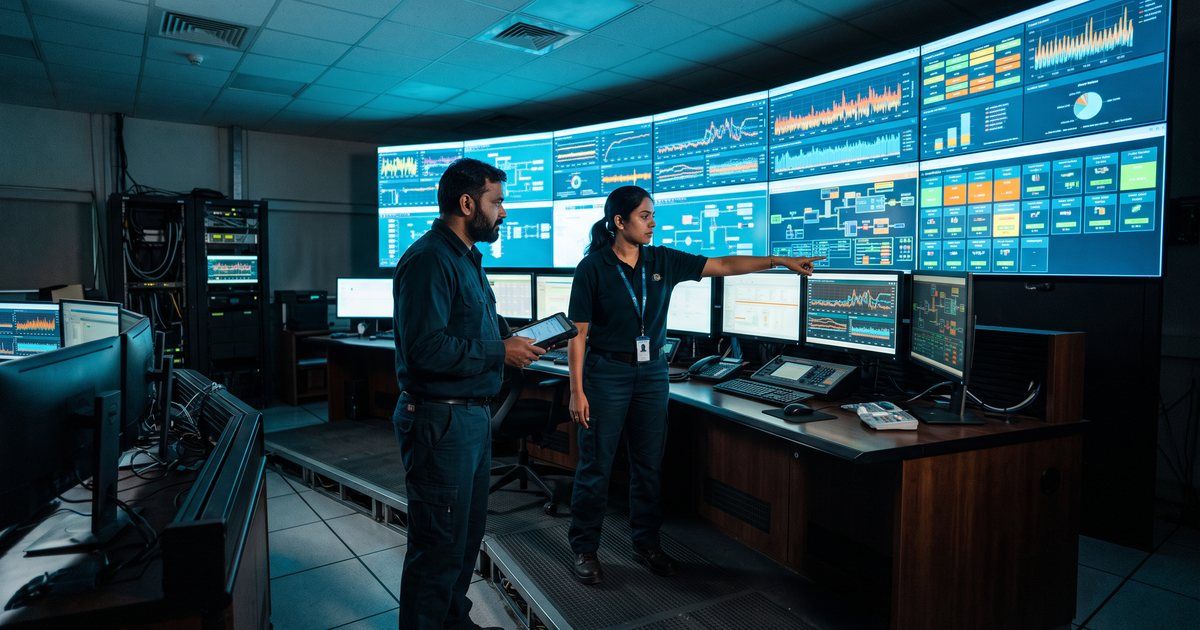
IoT Monitoring Platform: From Device Data to Control Room
 Author
 Date of Publication
 Category
An IoT monitoring platform has one job that matters: getting a meaningful signal in front of the person who can act on it, quickly enough for the action to help. Everything between the sensor and that person is plumbing, and the plumbing is where deployments quietly fail. This article follows the path data takes through an IoT monitoring platform, what breaks along the way, and why alert design decides whether the system changes anything at all.
Key Takeaways
- An IoT monitoring platform is judged on how fast a meaningful signal reaches a person who can act, not on how much data it collects.
- Store and forward behaviour at the gateway is the single most important resilience feature, because remote sites lose connectivity routinely.
- Alert design matters more than dashboard design. A system that flags constantly trains people to ignore it, including when it is right.
The Path Data Takes Through an IoT Monitoring Platform
Data crosses four boundaries between a sensor and a decision, and each one is a place where information can be lost, delayed or distorted. Knowing where those boundaries sit makes it much easier to work out why a monitoring deployment is not delivering what was expected of it when it was approved.
First the physical signal becomes a number, which depends entirely on sensor placement and calibration. Second the number reaches a gateway, usually over a wired or wireless field connection. Third the gateway forwards it upward, where an IoT monitoring platform stores and evaluates it. Fourth the evaluation becomes something a human sees or a system consumes.
The fourth boundary is where most value is lost. Plants routinely have all the data they need sitting in a database while nobody is told anything useful. Collecting is easy and has been for years. Converting a collected number into a specific instruction for a specific person is the part that requires design effort, and it is the part that consistently gets least of it. A useful diagnostic is to ask how a given reading would reach a named person on a night shift. If nobody can answer without describing somebody noticing a screen, the path is not designed and the platform will underdeliver regardless of how much data it holds.
What Happens When the Connection Drops
Remote industrial sites lose connectivity. Pumping stations, tank farms, quarry equipment and offshore assets all sit at the end of links that fail regularly, often for hours at a time and usually without anybody being told. An IoT monitoring platform that assumes a stable connection will silently stop protecting exactly the assets that most needed it.
The behaviour to specify is store and forward. The gateway keeps evaluating locally while offline, buffers results in order, and replays them once the link returns. Three details decide whether this works in practice: how deep the buffer is, whether replay preserves original timestamps rather than arrival times, and whether replayed events create a flood of duplicate alerts on reconnection.
The last row matters more than it looks. A monitoring system that goes quiet is indistinguishable from a plant with no problems, and that ambiguity has caused real incidents. Sites should report their own connectivity status so that silence is visible as a fault rather than quietly read as good news. A daily heartbeat from every site, and an alert when one stops arriving, is the cheapest way to close that gap. Lanware covers the field side of this in its guide to IoT connectivity technologies.
Designing Alerts People Will Actually Trust
Alert design is the difference between a monitoring platform that changes behaviour and one that gets muted. The failure mode is well documented in process industries, where alarm management has been a recognised discipline for decades precisely because badly designed alerts cause operators to disregard genuine warnings.
Three rules carry most of the benefit. Every alert must have an owner, because an alert routed to a shared inbox belongs to nobody. Every alert must have an action, since a message telling somebody a value has changed without saying what to do produces nothing. And the alert rate must stay low enough that people still read them, which usually means being willing to miss marginal events in order to keep the important ones credible.
Tuning sensitivity is therefore an operational decision, not a technical setting. The right threshold depends on what an inspection costs against what a missed fault costs, and those numbers belong to the maintenance team rather than the platform vendor. Getting them into the room early is the single cheapest improvement available to most deployments. It also gives the maintenance team ownership of the system's credibility, which matters when somebody eventually has to defend acting on an alert that turned out to be a false alarm.
How an IoT Monitoring Platform Sits Alongside SCADA
Sites that already run SCADA reasonably ask what a separate monitoring layer adds. The honest answer is that the two solve different problems and overlap considerably less than the feature lists suggest they do.
SCADA exists to supervise and control a process in the present tense. It is optimised for live values, operator response and deterministic behaviour, and it is deliberately conservative because it can act on the plant. An IoT monitoring platform is optimised for history, comparison across assets and sites, and analysis that would be inappropriate to run inside a control system. It reads and never writes.
In practice the monitoring layer takes on the questions SCADA answers badly: how this pump compares with eleven identical pumps at other sites, whether a signature has drifted over six months, and which assets are trending toward needing attention. Those questions need long history and cross site data that a control system was never designed to hold.
Where both exist, the integration should be strictly one way. The monitoring platform subscribes to data the control system already publishes, on a separate network segment, with no write path back. That boundary keeps the plant safety case intact and keeps the conversation with the controls engineer short.
Where an IoT Monitoring Platform Delivers Most
The value of monitoring scales with two things: how expensive the failure is, and how difficult the asset is to inspect manually. Where both are high, the case is straightforward. Where both are low, manual rounds remain perfectly rational and a platform adds cost without adding much. Being willing to say so about particular assets is what keeps a monitoring programme credible with the people paying for it.
Distributed and unmanned sites sit at the top of the list, because the alternative is a technician driving between locations to look at gauges. Maritime operations make the point clearly, since sending somebody to inspect an asset at sea is measured in days and considerable expense, which makes remote visibility worth far more per asset than the same capability inside a factory with staff on every shift.
Inside a plant, the strongest cases are assets whose failure stops a line, and utilities such as compressed air and cooling water whose degradation is gradual and easy to miss. Lanware's article on how industrial automation supports real time monitoring and data driven decisions covers the plant floor side of this in more depth, including how monitoring output connects back into existing control and planning routines.
Conclusion
An IoT monitoring platform succeeds when a meaningful signal reaches the right person fast enough to matter. That depends far less on how much data is collected than on three things: whether the gateway keeps working when the link drops, whether alerts have an owner and an action, and whether the alert rate stays low enough that people still read them. Get those right and the dashboards look after themselves. If you are scoping an IoT monitoring platform for distributed or unmanned sites, talk to the Lanware team about connectivity and alert routing before selecting hardware.
Frequently Asked Questions
What is an IoT monitoring platform?
An IoT monitoring platform collects data from connected industrial assets, evaluates it against expected behaviour, and delivers the result to people or systems that can act. It spans sensing, gateway, transport, storage and alerting across a site.
How is monitoring different from control?
Monitoring observes and reports. Control acts on the process directly. Monitoring platforms should read alongside the control system without any ability to write to it, because anything influencing control changes the plant safety case entirely.
What happens to data when a site loses connectivity?
A correctly designed gateway keeps evaluating locally, buffers results in order, and replays them once the link returns. Specify buffer depth, timestamp preservation on replay, and duplicate suppression, or reconnection produces a flood of alerts.
How do we stop operators ignoring alerts?
Give every alert an owner and a defined action, and keep the total rate low enough that people still read them. That usually means accepting some missed marginal events to keep the important alerts credible and worth responding to.
Who should set alert thresholds?
The maintenance team, not the vendor. The right threshold depends on what an inspection costs against what a missed fault costs. Those are operational numbers that belong to the people who will respond to the alerts in practice.
How do we know the monitoring system itself is working?
Each site should report its own connectivity status, so silence reads as a fault rather than as good news. A quiet monitoring system looks identical to a healthy plant, and that ambiguity has caused real industrial incidents in the past.
Which assets are worth monitoring first?
Assets whose failure is expensive and whose condition is hard to inspect manually. Distributed or unmanned sites rank highest, followed by equipment that stops a production line and utilities that degrade gradually without any obvious symptom.
Does an IoT monitoring platform replace manual inspection?
Not entirely. It reduces routine rounds and directs attention where something has changed. Physical inspection still catches conditions no sensor is measuring, which is why the two approaches work better together than either does alone.
How does monitoring data reach existing business systems?
Through direct integration with the systems people already use, so that detections arrive as scheduled work orders rather than as passive notifications nobody owns. Our enterprise application development team builds those connections into existing planning and maintenance software.
Can monitoring work across multiple sites at once?
Yes, and that is usually where it pays best. Comparing an asset against equivalents at other locations reveals outliers that a single site view hides. Lanware's case studies document several multi site deployments.
Related product
Merjio IIoT Platform by Lanware
Any sensor. Any industry. One unified data layer — explore SKID solutions, AI-driven analytics, and live monitoring on the Merjio platform.
Explore merjio.com