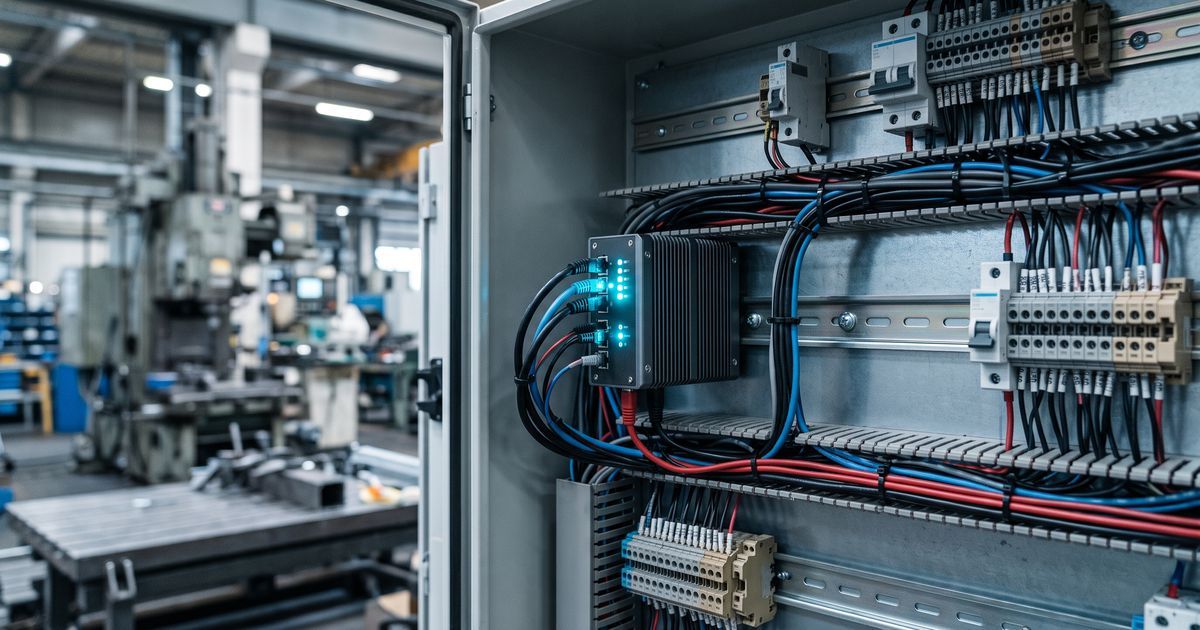
Industrial Edge Computing: Why Inference Belongs at the Asset
 Author
 Date of Publication
 Category
Industrial edge computing moves analysis out of the data centre and puts it next to the machine. That sounds like an architectural preference. In practice it is a hard constraint, because some decisions cannot wait for a network round trip and some data is too expensive to ship. This article explains what industrial edge computing actually solves, how to decide what runs locally, and what an edge gateway has to survive in a working plant environment.
Key Takeaways
Industrial edge computing exists to solve two problems: latency that a network cannot meet, and bandwidth that a business will not pay for.
Safety and control decisions run locally. Fleet wide comparison runs centrally. Most real deployments need both, so the split matters more than the choice.
An edge gateway is industrial hardware first and a computer second. Thermal range, power tolerance and remote update capability decide whether it survives.
What Industrial Edge Computing Actually Solves
Two constraints drive the whole category. The first is latency. If a machine has to react to its own condition, the decision cannot depend on a link to a data centre several hundred kilometres away. A round trip that takes two hundred milliseconds on a good day and fails entirely on a bad one is not a foundation for anything that protects equipment or people. Worse, the failure mode is silent: the system appears healthy right up to the moment it is needed, and the gap only becomes visible during the incident review afterwards.
The second is bandwidth economics. High rate vibration or current data from a few dozen assets produces far more traffic than most industrial sites can justify shipping continuously, especially on cellular or satellite links. Industrial edge computing resolves this by computing features locally and sending only what carries information, while raw data stays on the device and is retrieved on demand for diagnosis.
There is a third benefit of industrial edge computing that gets less attention. Local processing keeps working when the connection does not. A site that loses its link for six hours should continue detecting problems throughout, then reconcile with the central system when the link returns. Architectures that treat connectivity as guaranteed tend to fail quietly at exactly the remote sites that most needed monitoring.
Deciding What Runs at the Edge and What Runs Centrally
The clean way to make this decision is to write down the acceptable delay for each thing the system does, then place each one on whichever side of the link can actually meet it. Once that table exists, most of the debate resolves itself without anyone needing to argue about architecture in the abstract.
The pattern that emerges is consistent. Detection belongs near the asset because it is time sensitive and data heavy. Learning belongs centrally because it needs history from many assets. The model is trained centrally and then pushed down to run locally, which is why an edge to cloud architecture is usually the right answer rather than a choice between the two.
What an Edge Gateway Has to Survive
An industrial edge computing gateway is industrial hardware that happens to run software, and treating it the other way round is how deployments fail in their second summer. The specification that matters is rarely the processor. It is the operating temperature range, tolerance of unstable supply, vibration resistance, and whether the enclosure suits the area classification where it will be mounted.
Remote update capability is equally decisive. A device installed in a cabinet at an unmanned site may not be physically visited for years. Updates need signed images, verified rollback if a unit fails to return, and staged rollout so one bad release cannot disable an entire fleet at once. Lanware's embedded and firmware services team builds this update path in from the start, because retrofitting it onto deployed hardware is considerably harder than designing it in.
Storage deserves a moment of thought too. If the gateway is buffering through outages and retaining raw waveform for on demand retrieval, it needs enough durable storage to cover a realistic worst case outage, using media rated for continuous industrial write cycles rather than consumer components that will wear out in eighteen months. Sizing this properly at design time is far cheaper than discovering the limit during the first extended outage of the winter.
Running AI Models on Constrained Industrial Hardware
Running inference at the edge is not the same problem as running it in a data centre. The model has to fit within the memory and compute available on a device that also has to be cheap enough to deploy widely, and it has to produce an answer within the latency budget every time rather than on average.
In practice this favours smaller models, quantised where accuracy allows, with heavier analysis reserved for the central platform. It also means accepting that the edge model answers a narrower question. Detecting that a signature has departed from its established baseline is well within reach locally. Diagnosing precisely which of nine failure modes is developing usually is not, and does not need to be, because the useful action is generated by the detection rather than the diagnosis.
Lanware has written more broadly about why edge AI is becoming the default for industrial workloads. The short version is that edge computing stopped being a compromise once industrial grade silicon became capable enough to run useful models inside a realistic power envelope. Open efforts such as the LF Edge project have pushed the surrounding tooling forward at the same time.
A final point on siting. Industrial edge computing hardware is often installed wherever there happens to be cabinet space, which is a decision that comes back later. Cable runs from sensor to gateway have practical length limits, electrically noisy neighbours degrade analogue signals, and a cabinet that runs hot in summer will shorten the life of everything inside it. Walking the site with the installer before finalising positions costs an afternoon and routinely prevents a class of intermittent fault that is extremely difficult to diagnose once the plant is running and everybody has moved on to the next job.
What Industrial Edge Computing Costs to Run
The purchase price of a gateway is the easy number and rarely the important one. What decides the true cost of industrial edge computing is not the hardware line item but how much attention each device needs over its life, multiplied by how many of them are installed. A fleet of two hundred gateways that each need a site visit once a year is a very different proposition from a fleet that can be managed entirely remotely.
Three costs are consistently underestimated. Connectivity is the first, because cellular plans priced per device look trivial until multiplied across a site and a decade. Commissioning is the second, since physically installing sensors, running cable and validating readings against a calibrated reference takes far longer than configuring software. The third is the ongoing engineering time needed to keep thresholds and models matched to equipment that keeps ageing.
Set against those costs, the savings are real but need honest accounting. Reduced data transport is the most easily quantified. Avoided downtime is larger but harder to attribute, because a failure that never happened leaves no evidence. The practical approach is to instrument one asset class with a known failure history, measure the change over two or three quarters, and use that measured result rather than a vendor projection to justify the wider rollout.
Conclusion
Industrial edge computing is not a trend to adopt for its own sake. It is the answer to two specific questions: what has to happen faster than the network allows, and what data is too expensive to move. Answer those honestly and the architecture designs itself, with detection running locally, learning running centrally, and models moving down to the asset. If you are weighing an edge deployment against a purely central one, talk to the Lanware team about your latency requirements and site connectivity before choosing hardware.
Frequently Asked Questions
What is industrial edge computing?
Industrial edge computing runs data processing and inference on hardware located next to industrial assets rather than in a central data centre. It exists to meet latency requirements a network cannot satisfy and to reduce the volume of data shipped.
How is edge computing different from cloud computing?
Edge computing processes data where it is produced. Cloud computing processes it centrally after transport. Industrial systems typically need both, with detection running locally and model training running centrally on pooled history from many assets.
What is an IoT edge gateway?
An IoT edge gateway is industrial hardware that collects signals from assets, translates between protocols, runs local inference and forwards results upward. It also buffers data through network outages so nothing is lost while a site is disconnected.
Can machine learning models really run on edge hardware?
Yes, within limits. Smaller and quantised models run comfortably on modern industrial silicon. Heavier diagnosis stays central. The edge model usually answers a narrower question, which is generally enough to trigger the action that actually matters.
Does edge computing remove the need for a central platform?
No. Learning requires history pooled across many assets, which only exists centrally. The usual pattern trains models centrally and deploys them to run at the edge, so the two layers depend on each other rather than competing for the same role.
What happens when an edge site loses connectivity?
A correctly designed gateway keeps detecting locally, buffers results in order, and reconciles once the link returns. Architectures that assume constant connectivity fail quietly at remote sites, which are usually the ones that most needed monitoring.
How much storage does an edge gateway need?
Enough to buffer through a realistic worst case outage plus any raw waveform retained for retrieval. Use media rated for continuous industrial write cycles, because consumer grade storage tends to wear out well within the expected service life.
How are edge devices updated safely in the field?
Through signed images, verified rollback if a device fails to restart, and staged rollout so one bad release cannot disable a whole fleet. Our hardware services team designs this path before deployment rather than afterwards.
Which industries gain most from industrial edge computing?
Those with remote sites, poor connectivity or fast failure modes. That includes water treatment, mining, oil and gas, and discrete manufacturing where a fault can damage tooling in the seconds before a central system could respond.
Related product
Merjio IIoT Platform by Lanware
Any sensor. Any industry. One unified data layer — explore SKID solutions, AI-driven analytics, and live monitoring on the Merjio platform.
Explore merjio.com